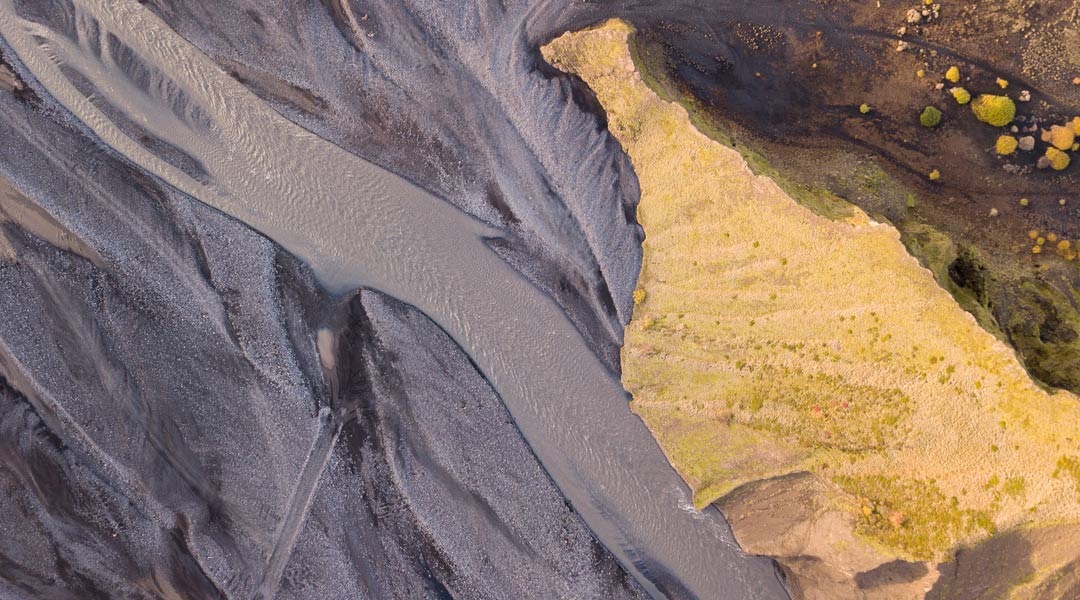
The surreal ‘scapes’ of Jay Yao’s drone photography



Jay Yao continues his experiment with technology, photography, and art in his recent body of works “The Low Hum of a Drone” at Galleria Duemila on 3 February to 10 March 2018.
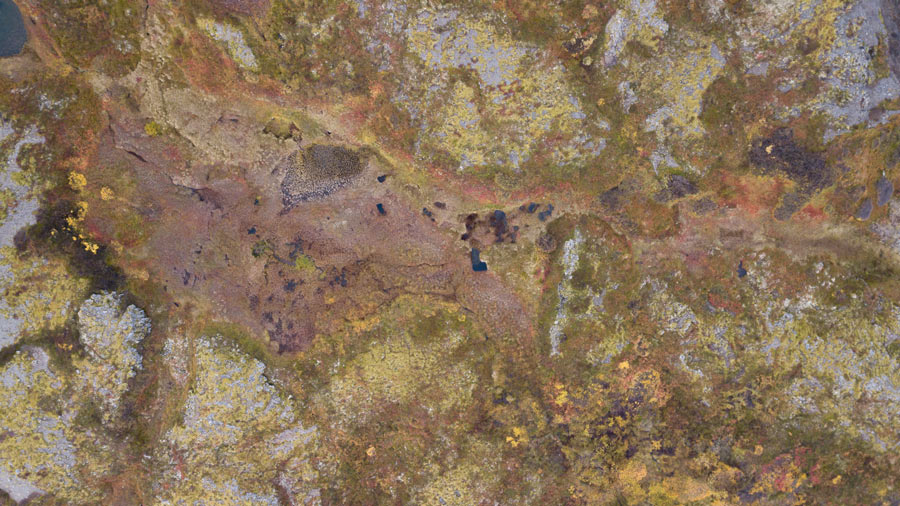
Landscapes of the northern hemisphere are presented alongside aerial views of Luzon. Yao generates perplexing photographs that reveal the process of conceptualizing them. The reflective qualities of green, blue, and silver in the wild landscapes and glaciers of Iceland produce illusions of texture. Flowing lines of water bodies and the topography are in conversation with hard-edged blocks of oranges and browns. The drone photo places the viewer in the position of a satellite, an omnipotent vantage point. And the distance, which cannot be achieved without technology’s help, removes one from the ordinary experience of a place.
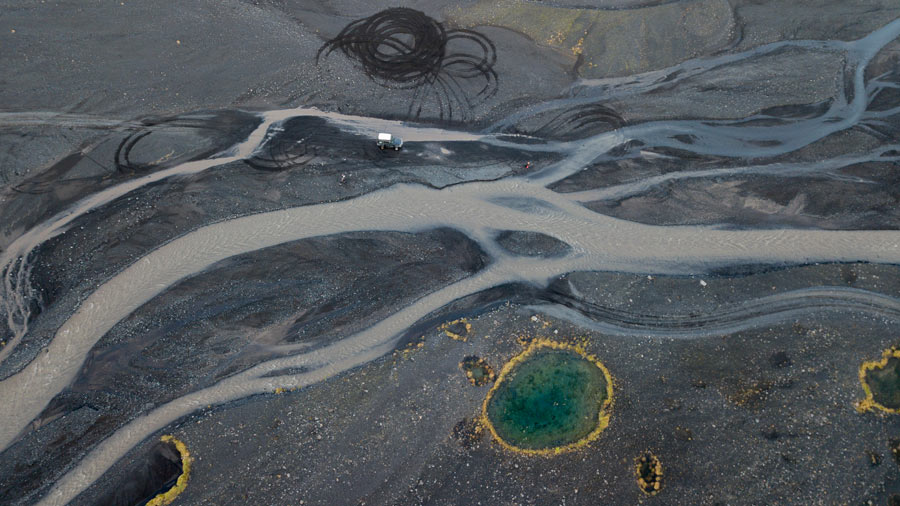
40.64 cm x 60.96 cm
aluminum dibond
The dream-like imagery and unconventional view of scapes project the central idea of Yao’s exploration. Through drone photography, the artist references the contemporary experience and effects of technology—how information systems easily get passed around resulting in abstracted understandings of reality.
Furthermore, “The Low Hum of a Drone” brings to mind the 2014 squabble between two Guardian art critics on the merits of digital photography as art. Jonathan Jones, bemoaning the high sale price of an Arizona canyon photo titled Phantom, wrote: “Photography is not an art. It is a technology…Lik’s photograph is of course beautiful in a slick way, but beauty is cheap if you point a camera at a grand phenomenon of nature.”
Sean O’Hagan takes the opposing stance and argues: “Photography is as vibrant as it has ever been—more so in response to the digital world, which Jonathan mistakenly thinks has made everyone a great photographer. It hasn’t. It has made it easy for people to take—and disseminate—photographs, that’s all. A great photographer can make a great photograph whatever the camera. A bad one will still make a bad photograph on a two grand digital camera that does everything for you. It’s about a way of seeing, not technology.”
In the case of Jay Yao, he has definitely given us a provocative way of seeing by harnessing the latest tools to frame of natural world. The photos are both mysterious—even alien, at first—and wonderful. And the curiosity with which they were taken is unquestionably human. 
READ MORE: Martha Atienza’s Sub-aquatic Procession Wins in Art Basel
About the artist
Jay Yao (Jose Campos III) currently resides in Manila (Philippines). He was shortlisted for the Ateneo Awards in 2014. Yao has a liberal arts degree in Hampshire College and studied at Parson’s School of Design. He completed a residency in Sherman Galleries, Australia, and represented the Philippines for the Goethe-Institut project called the “Art Connexions: SYD-MLA-KUL”
Galleria Duemila is located at 210 Loring St. 1300 Pasay City. You can contact them via (02)8339815.
Frequently Asked Questions
The central theme is the intersection of technology, art, and the contemporary experience of reality. By using drone photography to capture landscapes from Iceland and Luzon, Yao explores how technology provides an “omnipotent vantage point” that removes viewers from ordinary experiences. His work reflects how information systems can result in abstracted, dream-like understandings of the physical world.
Drone photography places the viewer in the position of a satellite, offering a high-altitude, top-down perspective that is physically impossible to achieve otherwise. This distance transforms natural features—like the flowing lines of water bodies and hard-edged topographical blocks—into abstract compositions of color and texture. This unconventional view makes the natural world appear mysterious or even “alien.”
The debate, highlighted by critics Jonathan Jones and Sean O’Hagan, centers on whether the mechanical nature of a camera diminishes its artistic value. Jones argues that photography is a technology that merely “points a camera at a grand phenomenon,” while O’Hagan contends that photography is about a “way of seeing.” In this view, technology is a tool, but the human curiosity and framing behind the lens are what create art.
Yao utilizes modern mounting techniques such as aluminum dibond for his works. Aluminum dibond is a rigid, lightweight composite material consisting of two thin sheets of aluminum bonded to a solid polyethylene core. This material provides a flat, stable surface that enhances the crisp, industrial, and high-tech feel of his drone-captured imagery.
The “low hum” refers to the auditory signature of a drone—a constant, mechanical presence that facilitates the capture of these surreal scapes. It serves as a metaphor for the pervasive but often unnoticed influence of technology in our daily lives, acting as the bridge between the human observer and the otherwise inaccessible aerial perspective of the landscape.