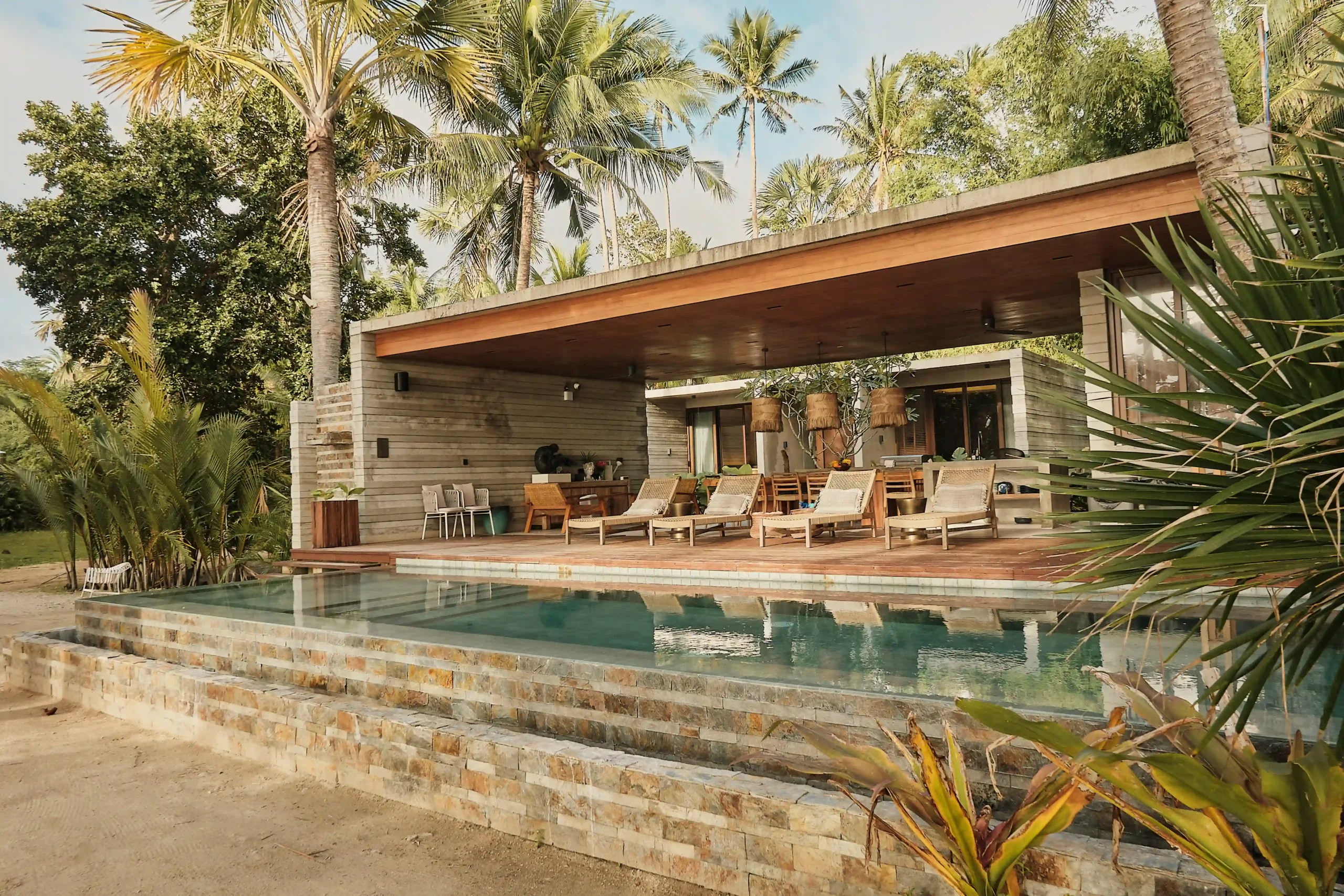
Overlooking Tayabas Bay, Agda Beach Villas occupies a one-hectare hilly property where the terrain descends toward the coast. Designed by VBo Architects + Engineers, the tropical retreat responds to the sloping terrain through villas and shared spaces oriented toward the surrounding landscape. Before construction began, Bocalid was drawn to the property’s steep terrain and secluded […]
Inside Art Fair Philippines 2026: Religious Imagery, Material Experimentation, and Social Commentary



Art Fair Philippines 2026 gathered art enthusiasts and collectors in Makati for one of the country’s leading showcases of contemporary Philippine art. Designed by Nazareno/Lichauco, the fair moved to Circuit Corporate Center One in Ayala Circuit, marking a new chapter in its spatial identity.
Across its booths and projects, the fair positioned contemporary Philippine art in dialogue with faith, materiality, and urban politics. BluPrint revisited the works that defined this year’s edition.
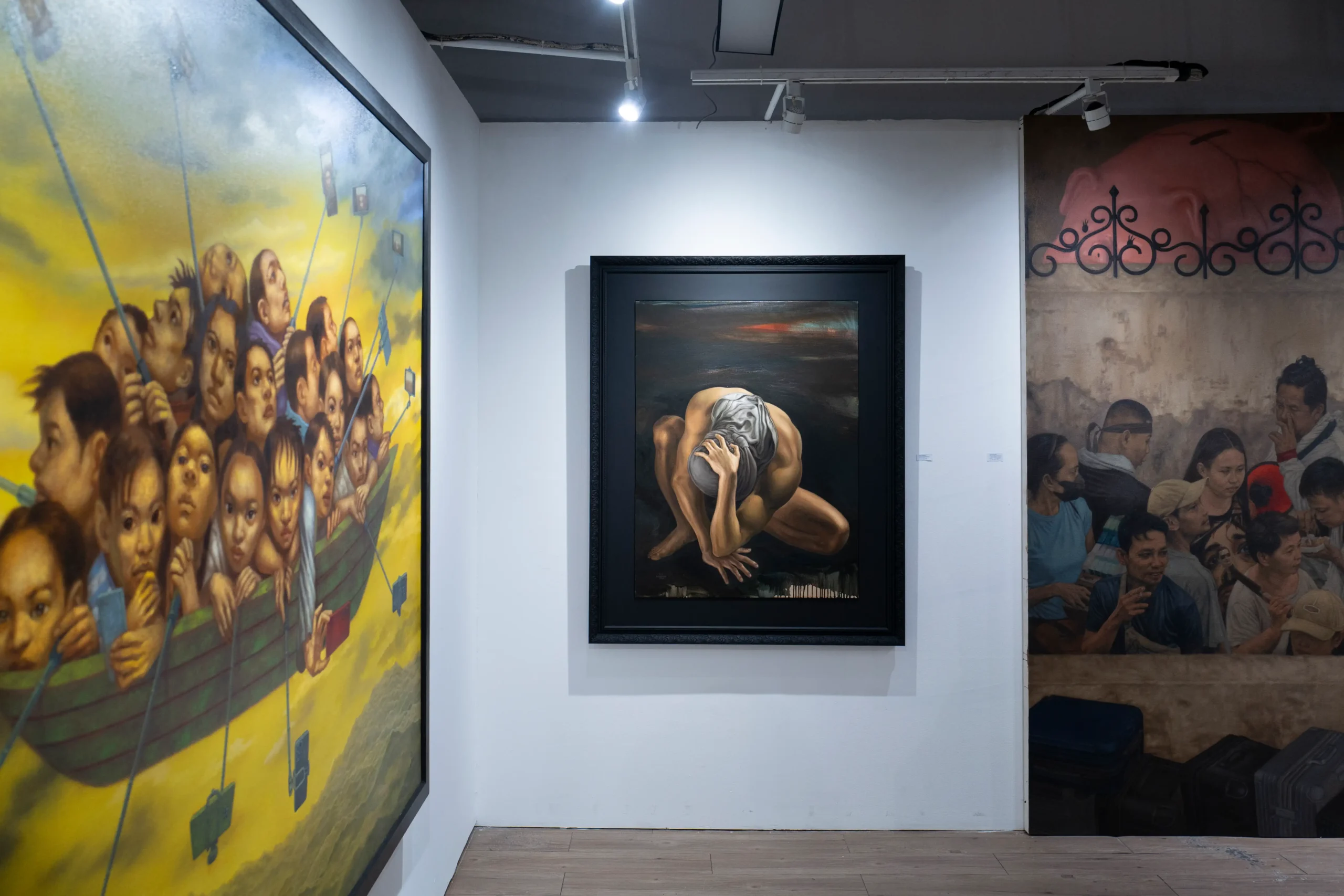
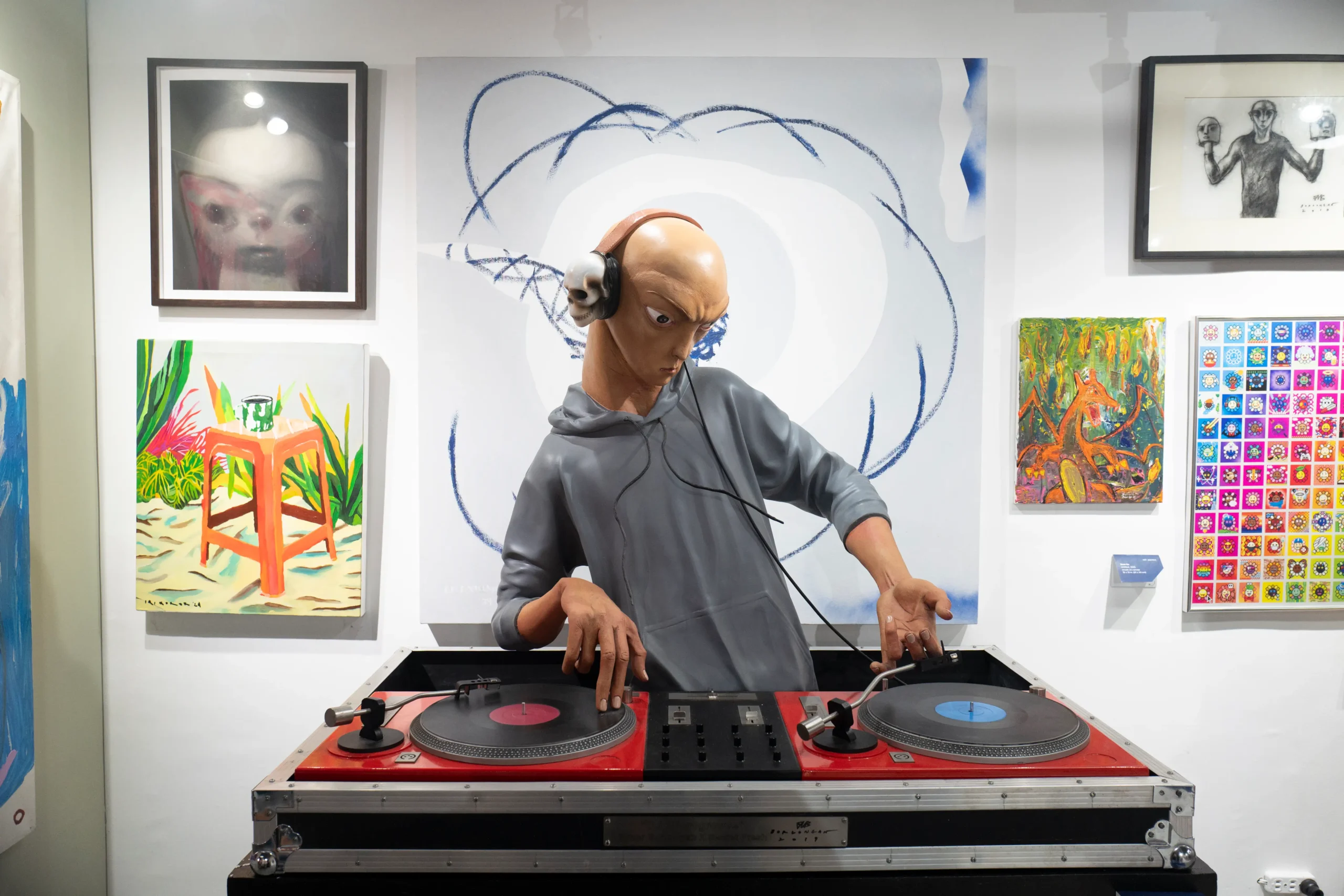
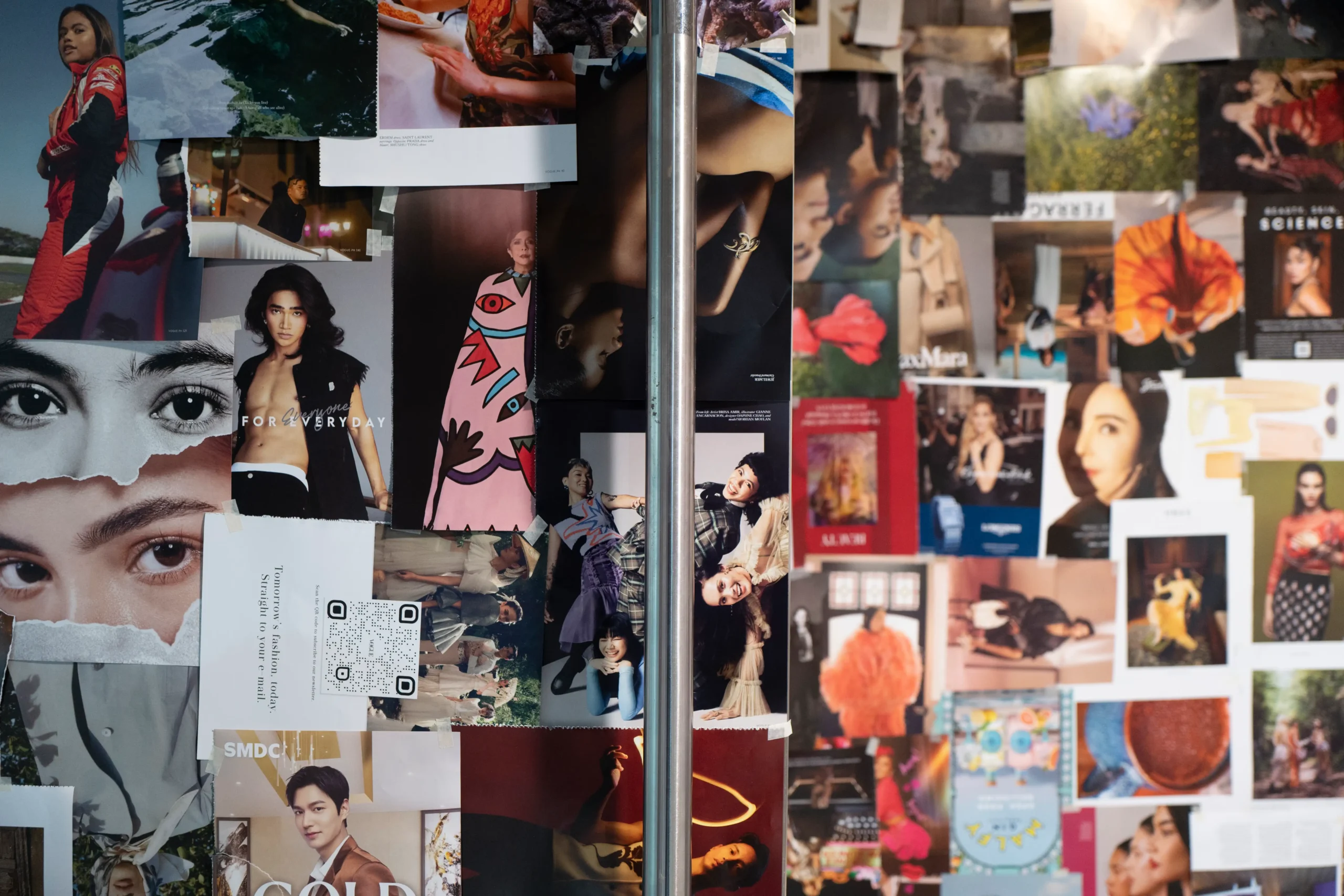
The Sacred and the Profane: Religious Imagery in Art
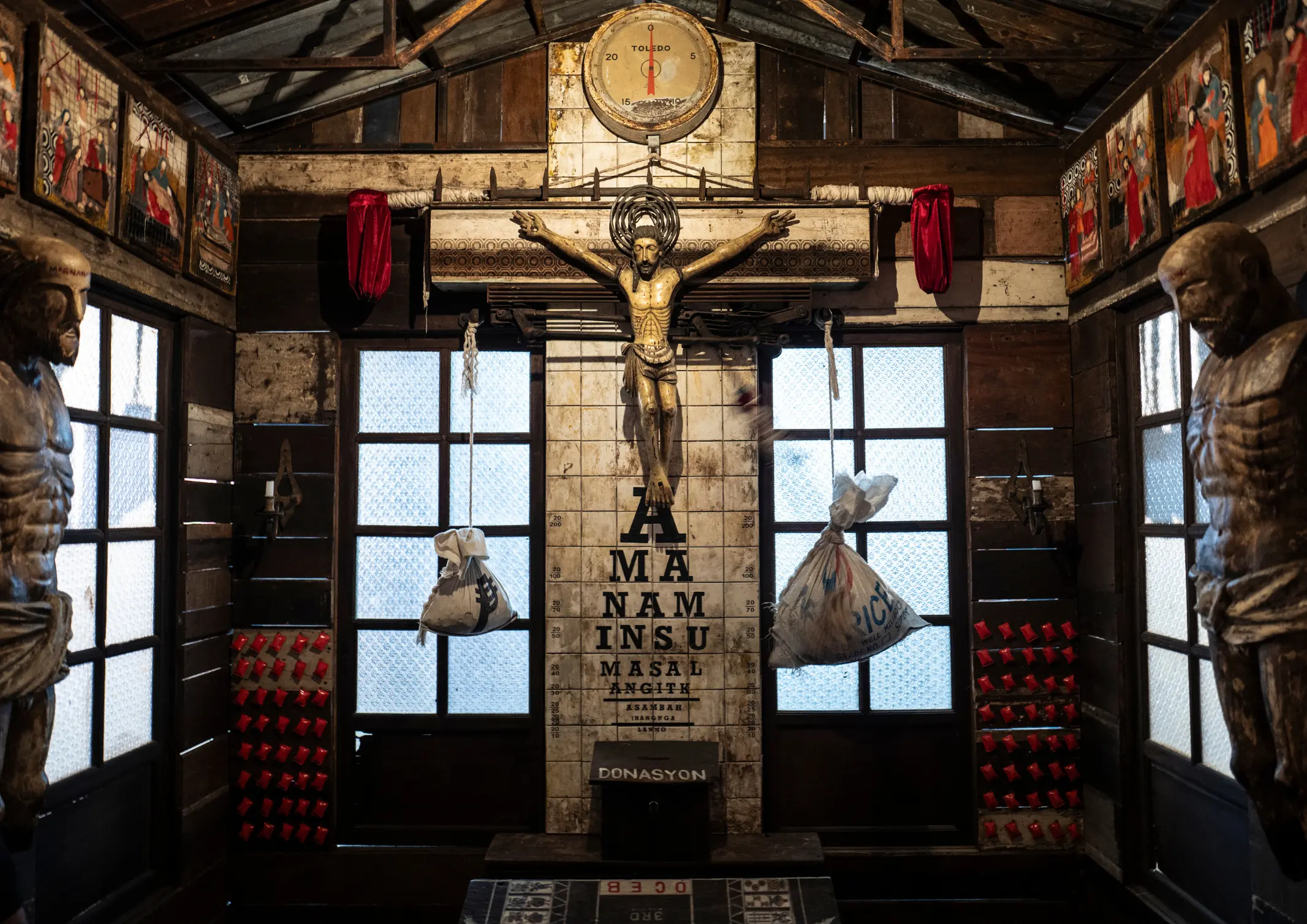
Several galleries foregrounded religious imagery, but Max Balatbat’s Kapilya stood out for its immersive reconstruction of his grandmother’s street chapel. Installed in the Projects section, the work transformed a devotional space into a social commentary: a rhythmic whip at the altar strikes a money bag and a sack of NFA rice, mimicking the mechanical cadence of prayer and petition. By merging ritual objects with symbols of poverty and survival, Kapilya reframed Catholic devotion within the material realities of Filipino life.
Right in front of the chapel stood a cast sculpture of a young girl selling sampaguita garlands, her underwear pulled down to her knees—a stark contrast to the sanctity of the altar behind her. Balatbat noted, “Doon sa paligid sila ng kapilya nagdarasal, hindi sa loob,” underscoring how prayer often unfolds outside the church rather than within it. The sculpture complicated the boundary between innocence, poverty, and devotion, situating faith within lived social conditions.
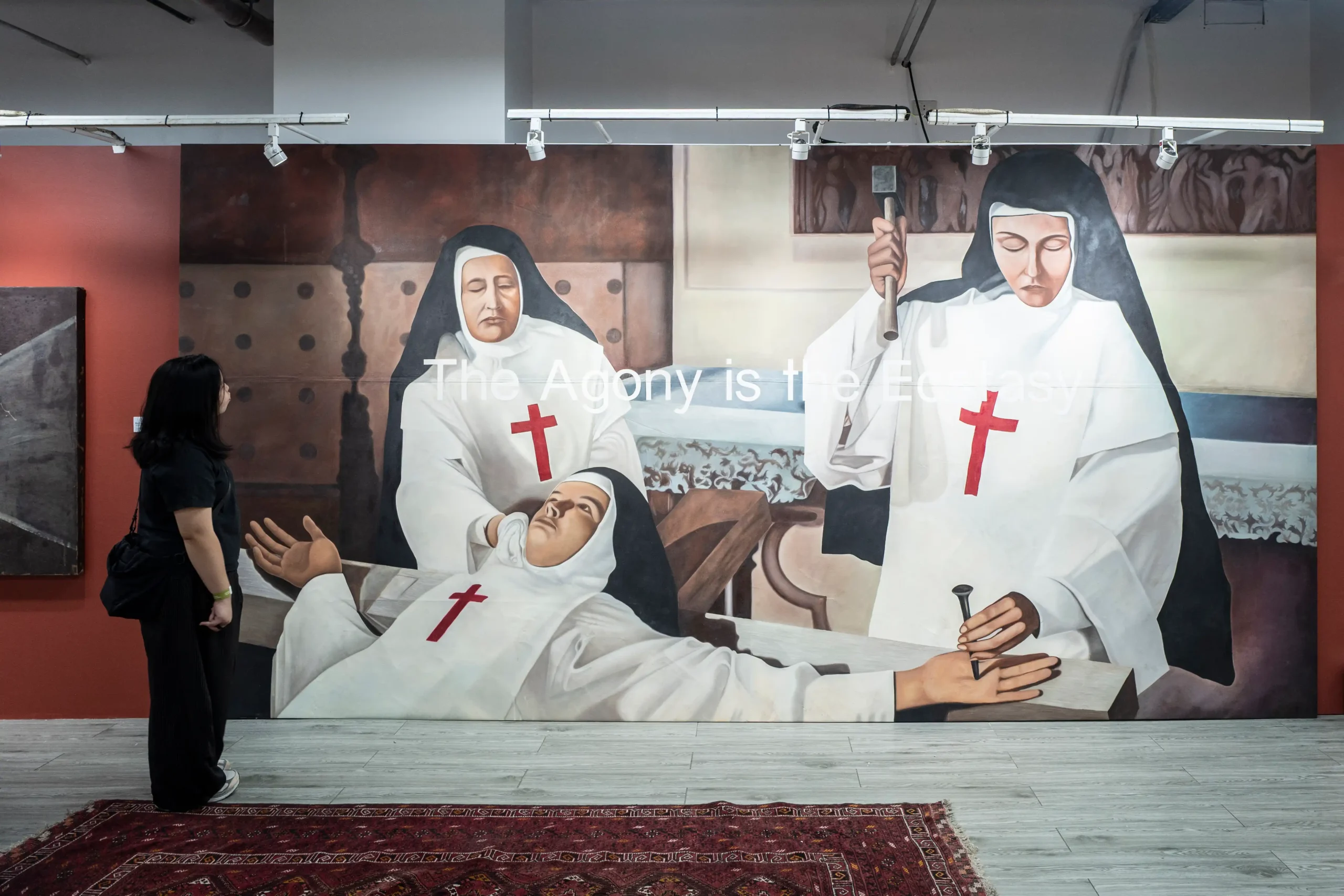
Wire Tuazon’s The Agony is the Ecstasy, an oil-on-canvas work, commands attention through its scale and confrontational imagery. Three nuns restrain a fourth as they nail her to a wooden cross—an explicit reworking of the crucifixion narrative. Their calm expressions heighten the tension, framing pain and sacrifice as acts of devotion. By reconfiguring Catholic iconography through female figures, the work interrogates authority, submission, and the politics of faith.
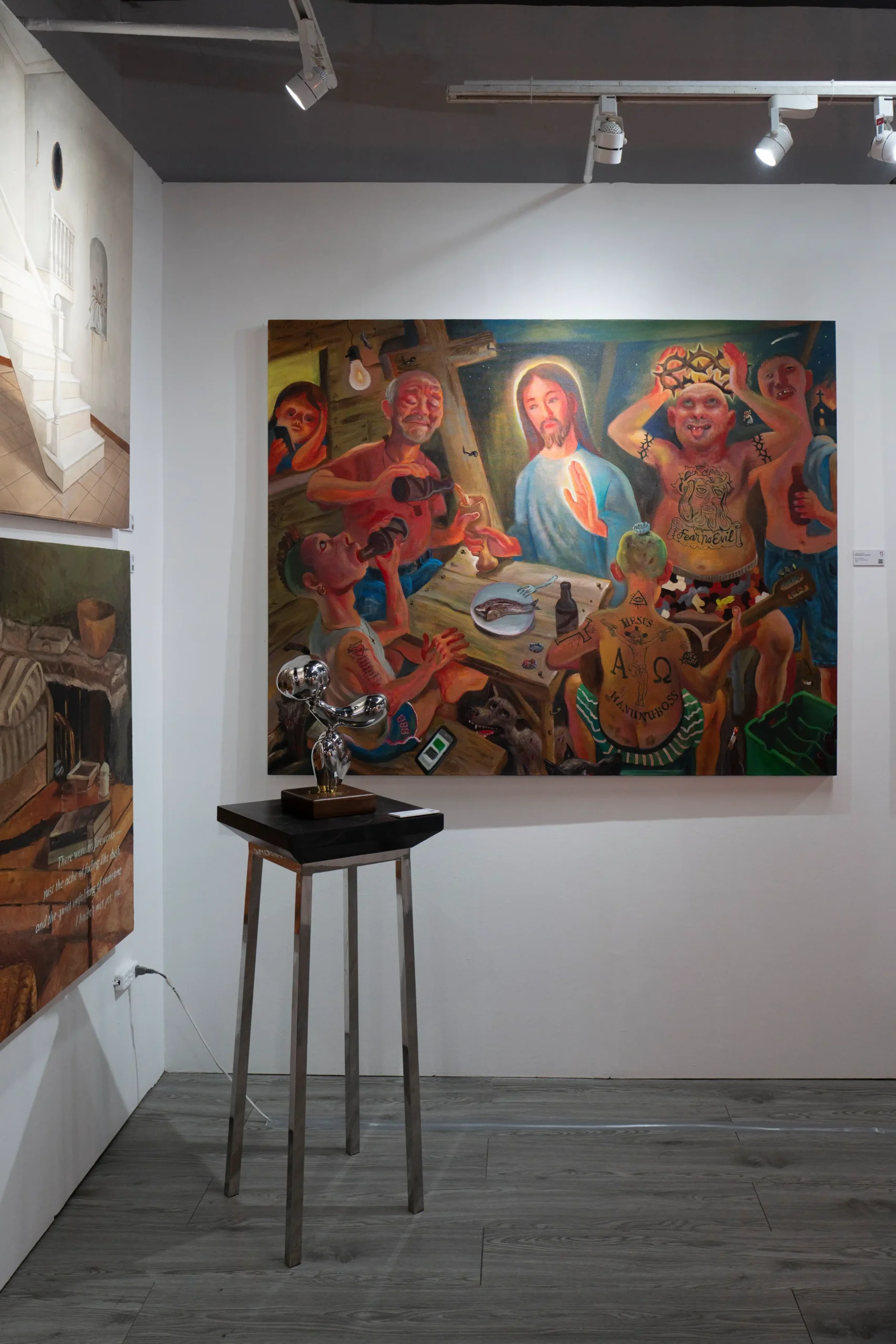
Meanwhile, Dengcoy Miel’s Kainuman ni Kristo situates Jesus Christ within a familiar Filipino inuman (drinking session) scene. Surrounded by tattooed uncles drinking, pouring alcohol, and strumming guitars, Christ becomes part of communal leisure rather than distant divinity. The work collapses the distance between the sacred and the everyday, suggesting that faith in the Philippines often resides in shared ritual as much as in formal worship.
For the religious person, lived materialities are rarely uniform. These works stage a juxtaposition between the sacred and the profane, showing how popular religiosity in the Philippines blurs the line between the revered and the ordinary. Religion, here, operates outside the formal church hierarchy, negotiated instead through personal, emotional, and tangible connections with the divine.
Reimagining Forms and Materials
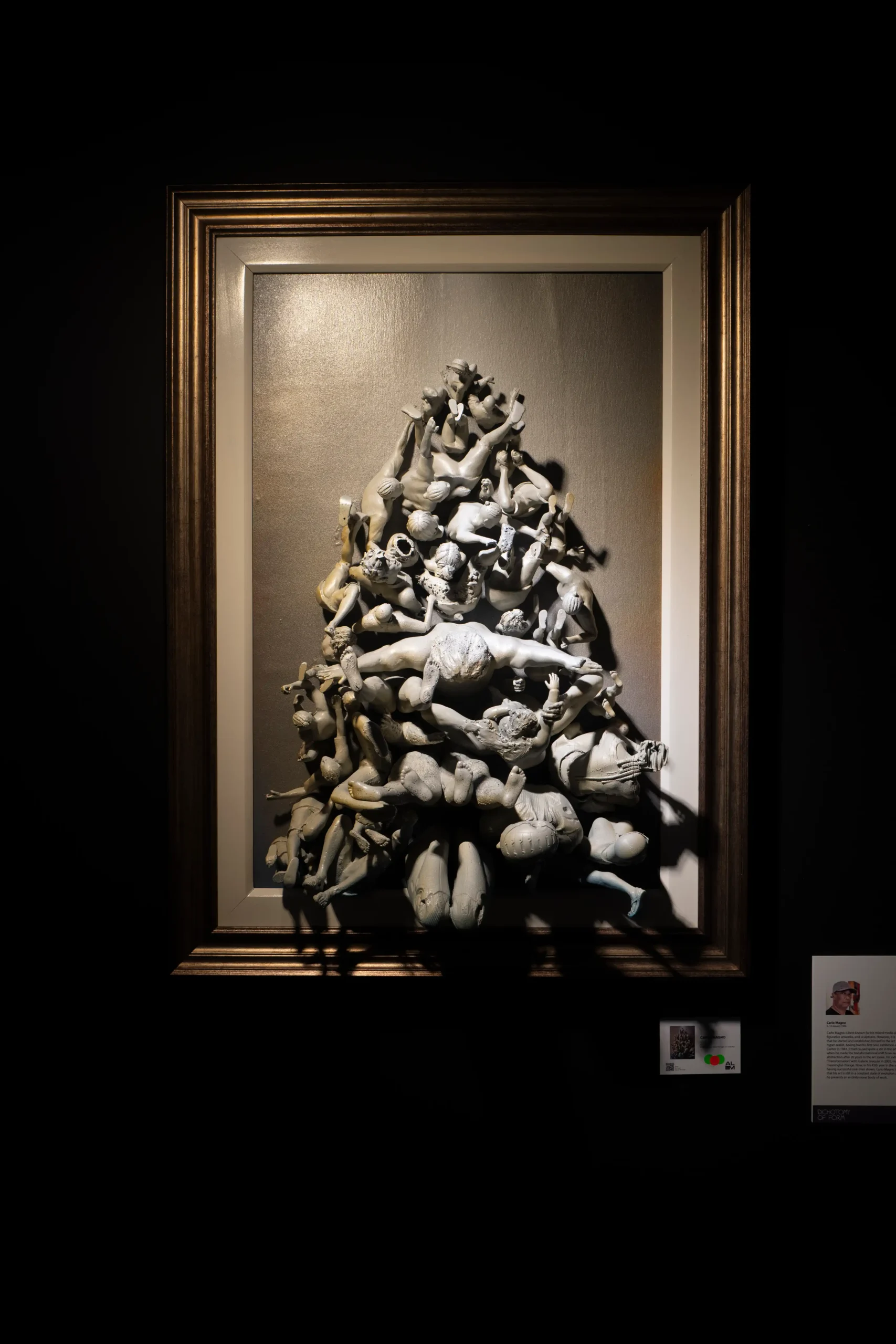
Artists pushed the boundaries of form and material across several booths. At Art Lounge Manila’s Dichotomy of Form, Carlo Magno’s Broken Spirit—a mixed-media assemblage on canvas—used shadow and texture to construct a tower of bodies spilling beyond the frame. Through its vertical thrust and cascading figures, the work pushes against the limits of the canvas, turning the frame into a point of rupture rather than containment.
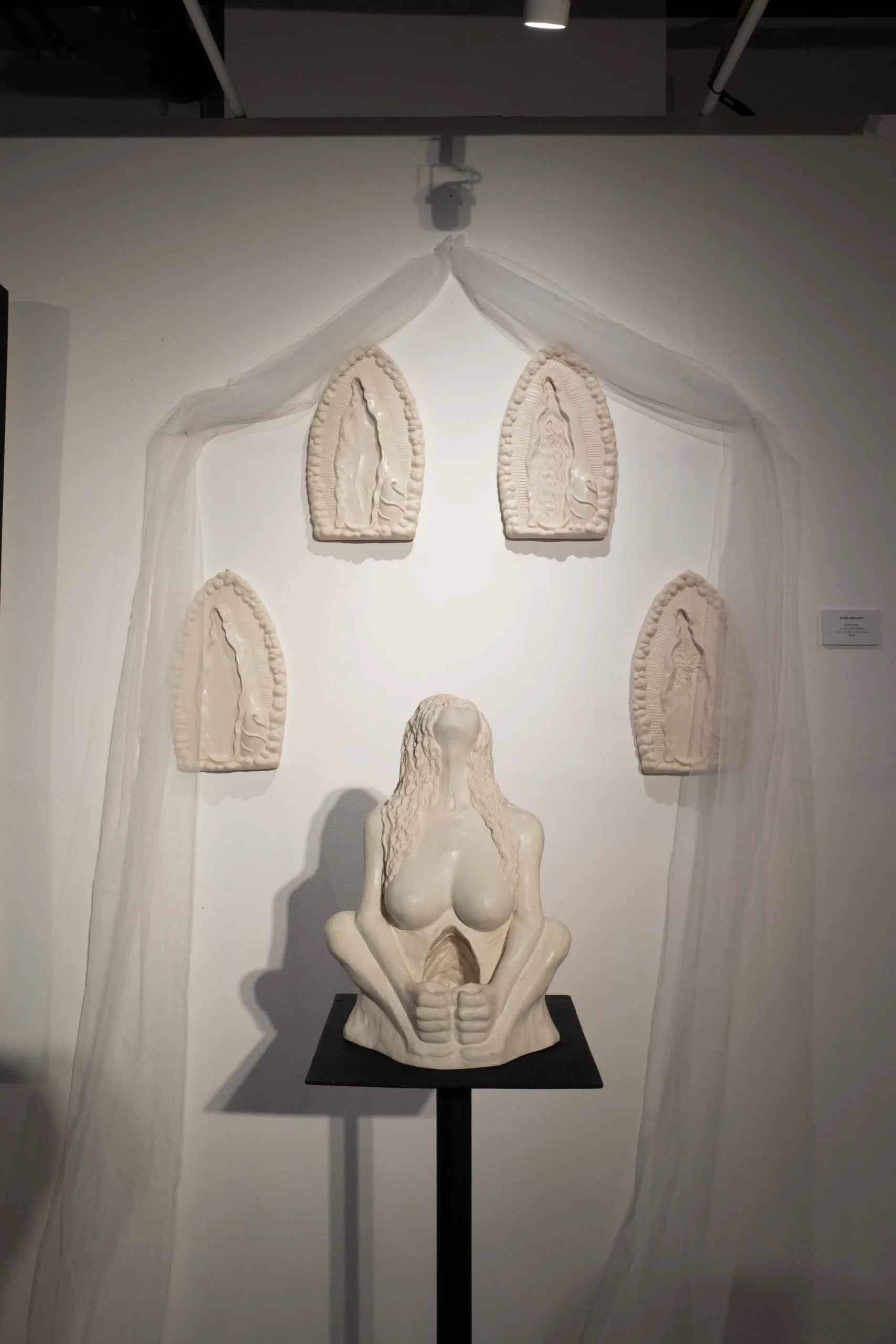
In Agnes Arellano’s Sisa, rendered in cold cast marble, the tragic character from Noli Me Tangere appears with her womb cut away and suspended around her as she gazes upward. The fragmented forms echo Marian iconography, turning the body into both relic and site of vulnerability. The sculpture confronts the politics of motherhood and reproduction, reframing Sisa not only as a literary figure but as an enduring symbol of feminine sacrifice.
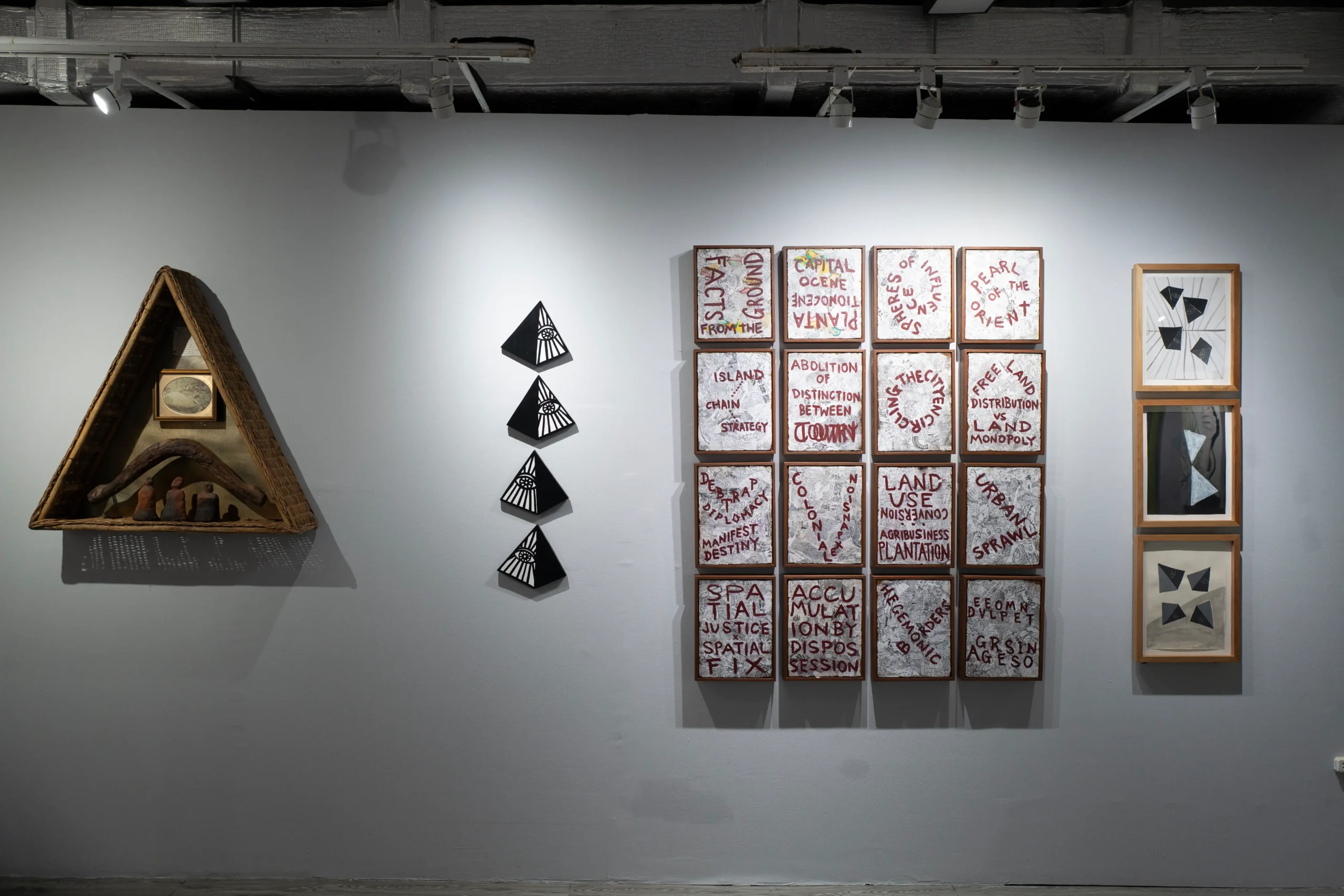
Other works turned directly toward urban politics. In Cian Dayrit’s Spatial politix on naming spaces, acrylic and collage panels overlay maps of Philippine cities with phrases such as “accumulation by dispossession,” “development aggression,” and “urban sprawl.” By inscribing theory onto geography, the work exposes how language, policy, and capital shape social inequality within the urban landscape.
A Snapshot of Contemporary Philippine Art
Art Fair Philippines brought together emerging and established artists from the Philippines and beyond, offering a snapshot of the country’s evolving contemporary art scene. Across its galleries and projects, the fair revealed how artists grappled with faith, materiality, and urban politics. From sacred iconography to material experimentation and urban critique, artists negotiated identity, power, and place within a rapidly shifting cultural landscape.
Photographed by Ed Simon.
Read More: Art Fair Philippines 2025 Brings The Thrills of Creativity to the Masses
Frequently Asked Questions
The fair moved to Circuit Corporate Center One in Ayala Circuit for this edition, with the spatial identity and layout designed by the firm Nazareno/Lichauco. This change in venue marked a new chapter for the fair, shifting the visitor experience toward a more corporate-integrated environment in the heart of Makati’s newer district.
In the Projects section, Balatbat presented an immersive reconstruction of his grandmother’s street chapel to critique the intersection of faith and poverty. Technically, the installation featured a mechanical whip that struck a money bag and a sack of NFA rice, synchronizing the sound of religious flagellation with the struggle for basic sustenance. This work challenged the sanctity of the altar by placing it in direct dialogue with symbols of economic survival.
Tuazon’s massive oil-on-canvas work reconfigured the crucifixion narrative by substituting traditional male figures with nuns. The image depicted three nuns calmly nailing a fourth to a cross, a technical and visual choice intended to interrogate the politics of female submission, authority, and the historical representation of sacrifice within the Church. The calm expressions of the figures served to heighten the tension between pain and religious ecstasy.
Arellano used cold cast marble to recreate the tragic literary character Sisa from Noli Me Tangere. The sculpture presented a fragmented anatomy, with Sisa’s womb cut away and suspended around her as she gazed upward in a pose reminiscent of Marian iconography. This transformation of the body into a “relic” allowed Arellano to confront the politics of motherhood and feminine sacrifice through a durable, stone-like medium.
In his work “Spatial politix on naming spaces,” Dayrit utilized acrylic and collage panels to overlay actual maps of Philippine cities with theoretical text. By inscribing phrases such as “accumulation by dispossession” and “development aggression” directly onto urban layouts, the work functioned as a technical mapping of social inequality. It exposed how policy and capital redefine geography and displace marginalized communities within the evolving landscape of Metro Manila.
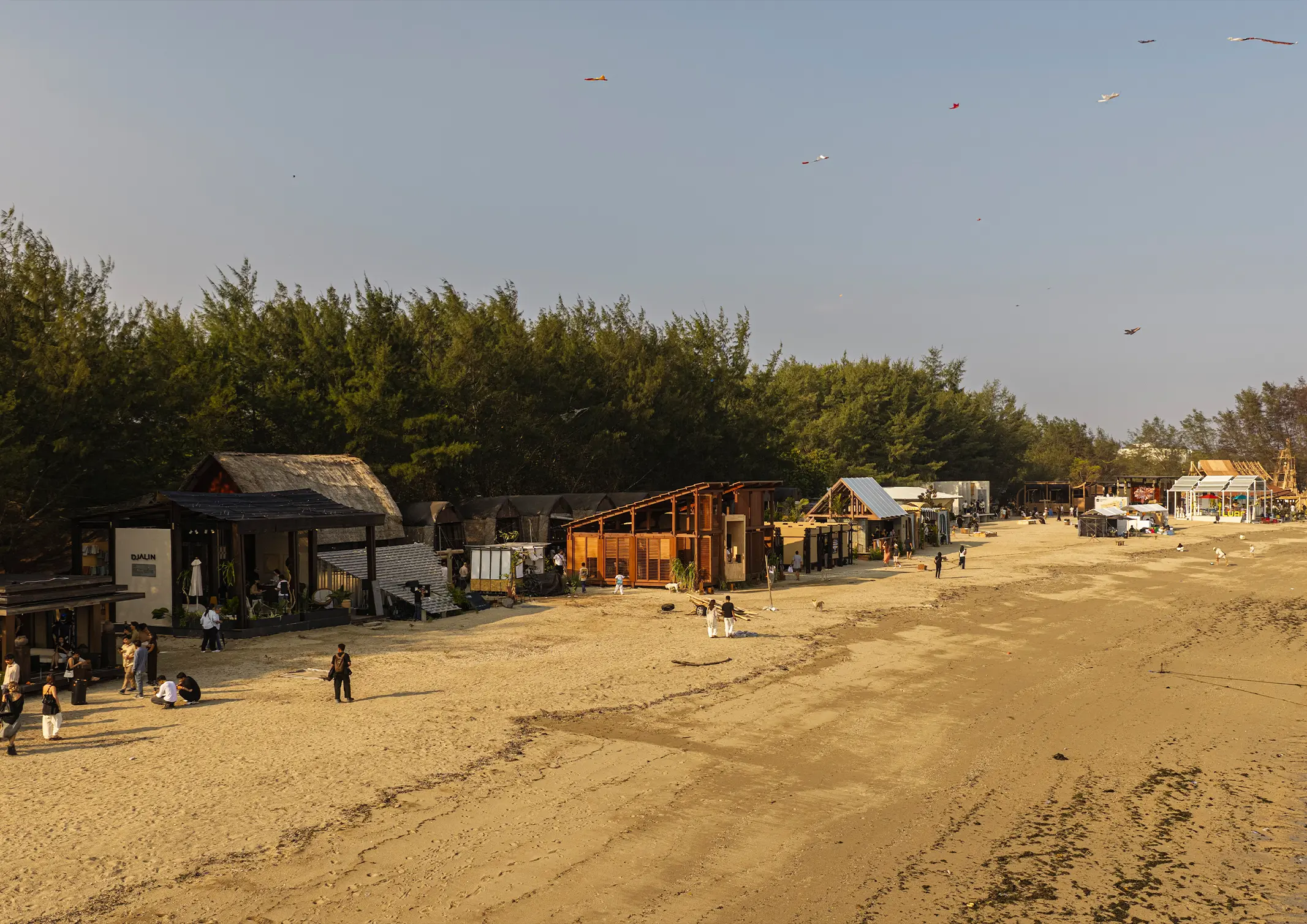
After being set amongst the ruins of an abandoned theme park in the past years, Jia CURATED found a home on the shores of Pengembak Beach, Bali for this year’s installment. It’s a unique location with multiple natural features like Sanur’s coastline, pine and mangrove forests, and a stream—making nature an important participant for how […]
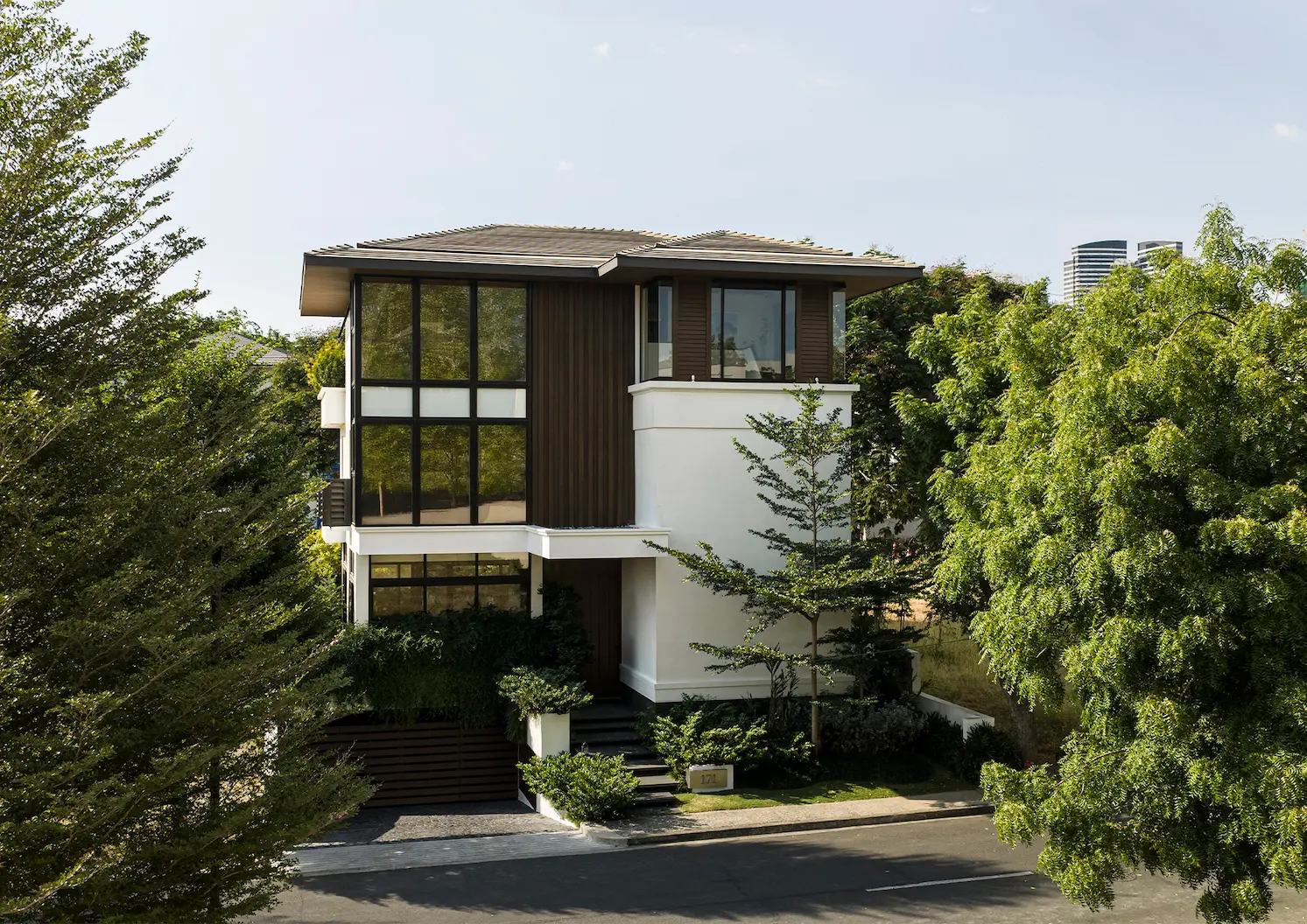
Just moments away from the bustling area of Bonifacio Global City is 171, a multi-level villa set on a 302-square-meter lot. M.CAL Architecture Design Studio, headed by Ar. Monique C. Albert-Lopez, built the residence as a minimalist modern sanctuary surrounded by landscaped gardens. This creative direction was drawn from the homeowners’ brief to create a […]
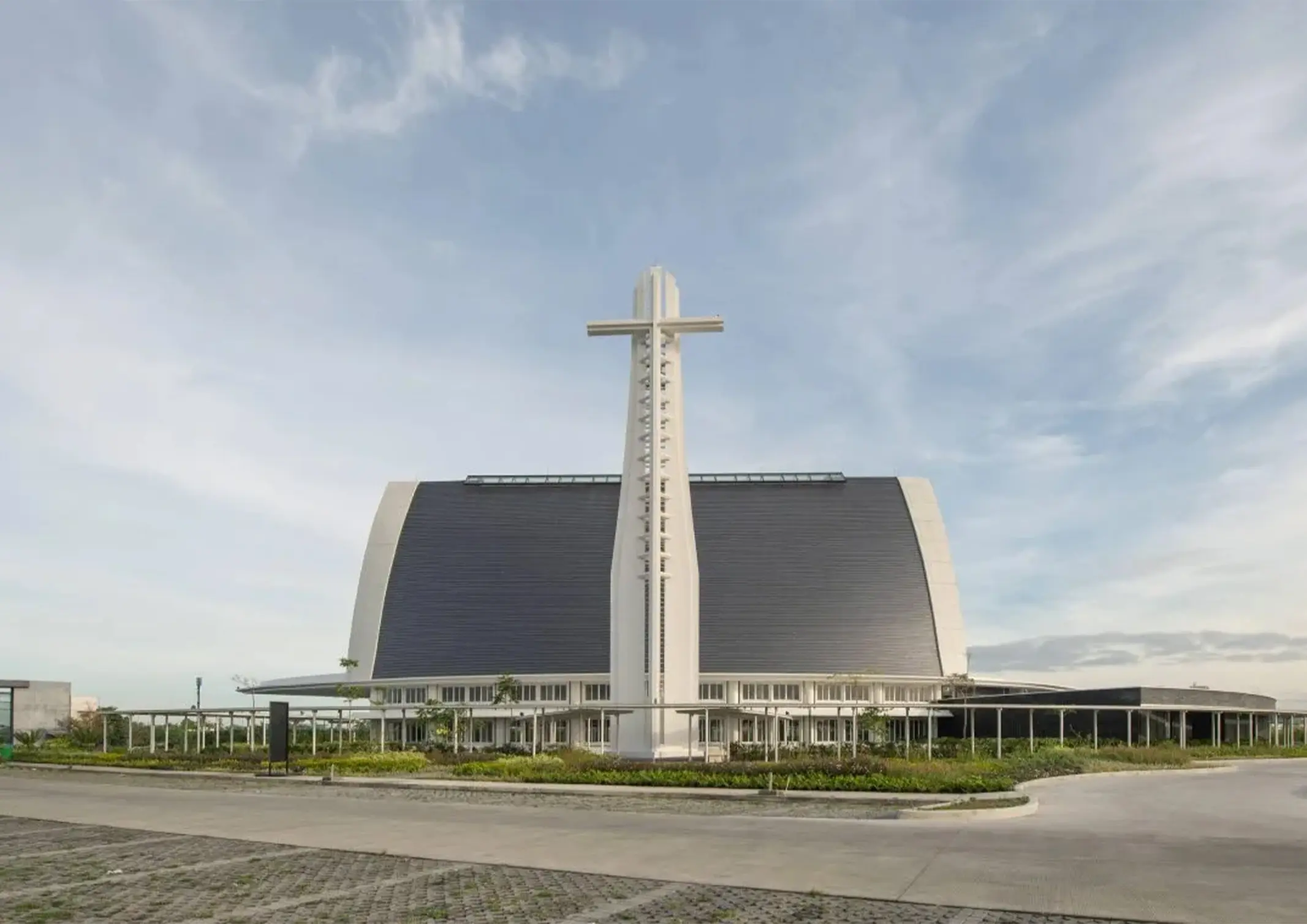
The World Architecture Festival (WAF) has announced its 2026 shortlist, with several Filipino practices earning recognition across a diverse range of categories. Across civic architectureArchitectureThe art and science of designing and constructing buildings, structures, and spaces that are functional, safe, and aesthetically pleasing. It encompasses the planning, design, materials, and techniques used to createGo to […]
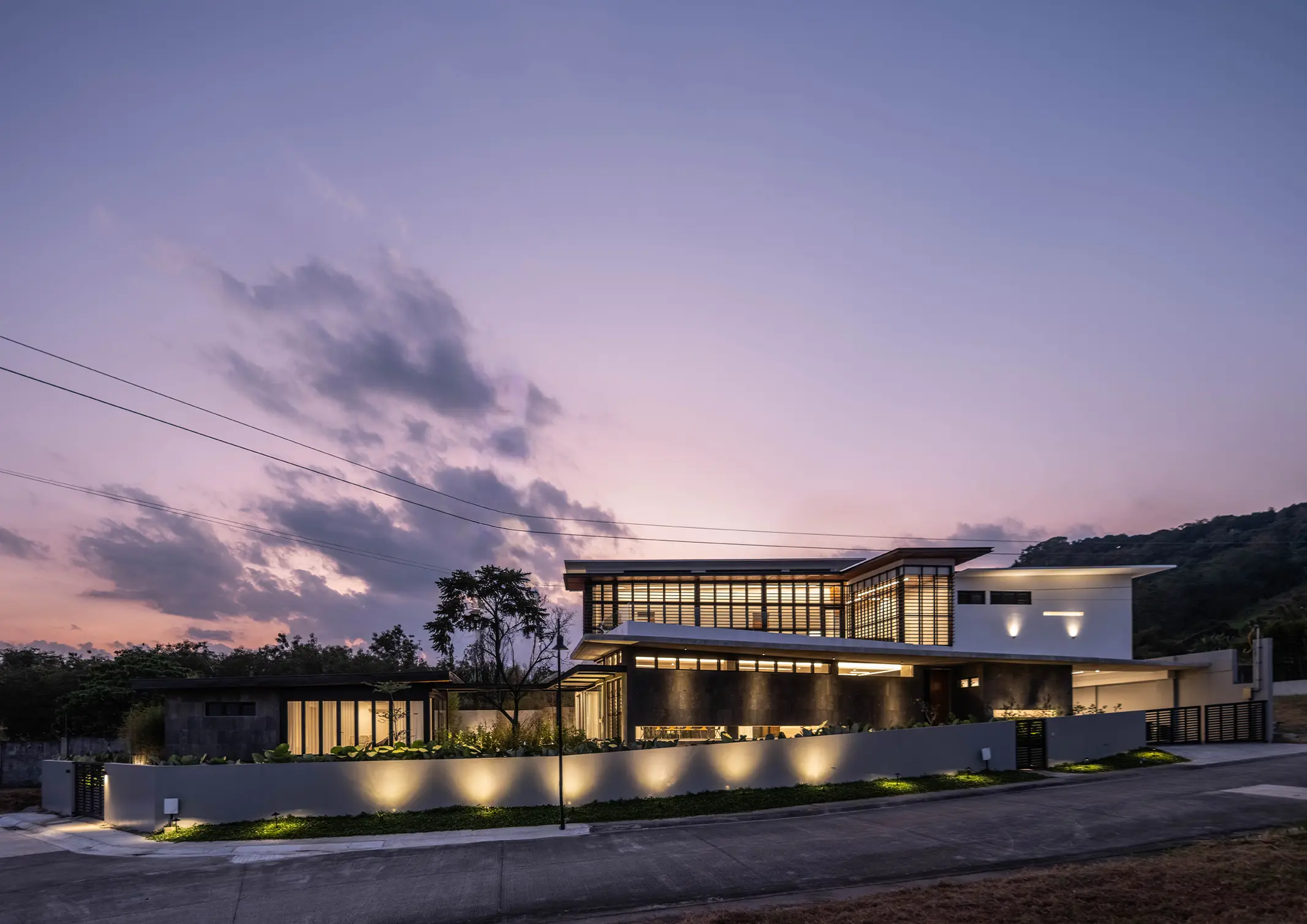
Located in Paroc, Pampanga is MQ Residence—a tropical-modern private residential home designed by Marikina-based architectureArchitectureThe art and science of designing and constructing buildings, structures, and spaces that are functional, safe, and aesthetically pleasing. It encompasses the planning, design, materials, and techniques used to createGo to Architecture Glossary firm Arkisens, spearheaded by principal architect and co-founder […]
Read the issues.

Collect the volumes.

Recommended Video
Tap to Unmute
Unmute
0:00
0:00