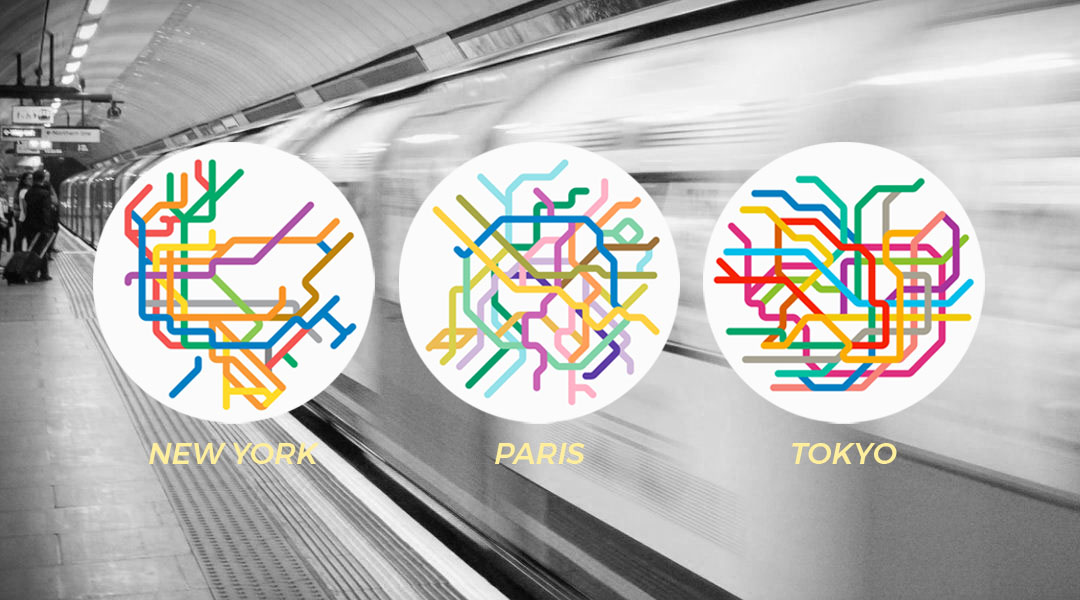
Mini Metros, simplified city rail systems (Manila included)



With a new Metro Manila subway system underway, it would be interesting to see how our current metro railways (the LRT-1, LRT-2, and MRT-3) compare to others around the world. One can compare facts and figures, or simply take a look at Mini Metros, a project by Wasington-DC-based graphic designer Peter Dovak.
Last year, the designer undertook the personal project of shrinking and simplifying 220 metro and light rail systems from around the world. Transit Oriented, Dovak’s blog and portfolio, is a collection of the designer’s efforts to document different modes of public transportation. Mini Metros was launched in September 2016 and has since been updated three times to match the expansions of some cities’ rail systems.
Dovak writes that the project was borne out of an attempt to make an iPhone app in which he had to design icons for navigation. The Washington Metro map, very recognizable even at its tiny scale, inspired him to create more city rail graphics.
READ MORE: Get to know the recently approved Metro Manila subway
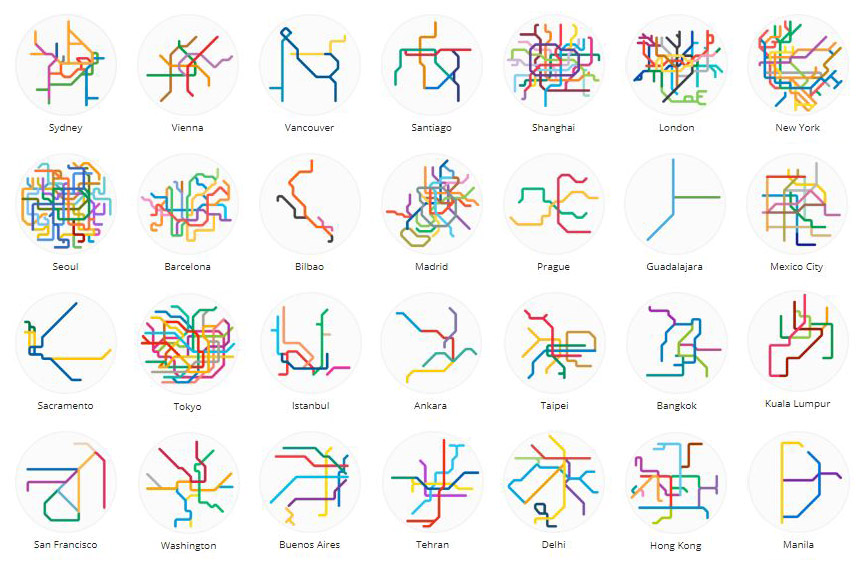
“All of the cities in the project had the same requirements: they had to fit in a 120px circle (with 10px of padding), the lines had to be 3px wide with a minimum of another 3px between the next parallel line, and all diagonals had to be 45-degrees. The systems themselves needed to be full-fledged heavy rail metro systems or light rail networks that were distinct enough from trolleys or streetcars,” he adds.
Taking it a step further, we attempt to find an estimate of how many people some city rails serve. Below is a rundown of different metro maps along with the square areas and populations of the cities they are in.
New York City | 789 sq. km | population: 8.5 million

Paris | 105 sq. km | population: 2.2 million

Tokyo | 2188 sq. km | population: 13.6 million

Seoul | 605.2 sq. km | population: 10.58 million

Busan | 767.4 sq. km | population: 3.5 million

Madrid | 604.3 sq. km | population: 3.16 million

Bilbao | 41.5 sq. km | population: 345 thousand

Buenos Aires | 203 sq. km | population: 2.8 million

Caracas (Venezuela) | 777 sq. km | population: 1.9 million

Shanghai | 6340 sq. km | population: 24.15 million

Delhi | 1484 sq. km | population: 18.9 million

Tehran (Iran) | 730 sq. km | 12.22 million

Tashkent (Uzbekistan) | 334.8 sq. km | 2.31 million

Singapore | 719.1 sq. km | population: 5.6 million

Kuala Lumpur | 243 sq. km | population: 1.62 million

Bangkok | 1569 sq. km | population: 8.3 million

Manila | 614 sq. km | population: 12.8 million

READ MORE: The Hope for our Heritage: 3D Scanning Manila