Bigkis is the act of binding. In Tagalog, the word can refer to something used to bind or encircle, as well as a bundle formed by tying several separate elements together. Figuratively, it can also mean a bond, union, or unity. The meanings move from the physical act of joining things together to the connection […]
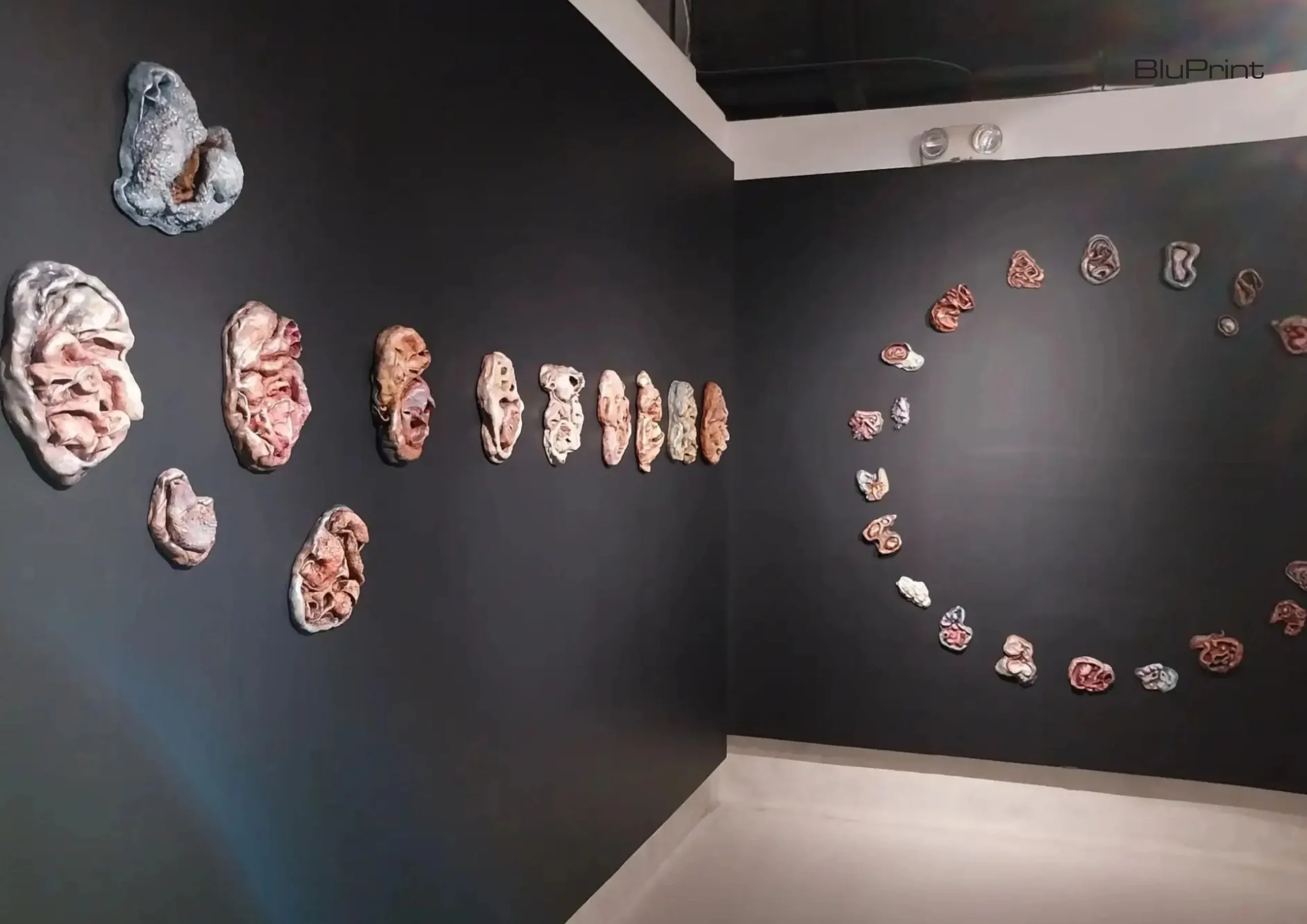
Sam Feleo Presents a Fleshy New Sculptural Vision with ‘Grip/Pulse’



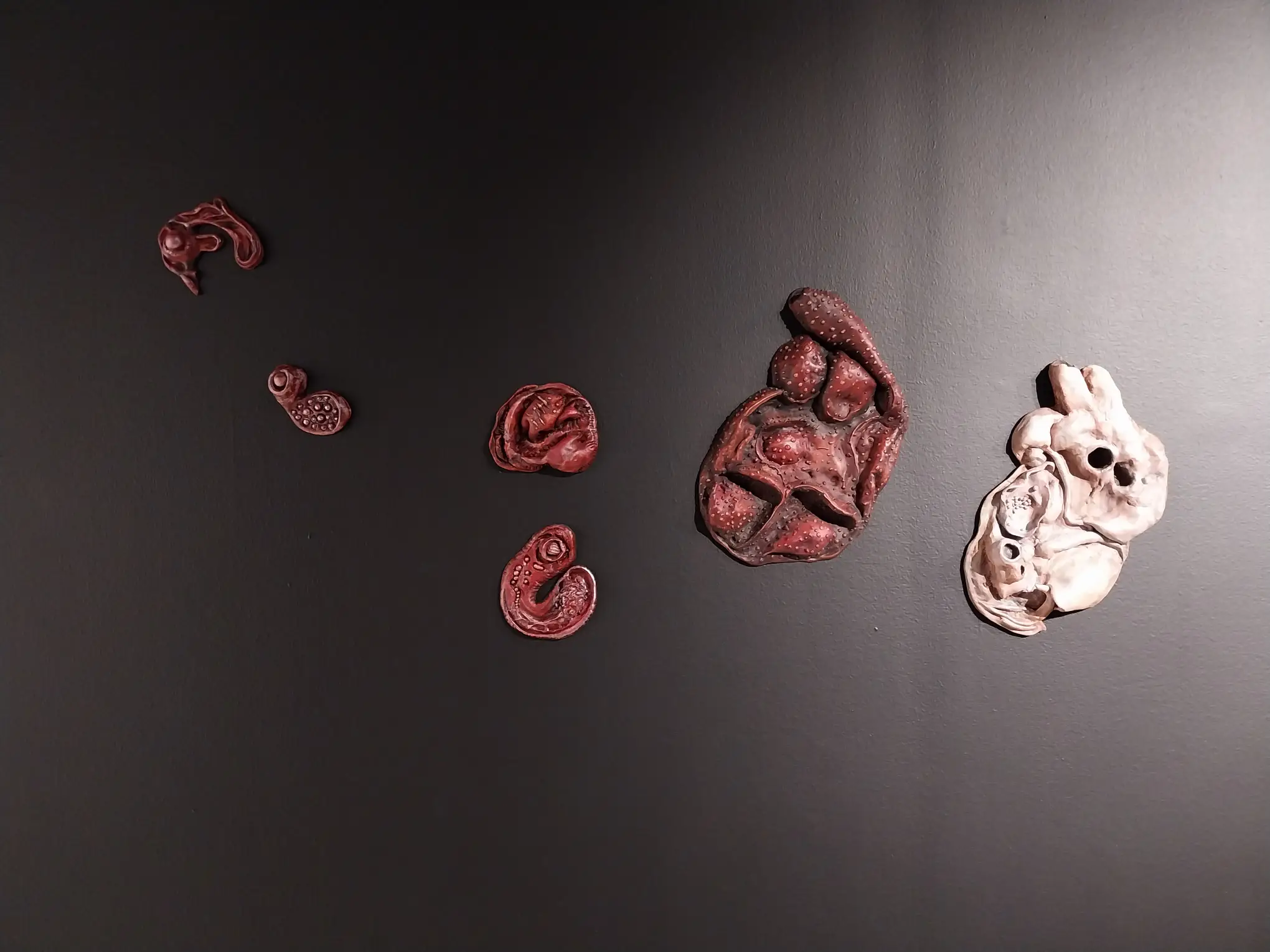
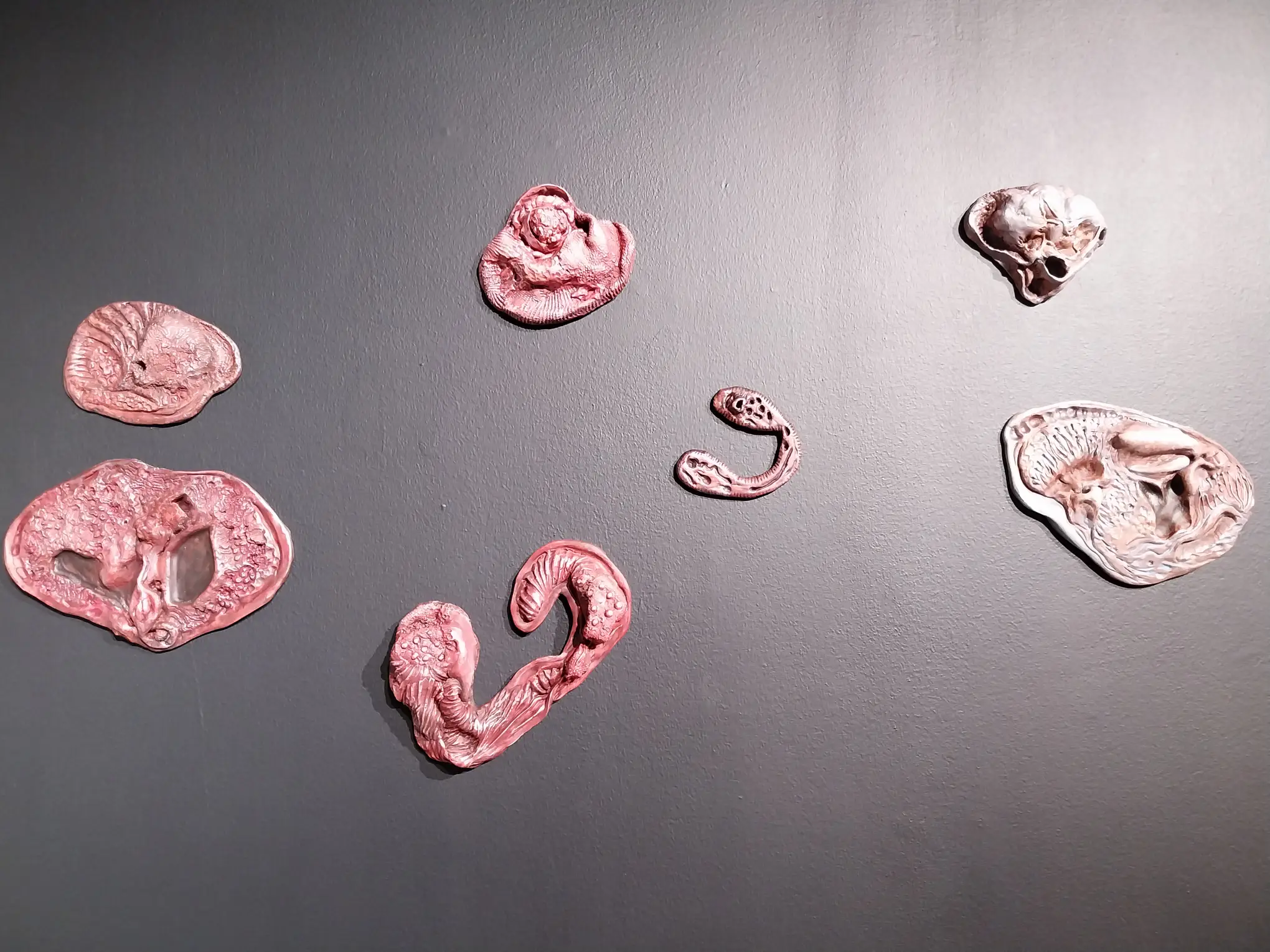
In Grip/Pulse, artist Sam Feleo‘s recent exhibition at Cartellino Art, ceramic stoneware pieces evoke an organic, almost alien quality. Their naturalistic hues and the way crystals seem to grow from within give each work a sense of life and quiet transformation.
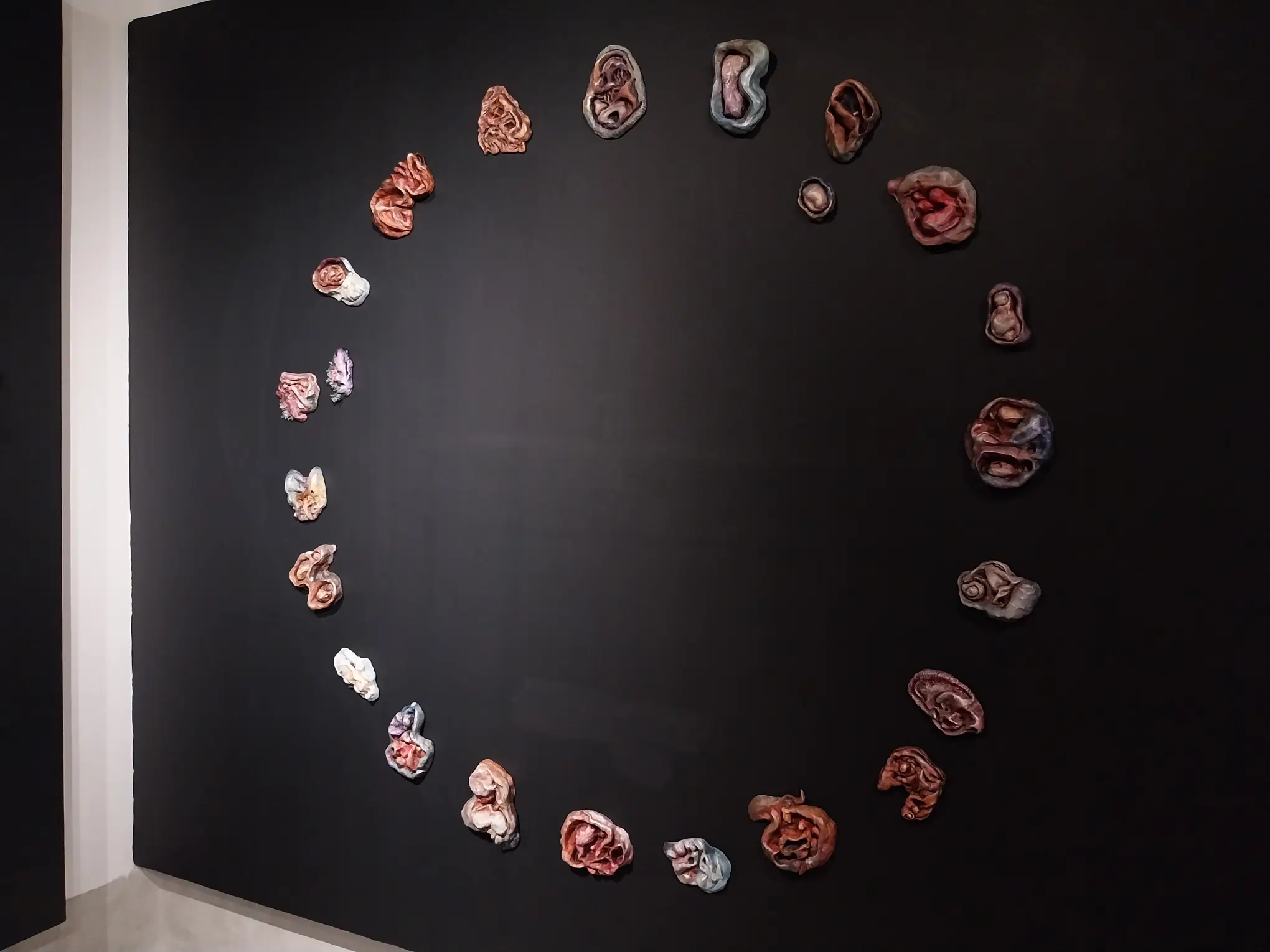
Feleo described the forms as “embryonic”. They reflect the natural state of flux found in nature, but also the way artists can change the conditions of a material to how they see fit.
“It translates the conceptual essence of organic unfolding into a sculptural language highlighting the interplay between artistic intervention and the processual unpredictability of crystal formation,” the exhibit write-up said.
‘Embryonic’ Artworks to Reflect Life
This collection utilizes pottery techniques that Sam Feleo modified to get the desired effect for her different sculptures. She avoids glazing her ceramic pieces, which makes the final product “glass-like”. Instead, she opts for more organic textures by hand-painting each work with acrylic pigments to emphasize their raw, tactile quality.
“All of these works are made from ceramic stoneware,” she said. “They are bisque-fired only. Not at all completely vitrified, because when you’re working with ceramics, you have to fire it twice. Itong mga works na ito, they’re only fired once para matanggal ang tubig.”
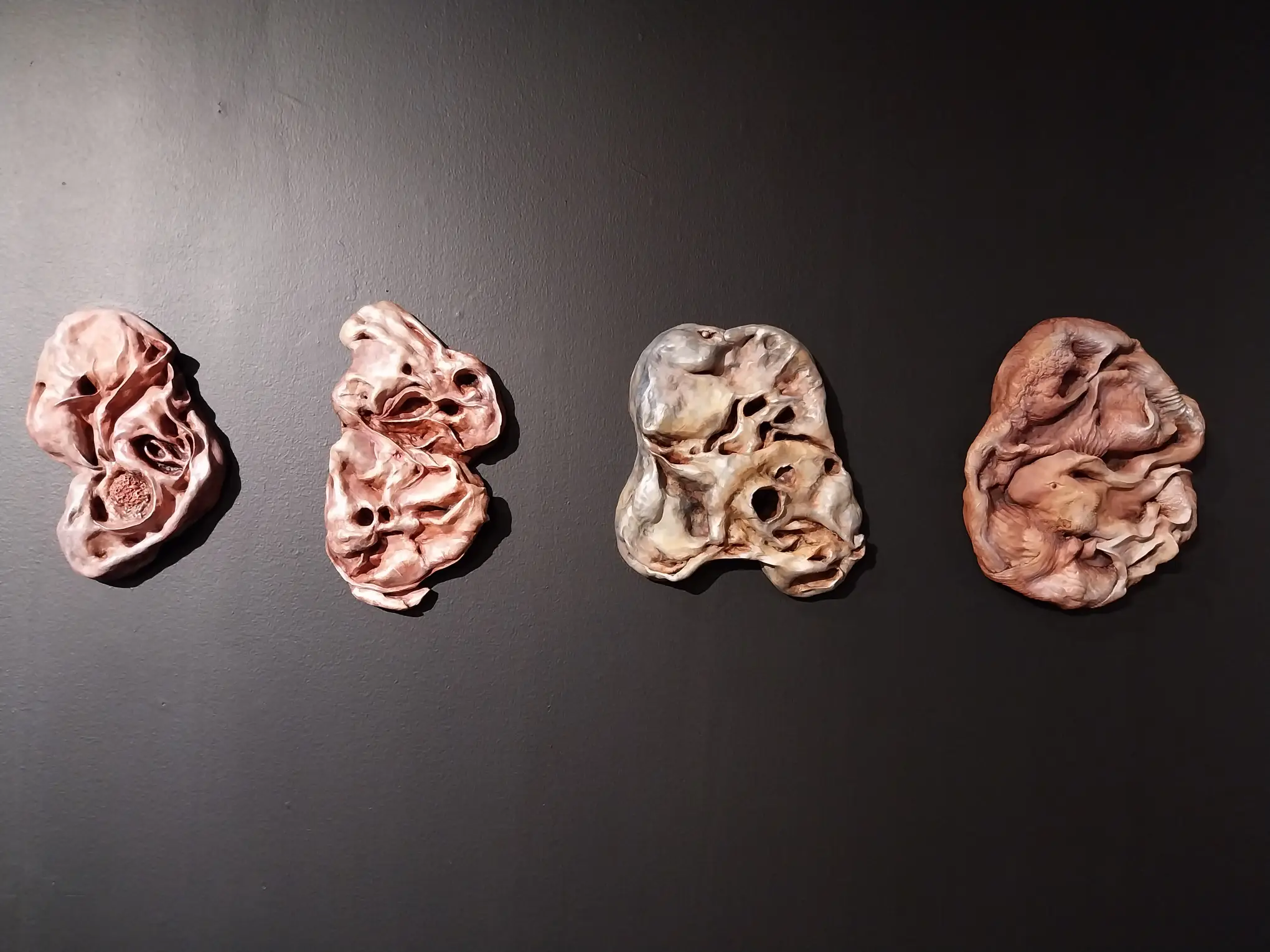
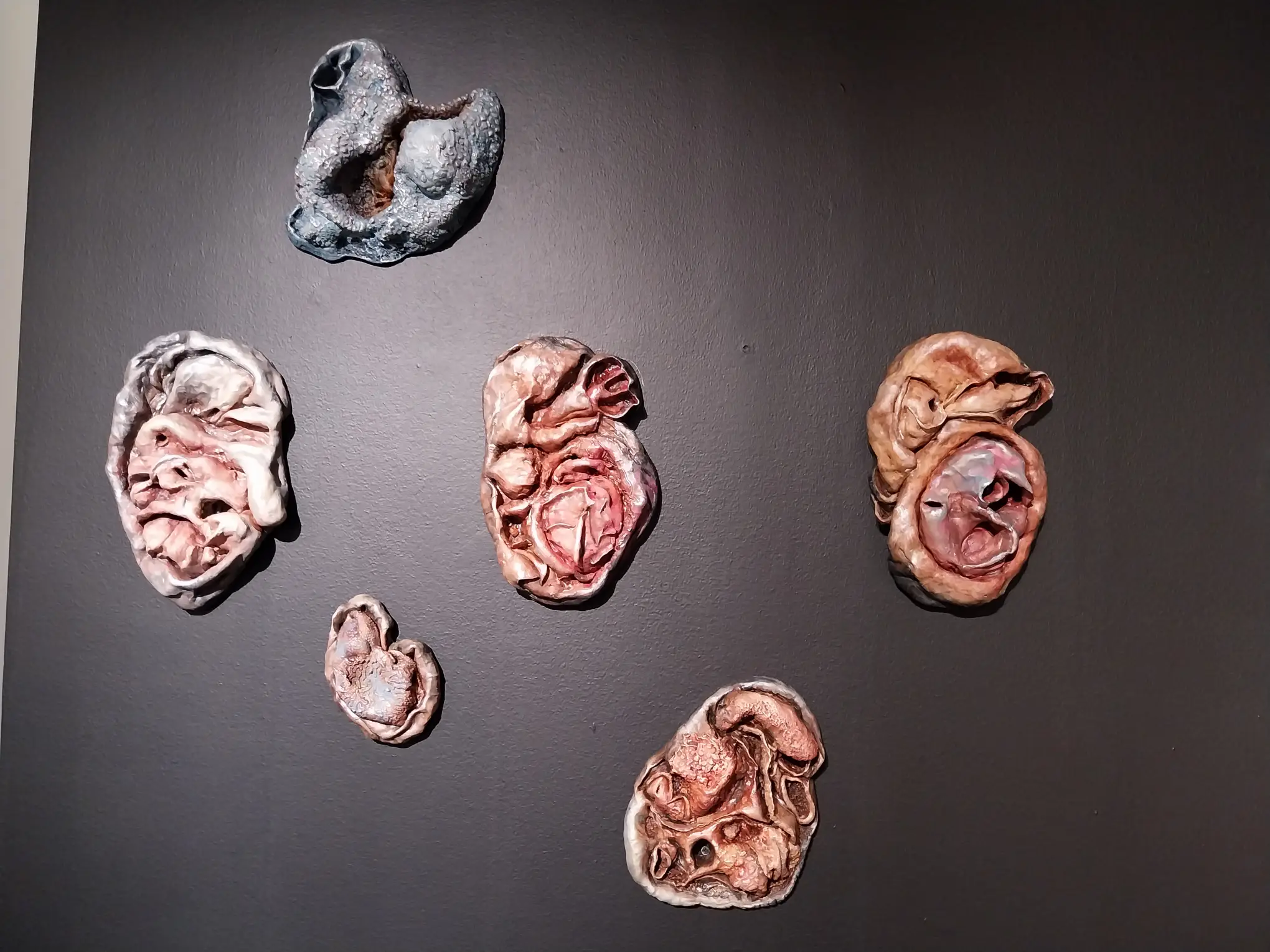
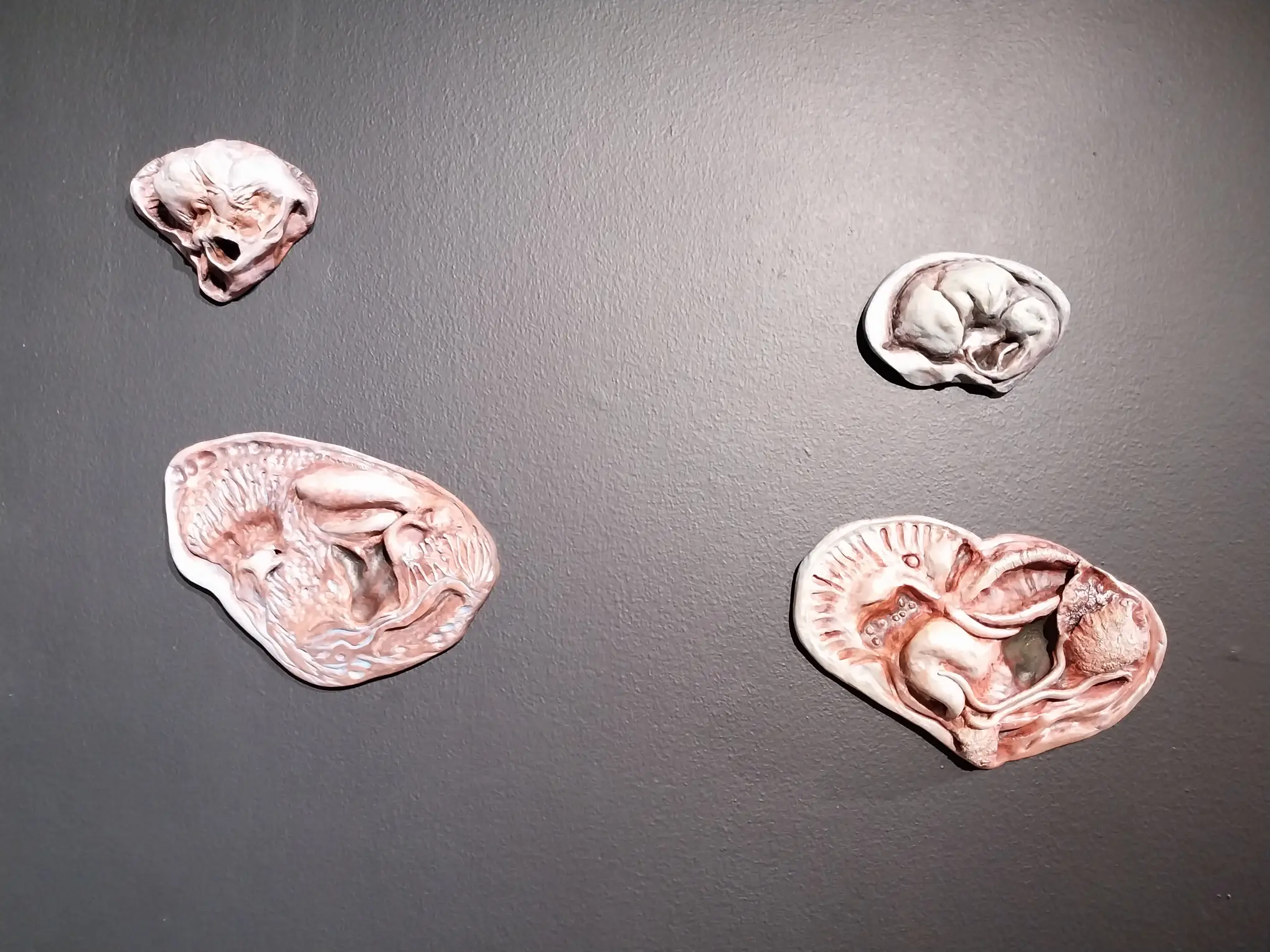
“Hindi ko kasi ma-achieve ang subtlety na gusto ko, yung fleshy effect with glazing,” she continued, “[so] I chose to hand paint all the pieces here.”
The forms Sam Feleo uses are striking because they defy the usual expectations of stoneware. Instead of appearing ceramic or rigid, they resemble flesh—rendered in brown and red tones, with folds, pores, and organic protrusions that mimic skin. Each piece feels suspended in motion, as if caught mid-transformation or gesture.
“Kaya siya embryonic forms kasi gusto ko paglaruan ang idea na ang art, hindi nila kailangan maging static, pwede siyang nag-ta-transform, nag-pupulsate,” she said. “I wanted to capture that softness, the organicness in these works.”
Sam Feleo Figures Out Her Own Process
In the exhibit write-up, Feleo cited James T. Merry, best known for his work with avant-garde pop musician Björk, as the inspiration for the works. The artist said in the exhibit write-up that Merry’s embryo forms “generated through Artificial Intelligence,” which are both fluid and futuristic in its arrangement.
But she also shared that the development of the ideas for the exhibit came as a result of her own experimentations with pottery and the form.
“[The] idea came to me serendipitously, I would say, in 2013,” she said. “I was learning to work with ceramics; nag-enroll ako sa isang class ni Ma’am Rita Gudino sa UP College of Fine Arts. At that time, I was only doing really small and very detailed seeds; para silang beads.
“So yung tanong niya is ‘Okay, kung ganyang kaliit at ganyang kadetailed, paano mo sila i-gla-glaze?’ Kasi pag gin-laze mo yan, mawawala yung detail. So sabi niya, wag mo na lang i-glaze. I asked kung pwede ko silang pinturahan at sabi niya wag din, kasi painting clay goes against the integrity of clay, na dapat ginaglaze. Ako naman, thinking about contemporary art practices, matigas ang ulo ko. Sabi ko, ‘hindi, hindi ko siya susundan.’”
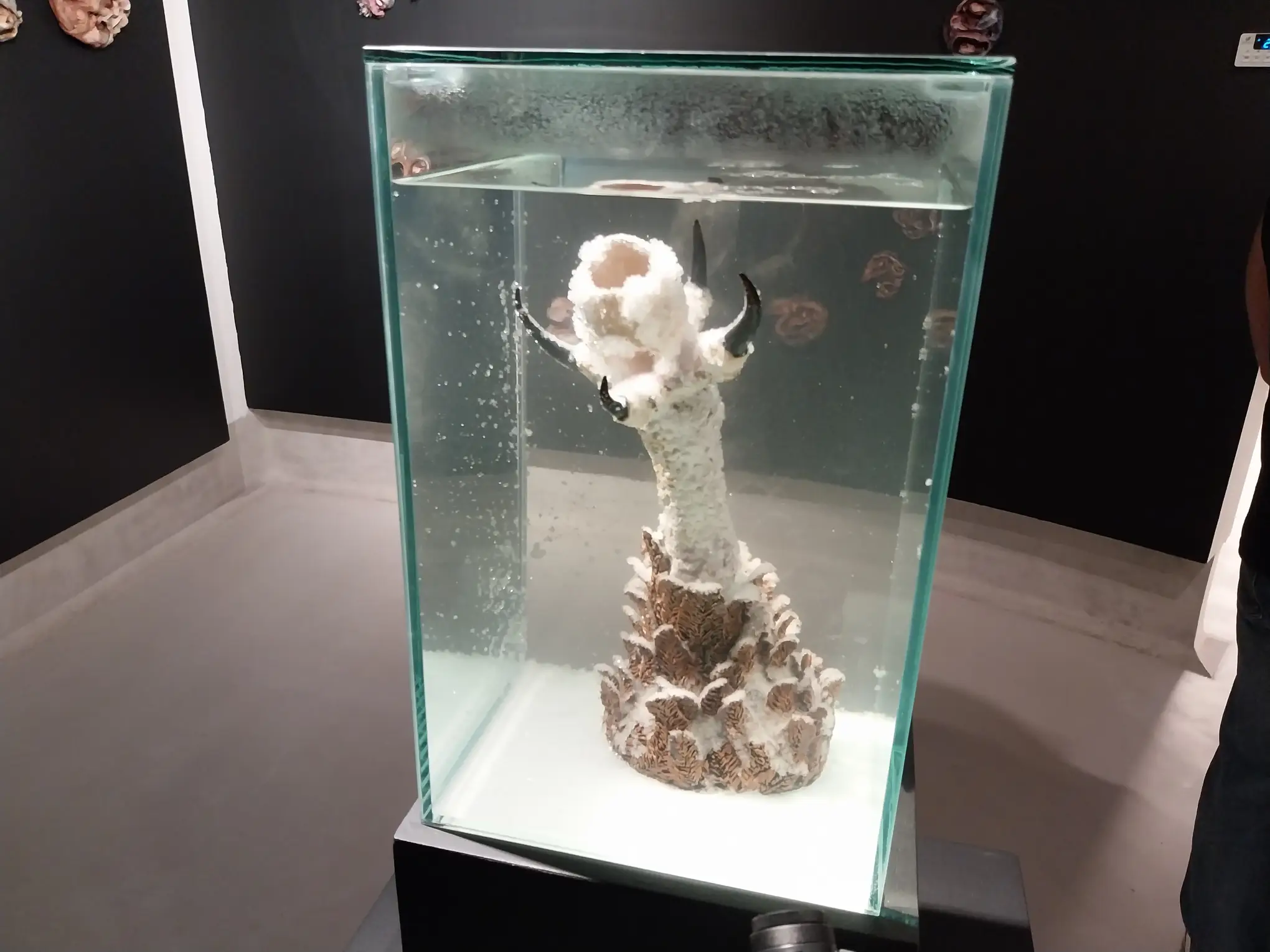
In the center of the exhibit is a work-in-progress, showing part of how she crafted the artworks displayed in Grip/Pulse. An aquarium contains a claw-like sculpture immersed in water and covered with crystals, which seems to emerge from a coral-like base.
Crystalline Sculptures
This artwork embodied the ethos of the show, which centers on the cycle of life, showcasing how growth and agency can be found in different natural processes that are different from ours but lives on just the same.
She started exploring the process recently from a crystal growing kit given to her by her husband. Instead of a plaster substrate, she used her own sculpture for the crystals to latch onto, and this reinvigorated her interest in the matter. It’s also another reason why she doesn’t glaze her sculptures: it removes the ability for the crystals to latch onto the work.
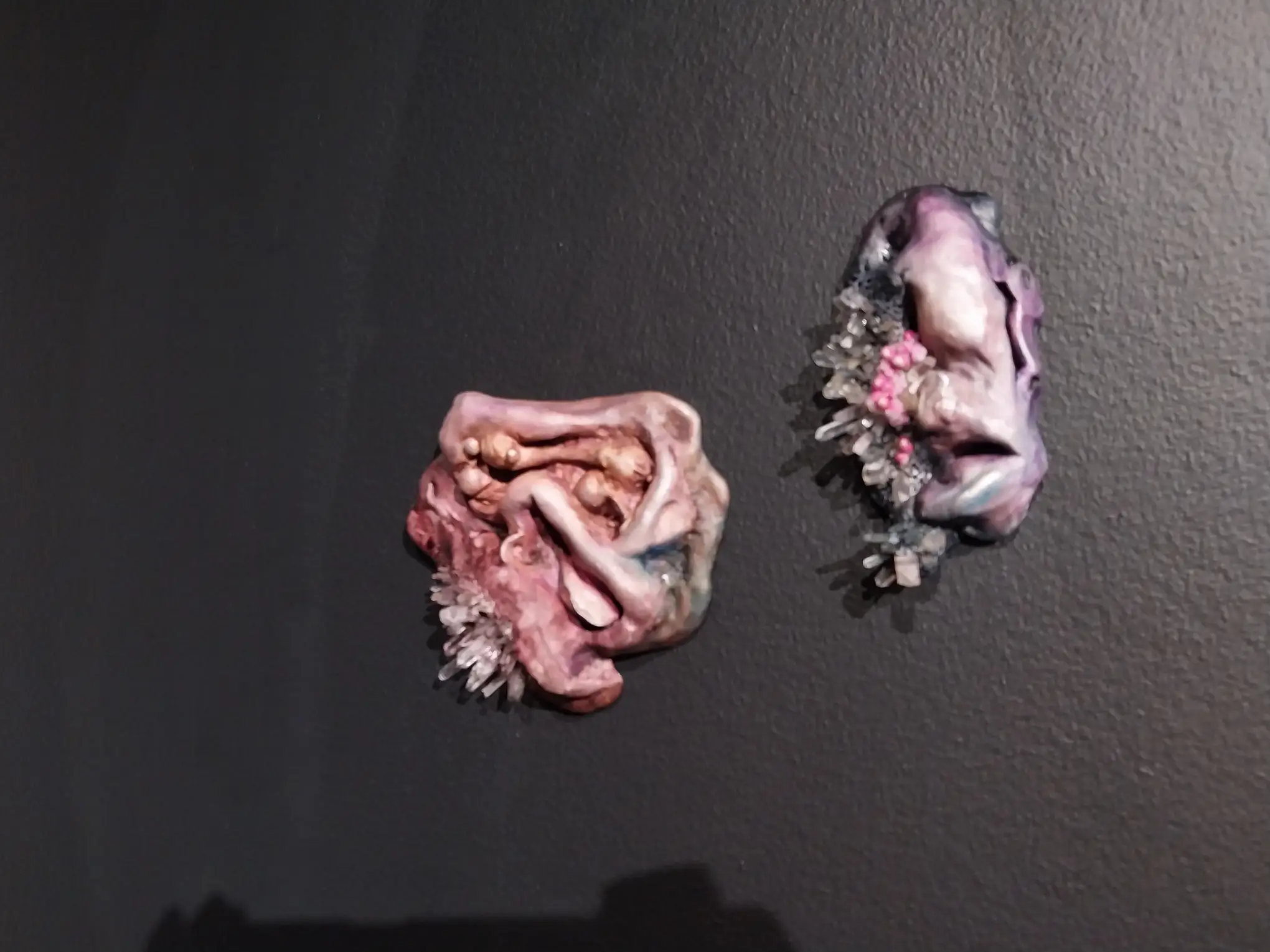
“I simply substituted that plaster substrate with my own sculpture and it worked,” she said. “Doon similar idea na pwede ko pala siyang gawin with clay. And since then I’ve tried it on shell, on rock, on paper, on found objects, [and] sponge plastic. But clay is still the best substrate, I would say kasi porous, maganda ang sipsip niya, [and it is] sturdy enough to sustain ang matagal na pagbabad.”
‘Grip/Pulse’ and the Constant Change of Life and Death
As an exhibition, Grip/Pulse discusses a broader idea about life cycles at work in nature. The flesh-like quality, her utilization of crystals, come together as a way of discussing the process of growth and decay, of how important both parts are in our lives. Sam Feleo sought to showcase that constant evolution includes both life and death, that both are necessary for a balanced existence within ourselves.
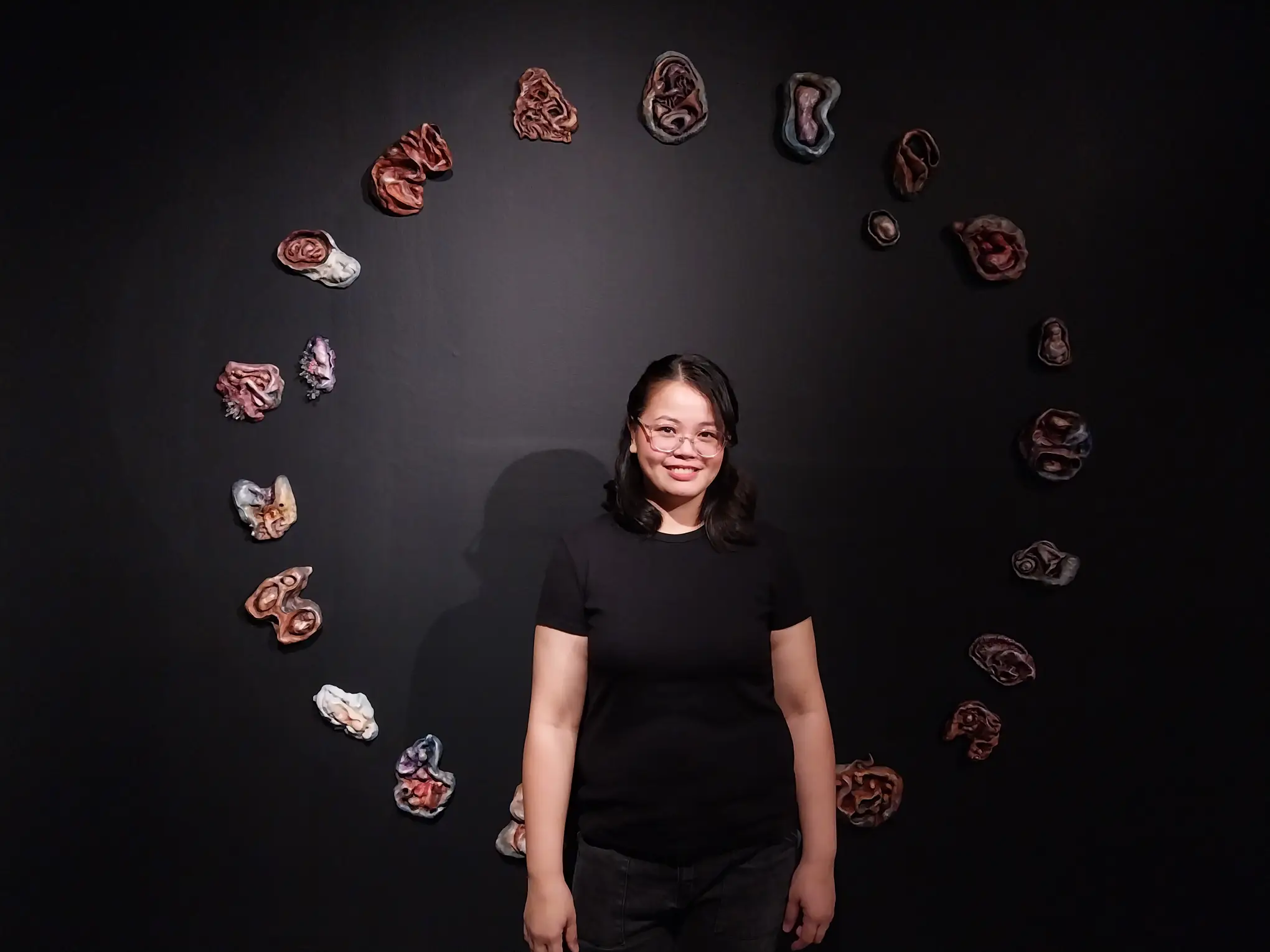
“This is not only about growth, it’s also about death, it’s also about regeneration,” she elaborated. “At first glance, it starts small. Tapos biglang lalaki, so gets mo na agad na this is a series, may nadedevelop na organism or form. But beyond that, hindi lang siya about growth. Kasi yung idea natin ng progress is always related to paglaki, pagyaman. But sometimes yung reverse engineering, yung pagliit at pagbawas, it’s also significant. Kasi, it might reveal something.”
Photos by Elle Yap.
Related reading: ‘Terror Incognita’ Shows How Generative AI Works Against Culture Creation
Frequently Asked Questions
‘Grip/Pulse’ explores the “embryonic” nature of life through ceramic sculptures that mimic fleshy, organic forms. Feleo challenges the traditional static nature of art by creating works that appear to be in a state of flux, pulsating with potential life or caught in mid-transformation. The exhibit uses a sculptural language to highlight the interplay between deliberate artistic intervention and the unpredictable, natural growth of crystals.
To achieve a realistic skin-like appearance, Feleo deviates from traditional pottery techniques by avoiding glazes, which she finds too glass-like and destructive to fine detail. Instead, her pieces are bisque-fired only once and then meticulously hand-painted with acrylic pigments. This process emphasizes pores, folds, and organic protrusions, allowing her to capture a raw, tactile quality that mimics biological tissue more effectively than standard vitrification.
Crystals serve as a symbol of growth and regeneration, emerging from the “embryonic” clay forms to suggest an ongoing natural process. Feleo uses her porous stoneware sculptures as a substrate, allowing crystals to latch onto and grow from the pieces while they are submerged in water. This technique integrates the unpredictability of nature into the artwork, showcasing a cycle where minerals and organic-looking forms coexist in a state of constant evolution.
Feleo’s style was born from a refusal to follow conventional ceramic rules, specifically the requirement that clay must be glazed rather than painted to maintain its “integrity.” While studying at the UP College of Fine Arts, she discovered that glazing would obscure the intricate details of her small, seed-like works. By choosing to “reverse engineer” the process and use non-traditional coatings, she successfully blended contemporary art practices with classical stoneware.
The exhibition reframes the concept of progress, suggesting that growth is not just about accumulation or getting larger, but also involves decay and “reduction.” By showcasing organisms that appear to be both growing and regenerating, Feleo highlights that death is a necessary part of a balanced life cycle. This “reverse engineering” of form reveals deeper truths about existence, moving away from a linear view of life toward a more circular understanding of nature.
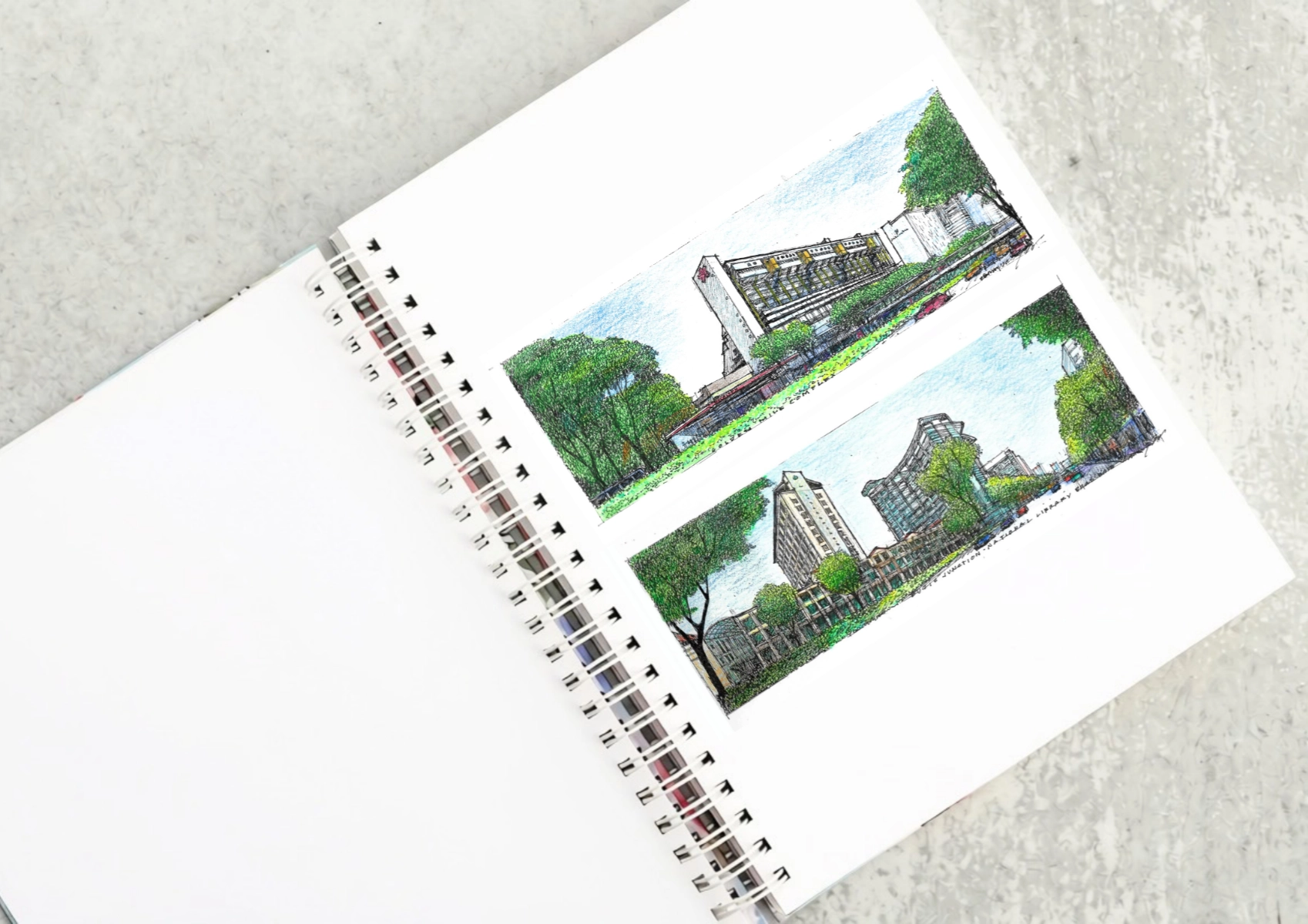
Two sketches of Singapore connect BluPrint Editor in Chief Paulo G. Alcazaren’s personal and professional history with Shared Ground: ArchitectureArchitectureThe art and science of designing and constructing buildings, structures, and spaces that are functional, safe, and aesthetically pleasing. It encompasses the planning, design, materials, and techniques used to createGo to Architecture Glossary of Care, Culture, […]
In a way, designers are the modern-day soothsayers and prophets. They design for the future, predicting how a room, a house, a building or a whole city will be used by people. They foresee how users will interact with a space, conjure exact shades of colors to elicit specific behavior and arrange furniture to build […]
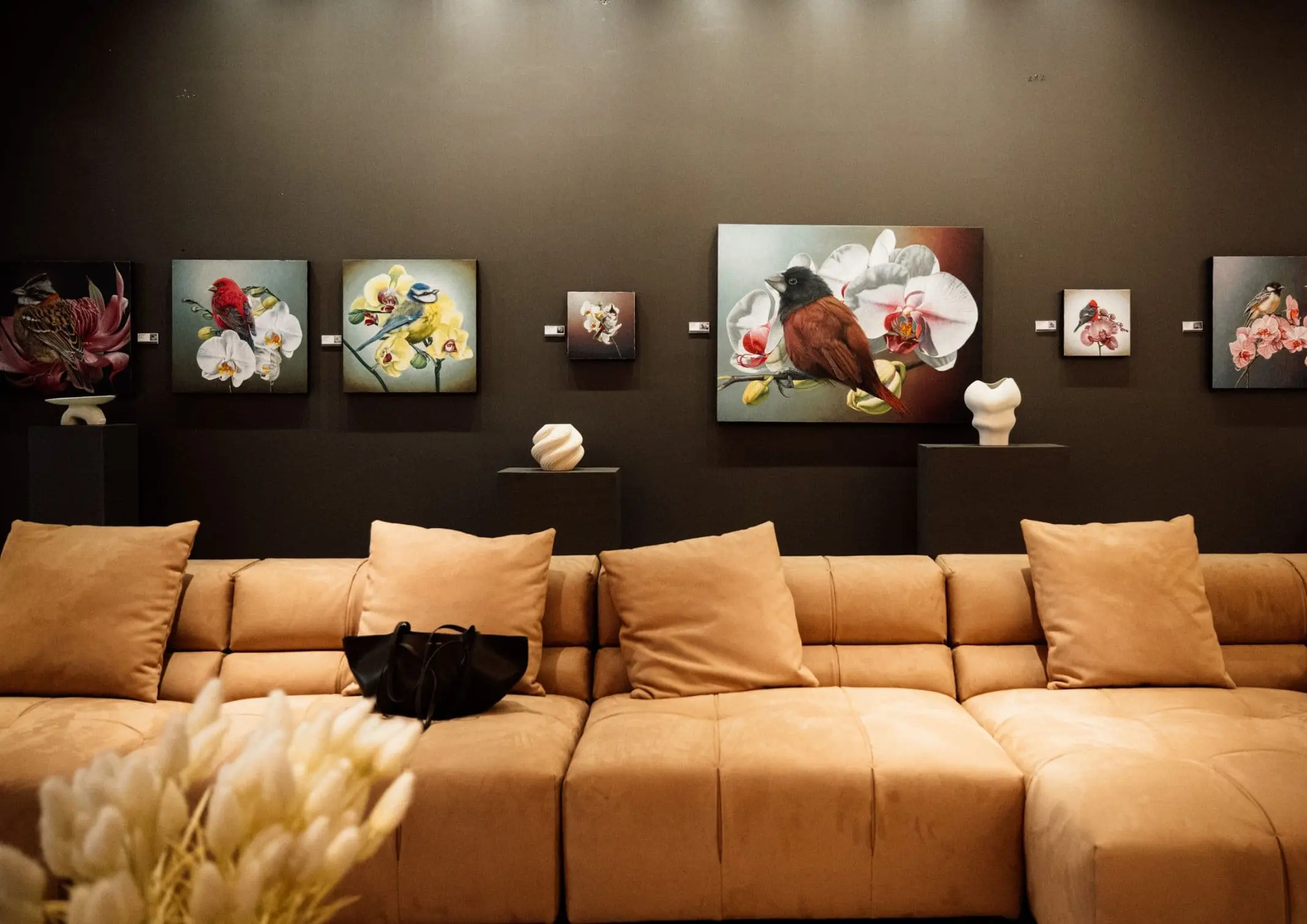
Art and furniture are often selected separately, yet their relationship can shape how a room looks and feels. The collaboration between Hooga and Galerie Joaquin explores how these elements can work together, bringing contemporary artworks into furnished residential settings at Hooga’s showroom in Uptown Mall, Bonifacio Global City. For Hooga, which curates furniture, lighting, and […]
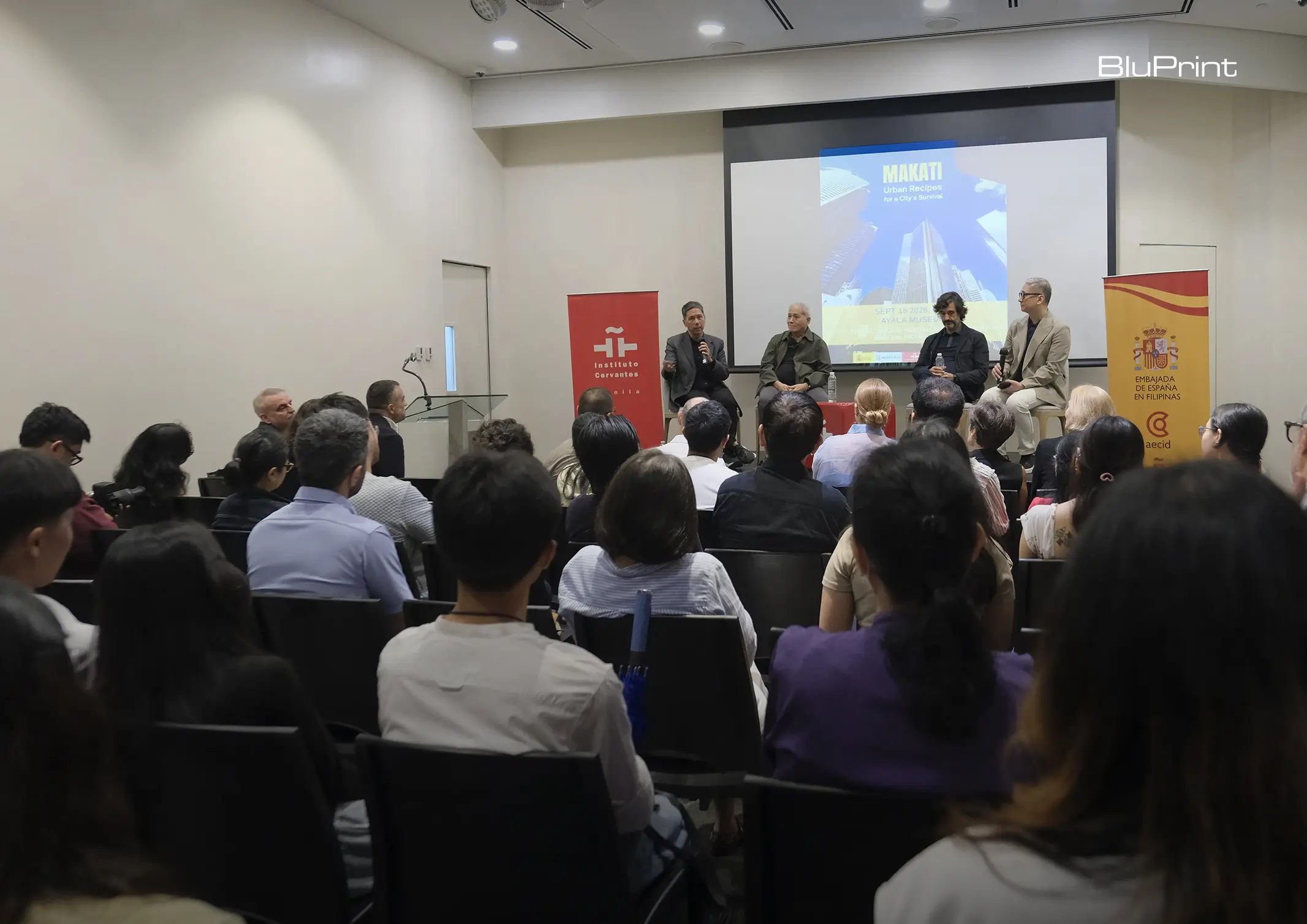
How can better-planned cities create the conditions for more creative, livable, and resilient urban environments? “Makati Urban Recipes for a City’s Survival,” a colloquium held at the Ayala Museum on September 15, brought together architects and practitioners from the fields of urbanism and the creative economy to discuss how design, planning, and collaboration can address […]
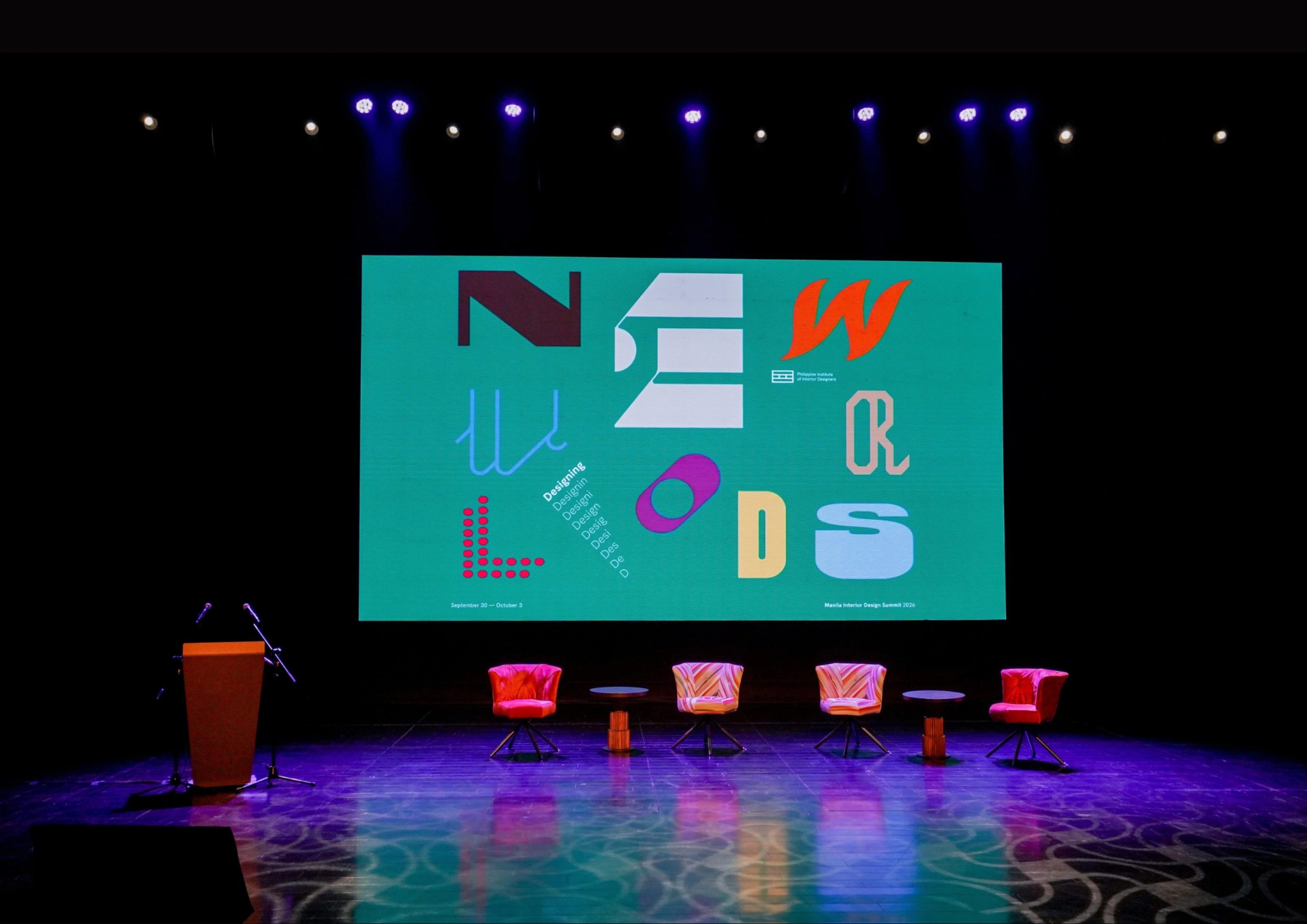
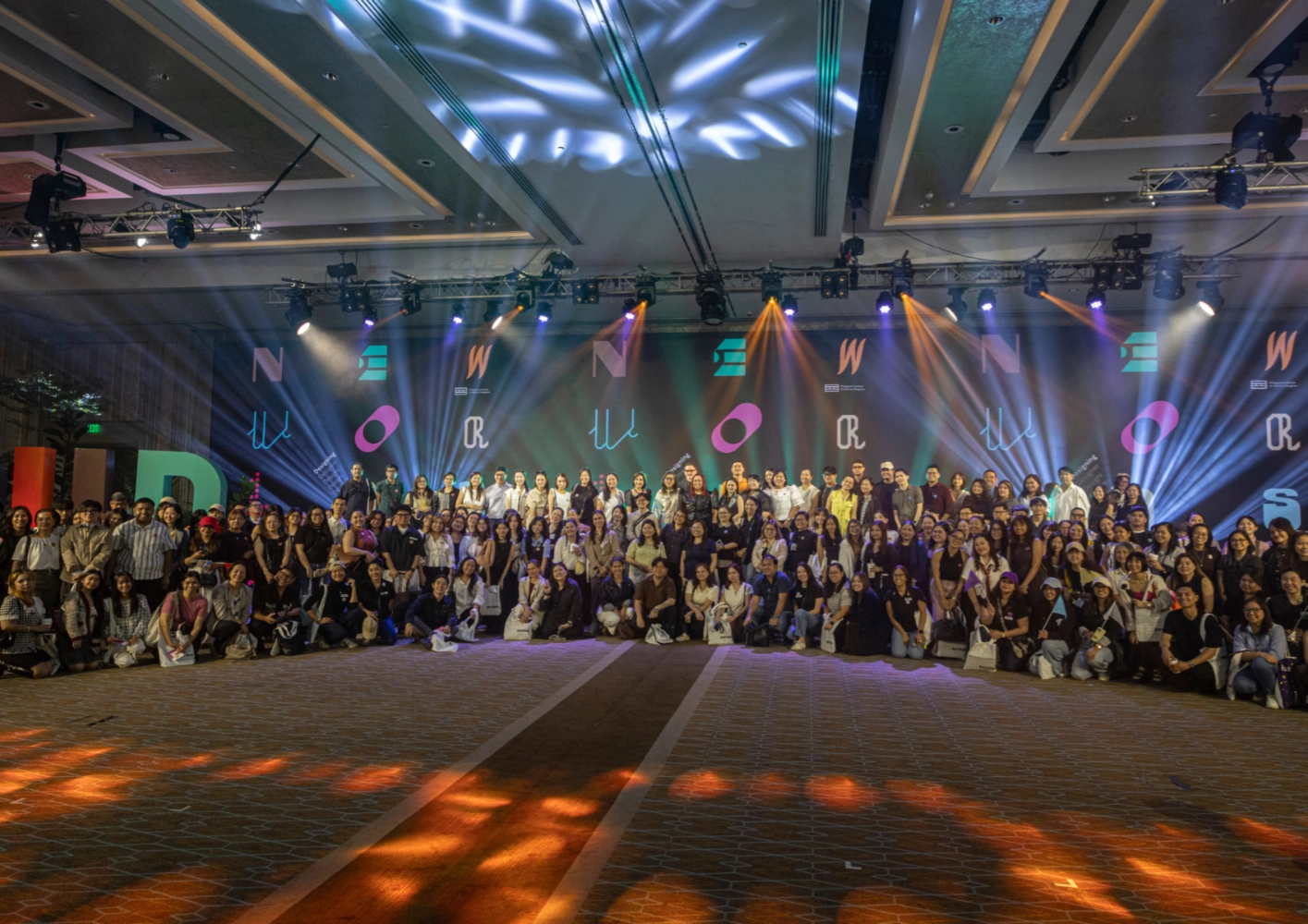
The fourth Manila Interior DesignInterior DesignThe discipline of planning and shaping interior spaces for function, comfort, safety, and beauty. It covers layout, lighting, materials, finishes, furniture, and color, and in the Philippines is a licensedGo to Interior Design Glossary Summit (MIDS) brought together more than 300 delegates for four days of conversations, exhibitions, and design […]
Read the issues.

Collect the volumes.

Recommended Video
Tap to Unmute
Unmute
0:00
0:00