In every society, clothing indicates a human being’s relationship with the community. It defines their beliefs and celebrates design artistry that speaks of their identity as a distinct group or individual. This is especially so in our pre-industrial societies, where Filipino textiles primarily defined a person’s material value and social status. Before colonization and modernization, the peoples of Mindanao, Sulu, and Tawi-Tawi were fierce defenders of their territorial identity. They were also demanding clients of traditional and imported weaving. These symbolized their uniqueness, qualities that are arguably “tracers” of cultural continuity.
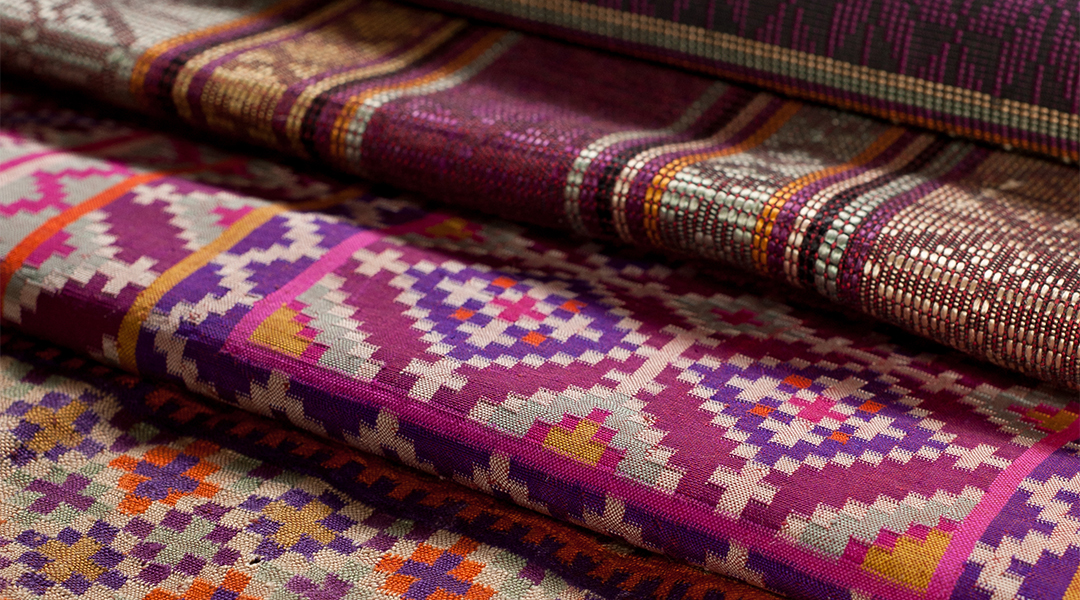
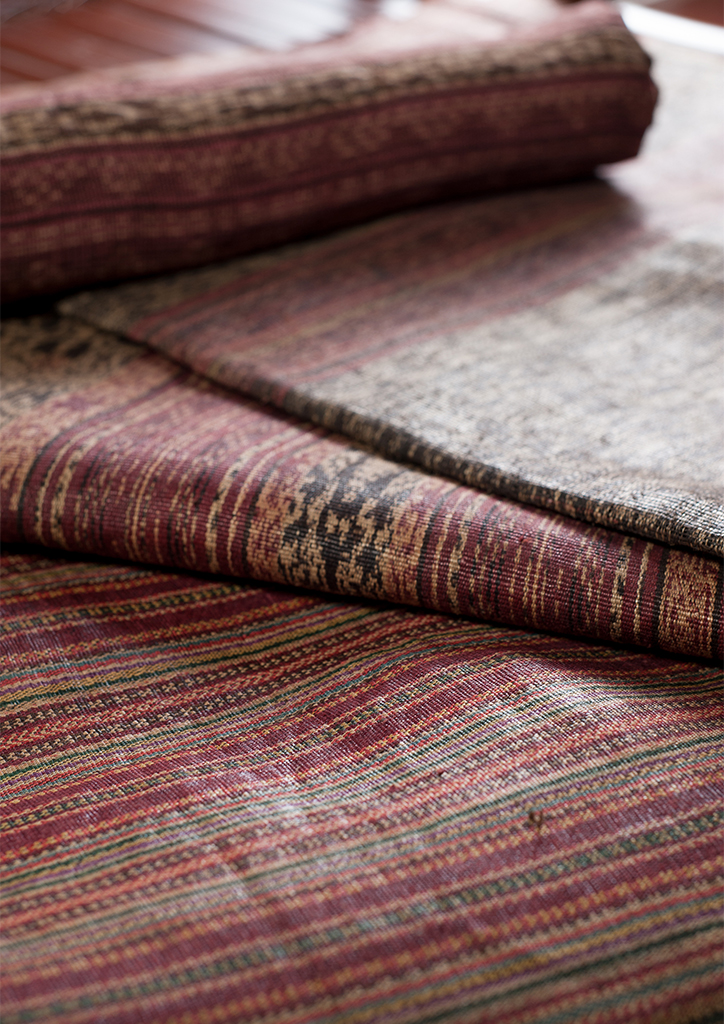
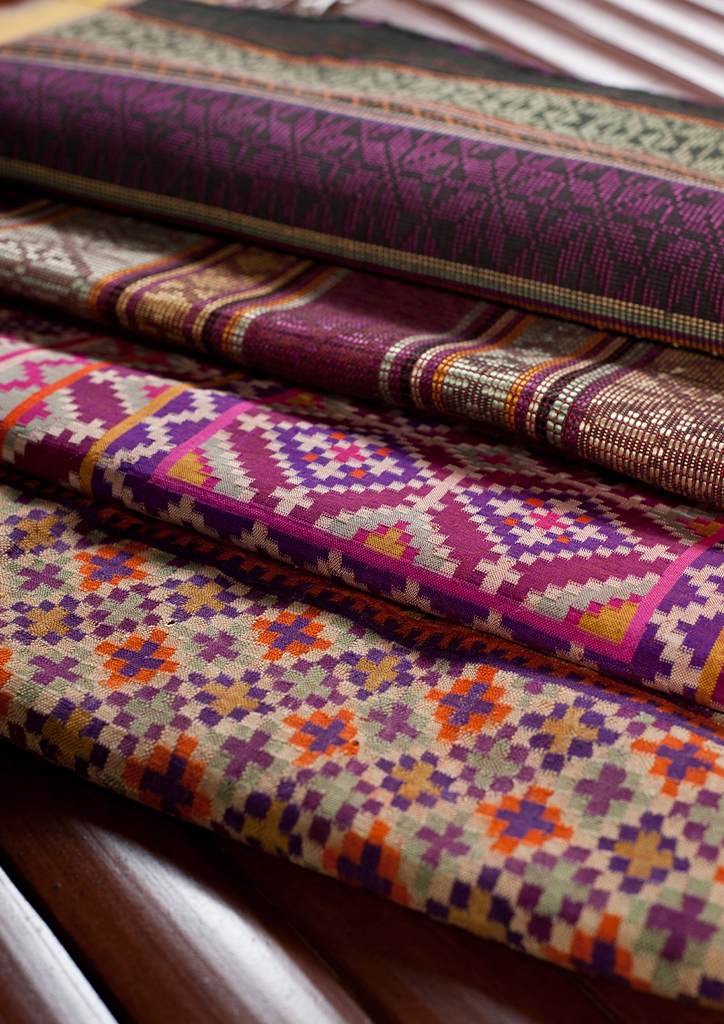
An ensemble of intricately woven and dyed Filipino textiles. Bottom: a Yakan pis (large kerchief) with the intricate kabangbuddi pattern of tiny cross, x’s, and triangles. Middle: a B’laan/Bagobo dyed textile, either called tabi or panapisan, used as wraparound skirts; and a B’laan sapi, also a wraparound skirt.The B’laan and Bagobo textiles focus on deeper reds, maroons, dark browns, and blacks. Large expanses of tie-dyed patterns are named after the number of threads used in the “belt” of the cloth.
Preserving a Dying Tradition
Collected by American ethnographers since the turn of the century, you can find many of these significant examples of clothing in foreign museums. Fortunately, former Senator Nikki Coseteng has championed traditional weaving as a source of cultural pride among Filipinas. She compiled an extensive collection of Filipino textiles from different areas of the country, rare examples of the high art that traditional weaving has achieved. In addition, Coseteng published a scholarly coffee table book in 1991.Sinaunang Habi, written by Marian Pastor Roces, discusses the importance of the dying tradition of Filipino weaving.
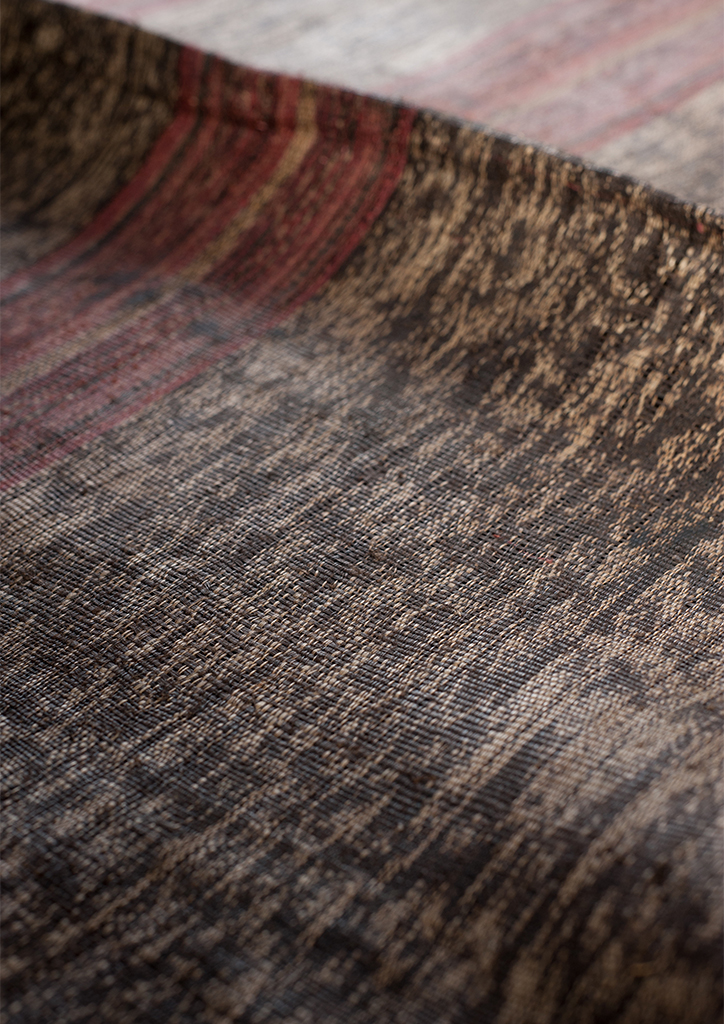
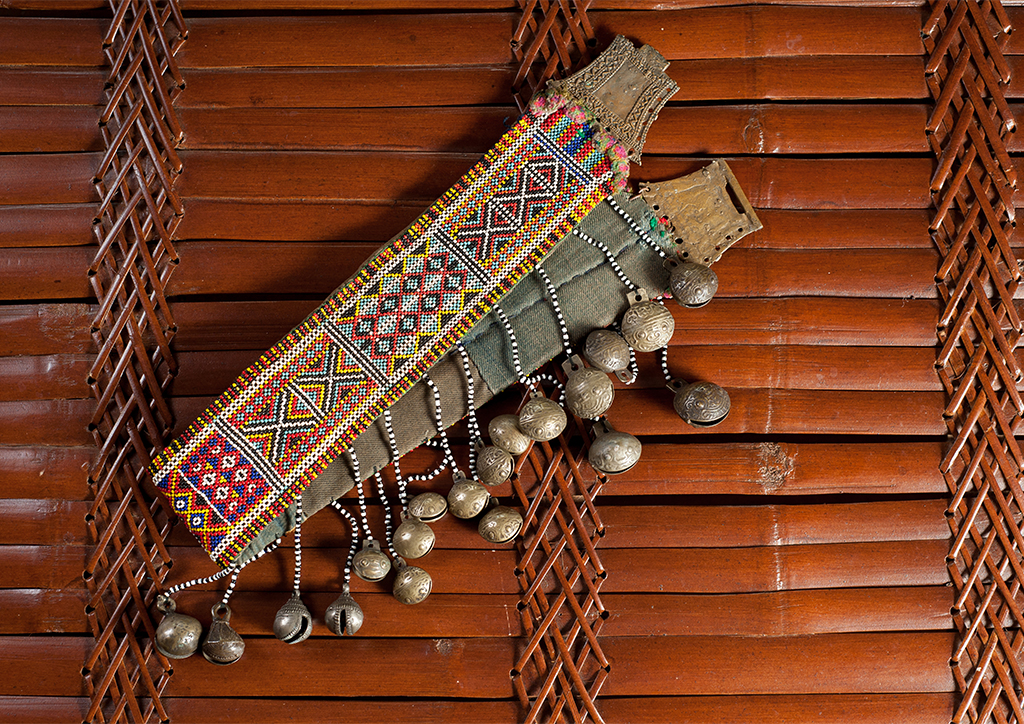
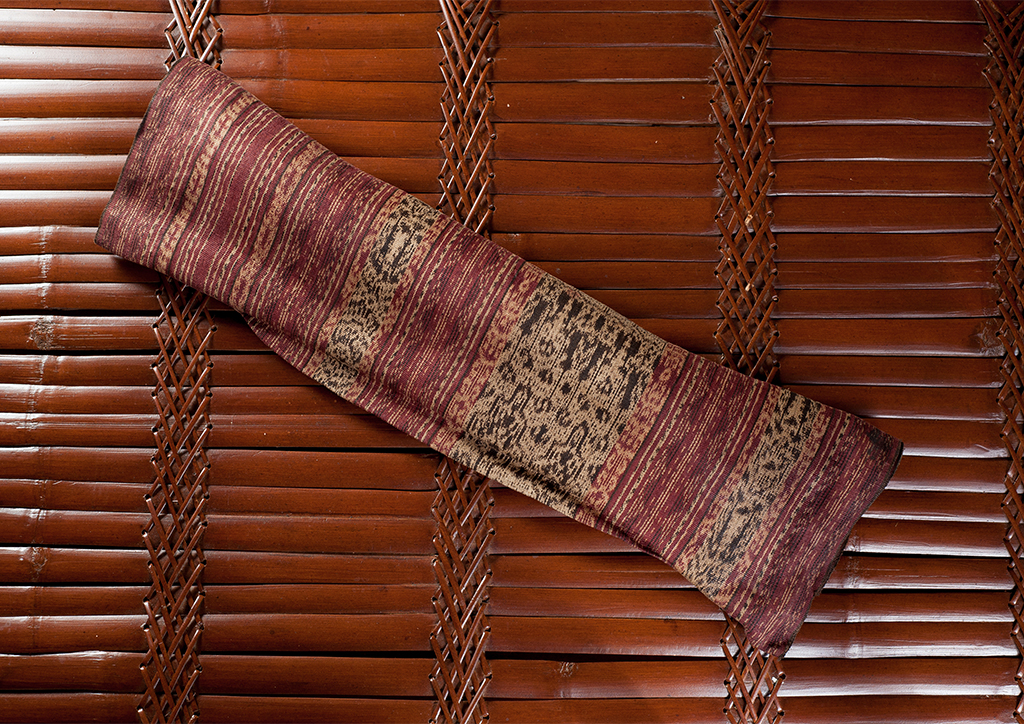
Brightly colored beads forming x’s, diamonds and triangles mark this brass-buckled belt of the Bagobo/B’laan. The brass hawk bells dangling in beaded tassels that allow it to jangle musically while walking indicate its feminine usage.The intricately tie-dyed abaca skirt called a tabi (B’laan) or panapisan (Bagobo) revels in its incredible detailing of mocha-sepia figures set against maroon and black. Weavers painstakingly count and tie lengths of thread with beeswax wraps and dye them in different colors.
Lumad and Moro
We can divide the traditional peoples of Mindanao and Sulu into two main groups. There’s the polytheistic lumad peoples of northeastern, central and southwestern Mindanao. These include the Bagobo, B’laan, Mandaya, Mansaka, Talaandig, and Kalagan-Tagakaolo.
Advertisement
The other group are the Islamized Moro peoples of the northwestern/western side of Mindanao island and the Sulu/Tawi-Tawi archipelagoes. Among them are the Maranaw, Maguindanaw, Ilanun, Subanon, Yakan, Tausug, and Sama-Badjao. You can differentiate the motifs of these two main groups between. The lumads have highly stylized human and animal figures. The Moros used abstracted geometric shapes with curvilinear patterns.
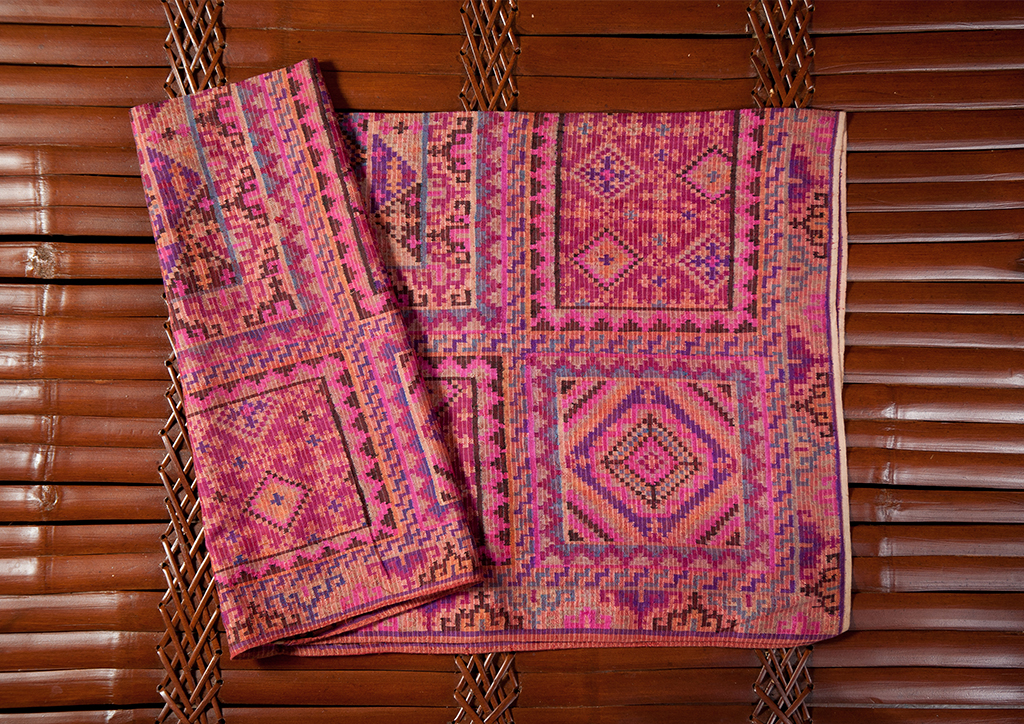
A quattro of gaily-colored textiles from Moro Mindanao. Bottom two: Yakan saputangan over-skirts. Top two: Tausug pis siyabit (headscarf) or hos siyabit (kerchief). The general use of abstracted forms is notable, with Yakan focusing on crosses, and Tausug on eight-petalled flowers and diamonds.A pink, purple, and blue Yakan saputangan weave textile, its subtly-burnished patterns of diamonds and triangles set amongst crosses and curlicues.
Weaving Techniques
There are also two main techniques for producing designs in these fabrics, shared by both groups. There’s the bë-bëd or ikat method of reserve dyeing; and the panayan or ansif method of embroidery and bead stitching. Notwithstanding the technique of decoration, all the peoples of Mindanao (indeed, all non-Christianized Filipinos) rely on a common form of assembling the warps and wefts through the back-strap loom. It’s a system of threads suspended on a set of wooden sticks, braced to the wearer’s back, and tied to a post—usually in the raised house’s silong.
Traditional weaving was, therefore, a supremely women’s art. It relied on their capacities for hard work, encoding knowledge, and relaying tradition. They even recited dreams into coherent and mathematically excellent weaving design.
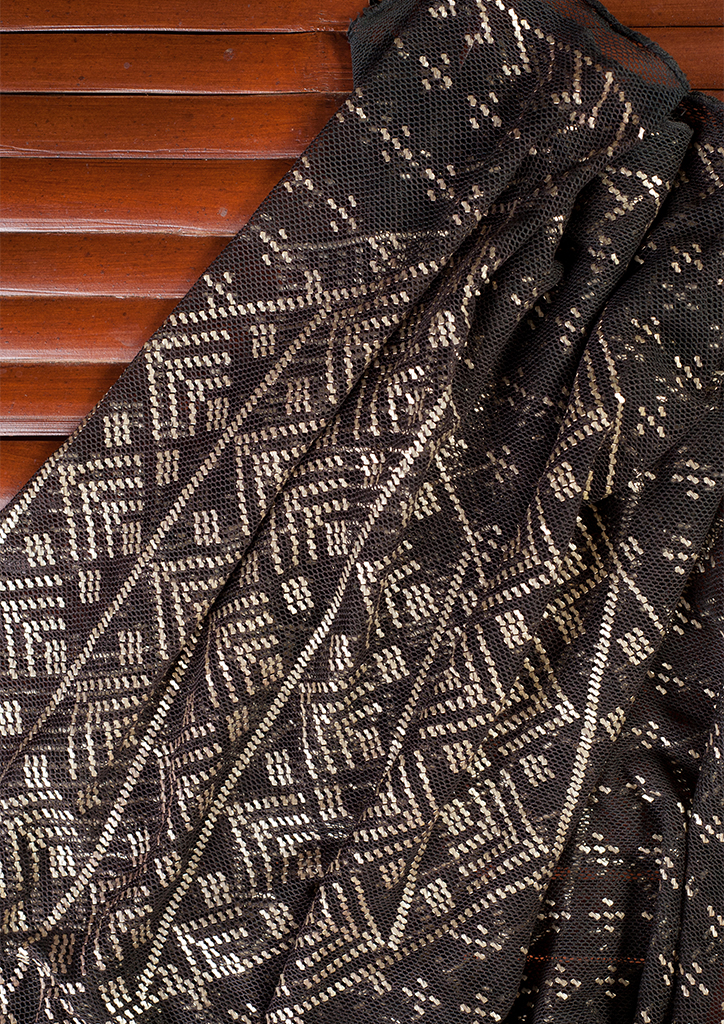
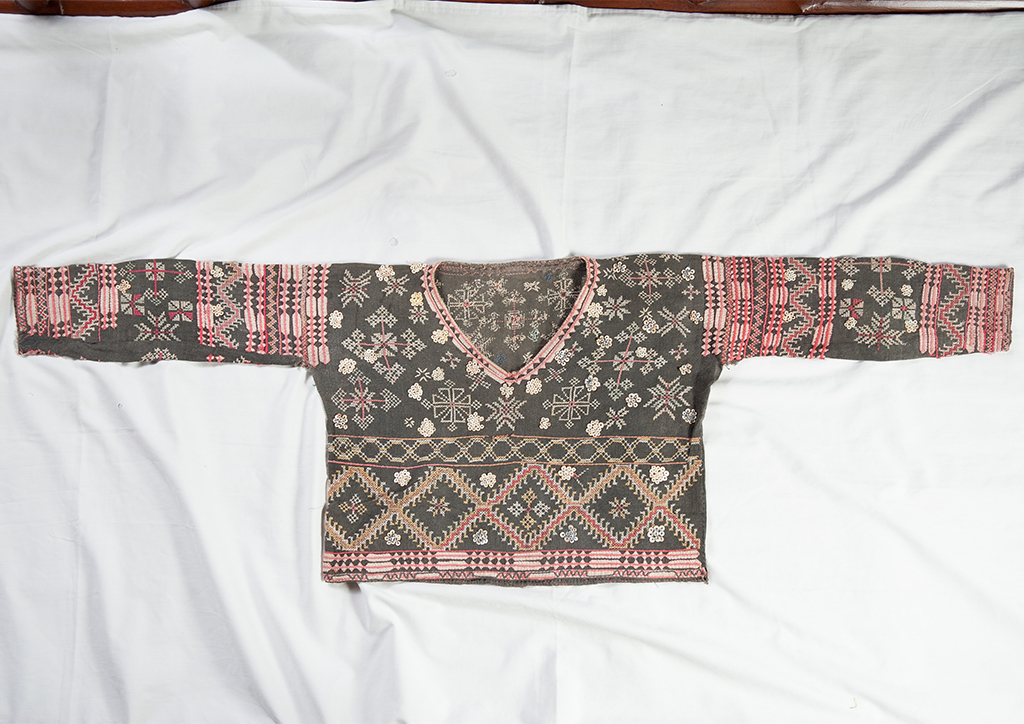
There is sublime simplicity in this Tausug luhul open stitchwork fabric (reminiscent of a fishnet). There is gold metallic thread embroidery set in the most austere of diamond-and-chevron versus cross geometry.The gay attire of an albong takmun worn by B’laan/Bagobo women as blouses. The use of extravagant embroidery, rendered into bead-like patterns alternating in geometric floral patterns, and a large band of alternating zigzag patterns at the abdomen area is typical of these people’s weaving.
Colors, Patterns, and Motifs
The color sensibility is the first thing that hits you between the two general traditions of Moro and lumad. The former is more riotous, with gaudy contrasts of red, yellow, black, green, purple, and white. The latter attached to a narrower range, from scarlets to maroons, bleached whites, browns, blacks, and more recently, blues.
Advertisement
There is also a more pronounced abstract geometry among the Moros. Weavers use diamonds, chevrons, crosses, triangles, and their distinct okir curves.Whereas the lumad exhibits a wide range of human and animal figures, primarily the crocodile (buwaya) or monitor lizard. Perhaps the most spectacular examplesfrom each group are the Maranao’s silk landap malong and the T’boli t’nalak. The landap features golden yellow squares bordered by bands of green, red, and purple. The t’nalak showcases abaco-woven bleached white patterns of crocodiles and human figures set against a deep brown. Its large diamonds and red bands create an effect resembling a python’s glistening skin from afar.
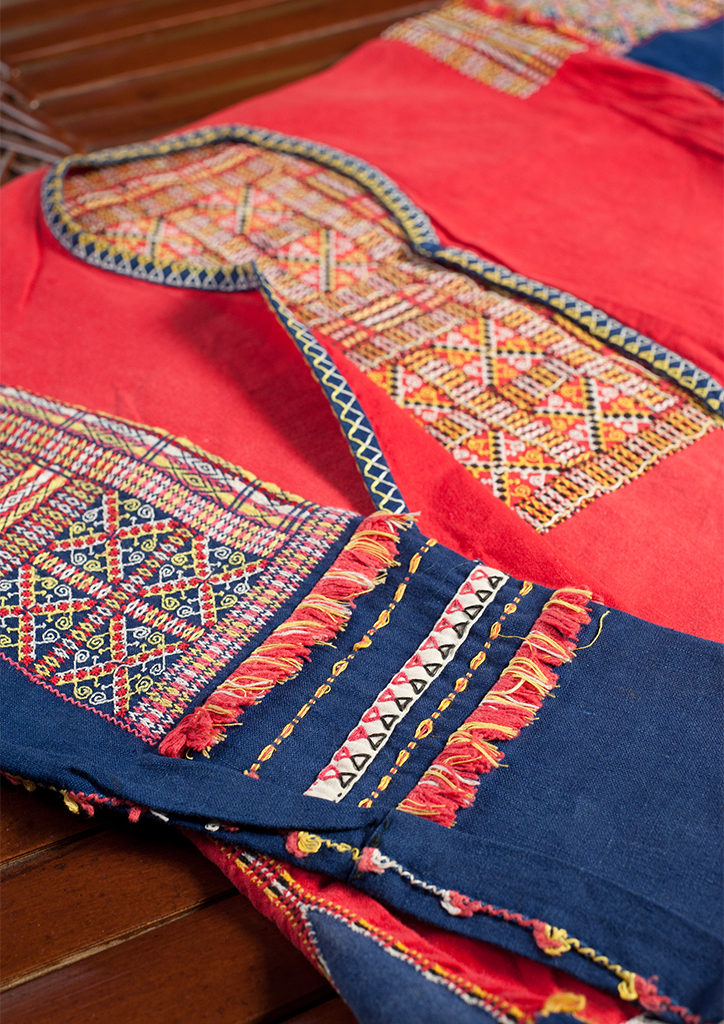
The rich chromaticity of a modern Mandaya dagmay blouse in red and blue cotton indicates its origins in trading with lowland Bisayans in the 20th Century. It still retains its archaic pattern of intricate beadwork in scaffold-like x’s running through the large part of the back and sleeves.
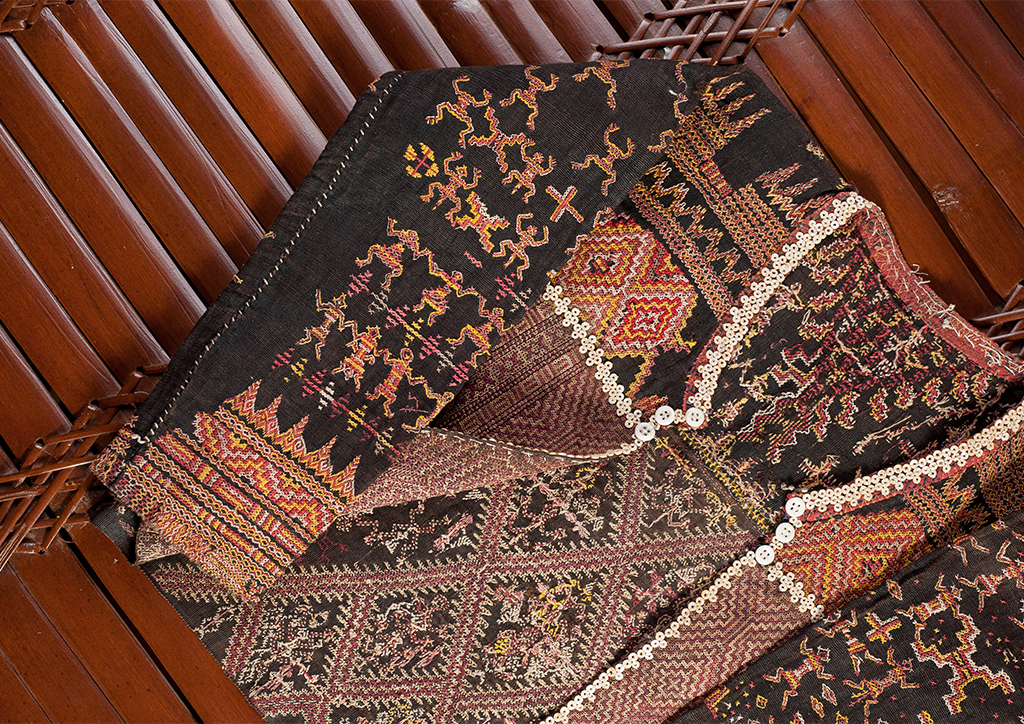
The austere deep brown against red and yellow supplementary embroidery pattern identifies this blouse as that of the T’boli kegal. The textiles feature human figures holding hands, placed among larger sections with diamond-shaped borders. These borders also contain richly geometric medallions with floral or animal designs that speak to the people’s well-known animistic beliefs. This is despite living near their Muslim neighbors.
The austere deep brown against red and yellow supplementary embroidery pattern identifies this blouse as that of the T’boli kegal.
Conserving Our Precious Traditions
Indeed, to talk about each Mindanao group’s unique textile designs, terms, and methods would fill up entire encyclopedia volumes. For now, you can view examples of the Nikki Coseteng Collection in thepages of Roces’ book to re-educate audiences about the power of tradition and native artistry. It demands continuation and reincarnation, before forgetfulness and ignorance destroy these most fragile of Filipino textiles and cultural design assets forever.
Advertisement
This article was first published in BluPrint Volume 5 2013. Edits made for BluPrint online.
Photographed by Greg Mayo
Frequently Asked Questions (FAQs)
Weaving in the Philippines is a traditional craft of creating fabrics and items using natural fibers like abaca, piña, cotton, and bamboo, often tied to cultural identity.
Advertisement
Popular weaving traditions include abaca weaving in Mindanao, piña weaving in Aklan, inabel weaving in Ilocos, and T’nalak weaving by the T’boli of South Cotabato.
T’nalak weaving from the T’boli people is often regarded as the most iconic, known for its abaca fibers and symbolic patterns inspired by dreams.
Weaving in the Philippines dates back to pre-colonial times, practiced by various indigenous groups who used natural fibers to create textiles for clothing and rituals.
Advertisement
Traditional weaving involves hand-looming natural fibers into textiles like inabel, hablon, piña, and t’nalak, often reflecting cultural symbols and community heritage.
Across Metro Manila, residential developments are increasingly designed around proximity. As cities grow denser and mobility becomes more complex, new housing is often positioned near transport nodes, commercial districts, and educational institutions. This approach reflects a broader shift in urban planning. Mixed-use environments allow residents to live closer to daily necessities—reducing commute times while supporting […]
Luxury in design is undergoing a quiet shift. Where once luxury was measured primarily through visual opulence, today it is increasingly defined by responsibility—through the way spaces are built, the materials selected, and the impact those decisions leave behind. At the Philippine World Building and Construction Expo (WORLDBEX) 2026, this evolving definition of luxury takes […]
For more than nine decades, Fisher & Paykel has approached design with a simple but exacting belief: that the best living environments are those shaped by people, place, and purpose. Rooted in New Zealand and deeply attuned to island and coastal living, the brand’s philosophy centres on quiet performance, material honesty, and appliances that integrate […]
At Helm, dining unfolds as choreography. An open kitchen anchors the room, allowing guests to witness the precision behind its Michelin-starred fine dining menu. Designed by Kevin Nieves of Headroom, the 24-seat restaurant reflects that same discipline in its interior design. Tucked within Ayala Triangle Gardens in Makati, Helm brings together culinary recognition and architectural […]
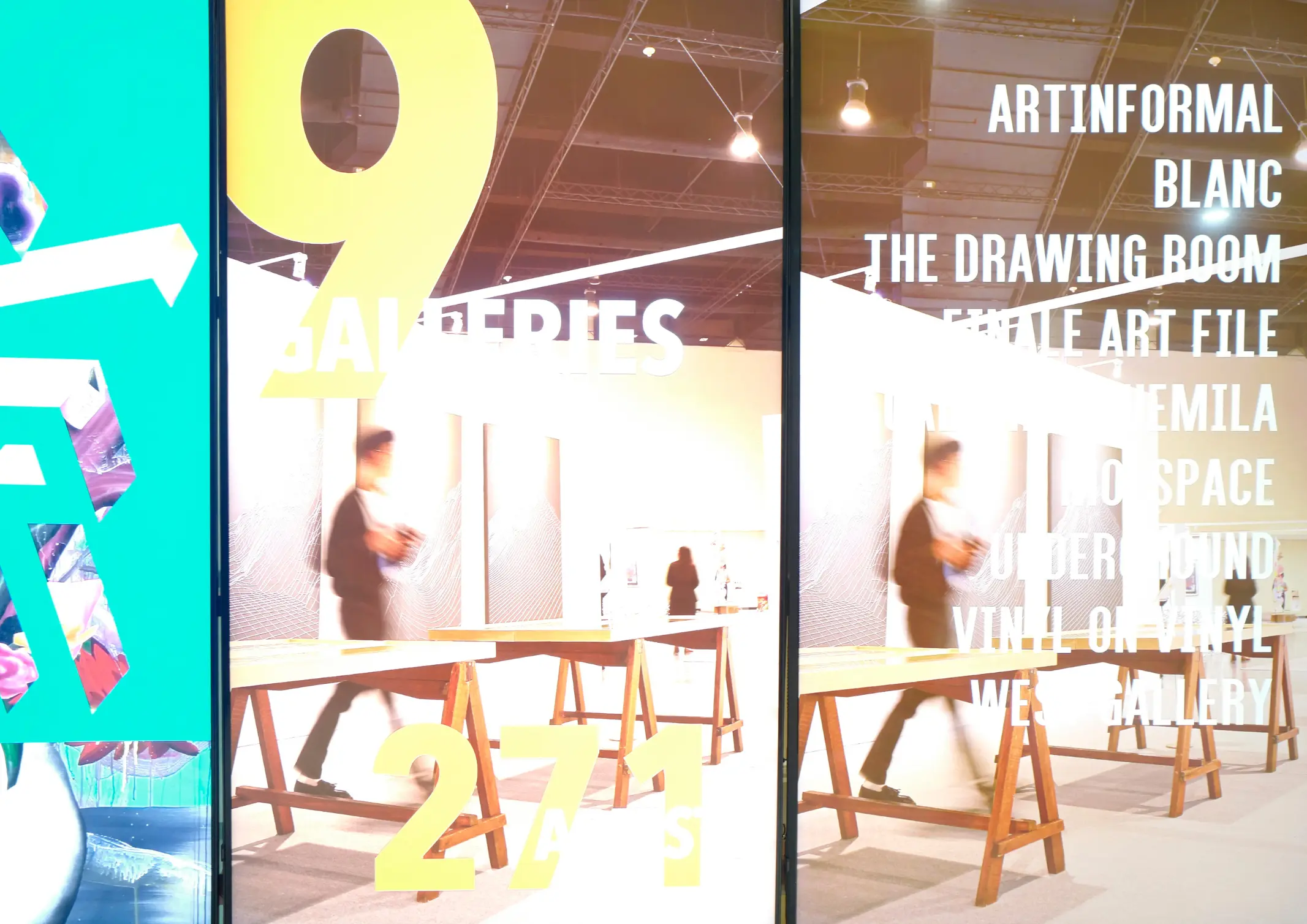
Exhibition designer Baby Imperial of All At Once shaped the spatial strategy of ALT ART 2026, its largest edition to date. The fair occupied Halls 1 and 2 of SMX Convention Center Manila, expanding in both footprint and ambition. Organized by the ALT Collective—Artinformal, Blanc, The Drawing Room, Galleria Duemila, Finale Art File, MO_Space, Underground, […]
Download this month's BLUPRINT magazine digital copy from: