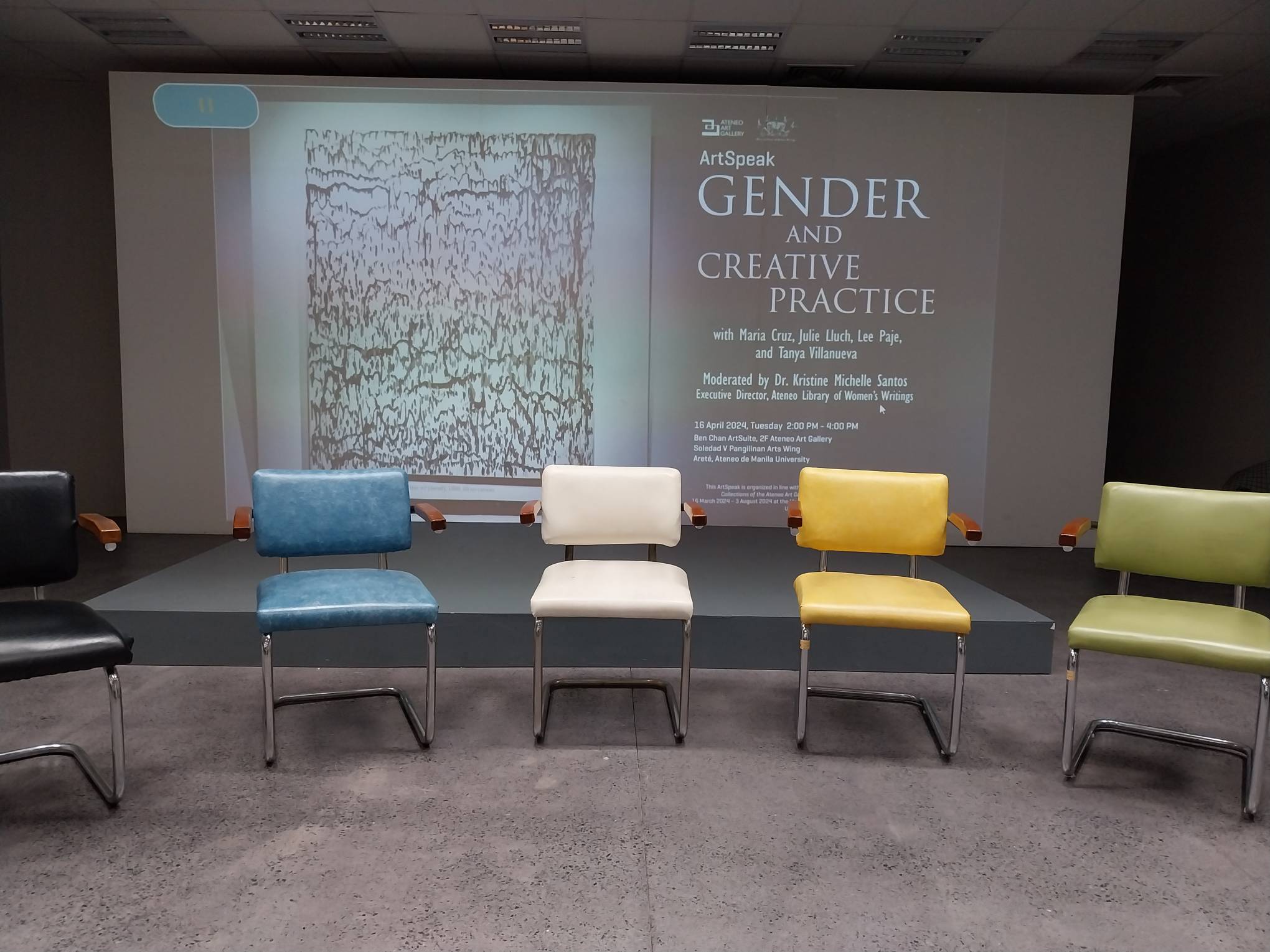
Gender and Creative Practice is a recent ArtSpeak discussion arranged by the Ateneo Art Gallery and the Ateneo Library of Women’s Writing (ALIWW). The exhibit was planned to be a way to complement the Matrix II exhibit which BluPrint covered in March.
The talk involves four artists whose work was featured in the Matrix II exhibit: Lee Paje, Julie Lluch, Maria Cruz, and Tanya Villanueva. Moderated by Dr. Kristine Michelle Santos from ALIWW, the forum centers on how gender affects an artist’s ability to create art.
The Label ‘Female Artist’
Off the bat, Lluch called out the necessity of labeling artists based on one’s gender.
Advertisement
“I have thought of how ludicrous it is if the same question was asked of a male artist. How would [a male artist] answer if an interviewer asks them, ‘sir, could you tell us what challenges and advantages you have encountered in your practice as men artists?’ They would just laugh and dismiss it as a prank,” she said.
Despite this, she sees why it is still being discussed even today: opportunities for women remain small. The gender-related questions continue to come alongside questions of class, religion, and race. “In the absence or deterred of women’s art is a resolve or a lack of opportunity but certainly not a lack of talent among the women’s artist,” she said.
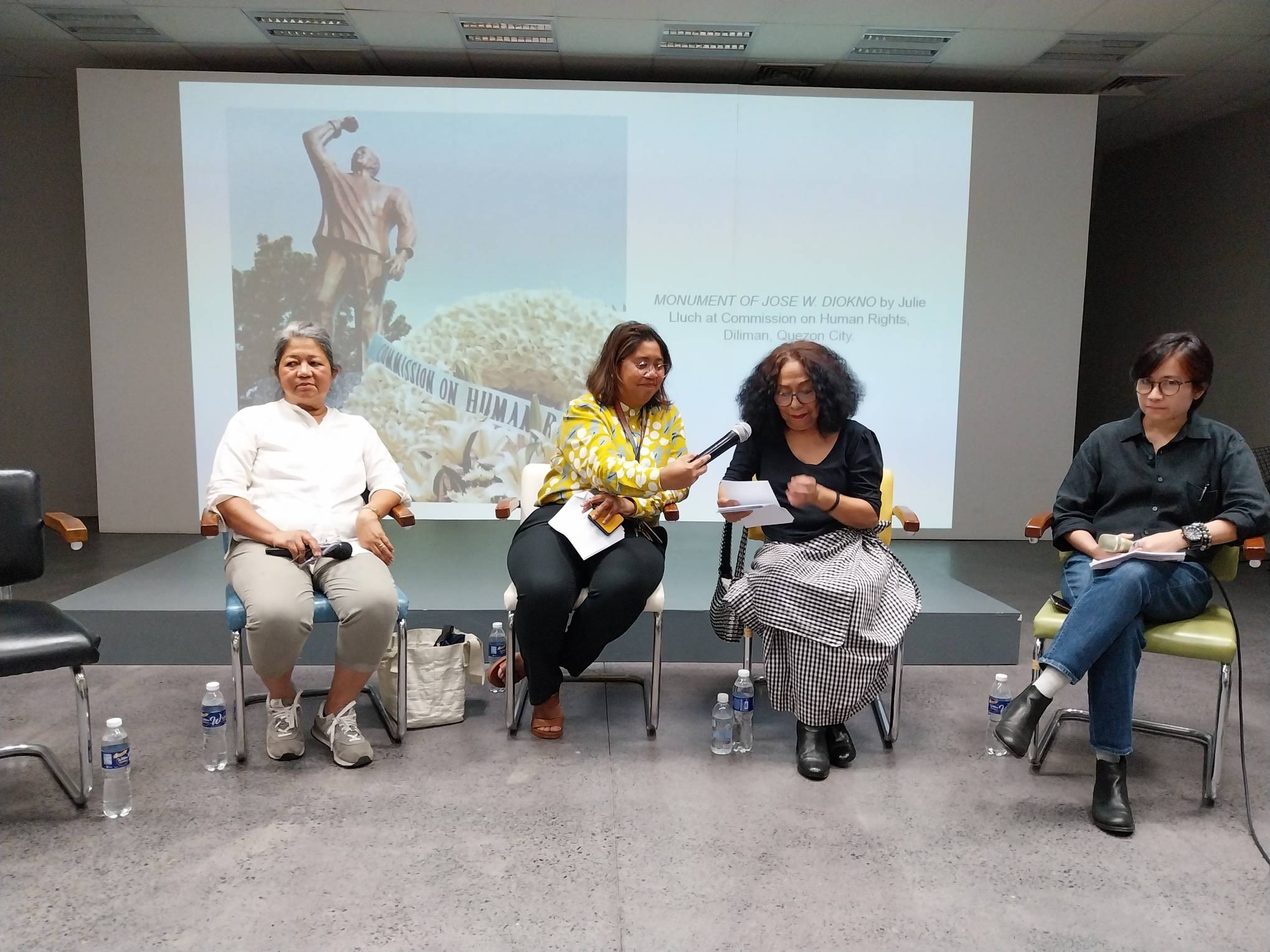
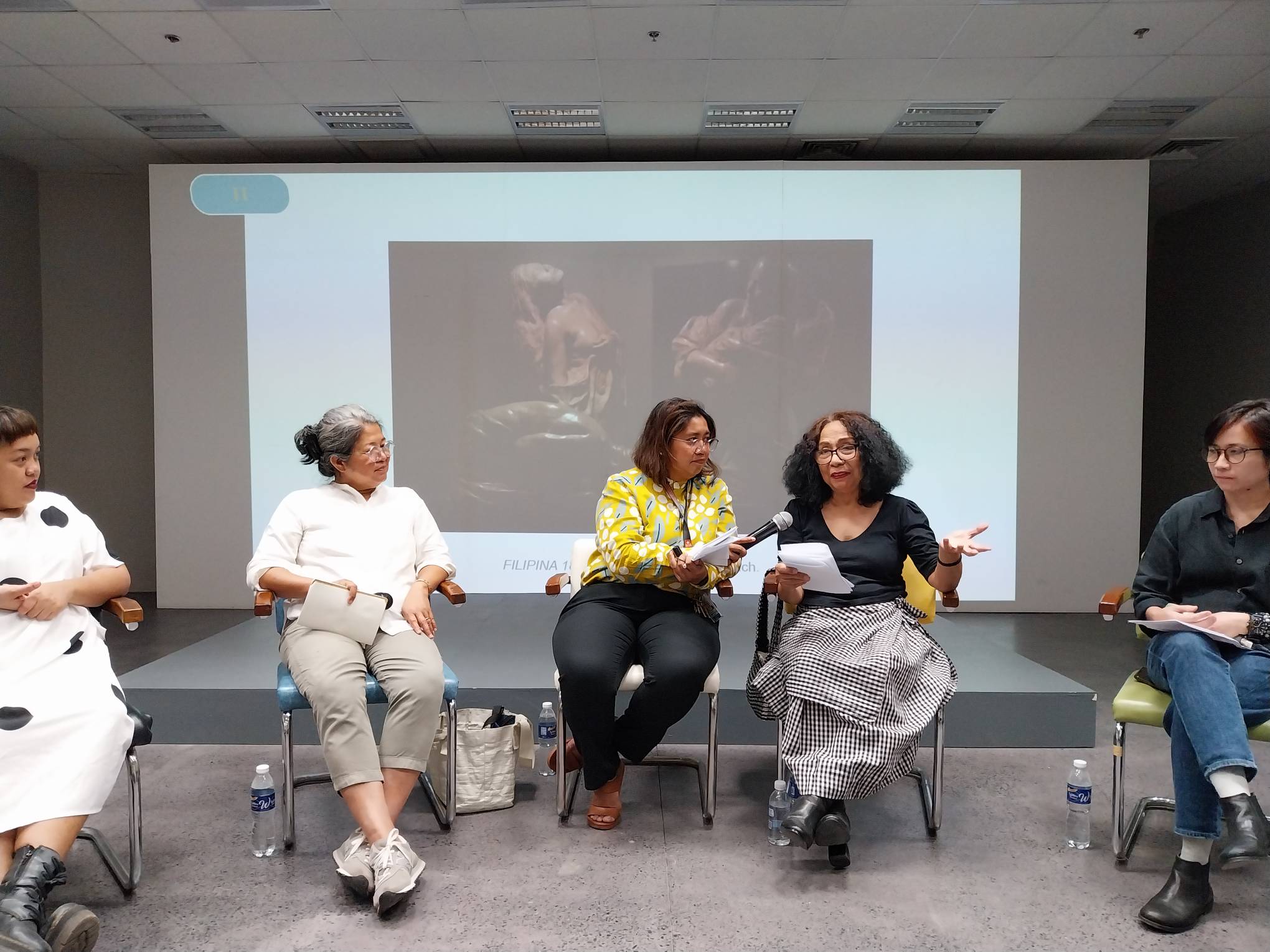
(from left) Maria Cruz, Kristine Michelle Santos. Julie Lluch, and Lee Paje during “Gender and Creative Practices.” Photo by Elle Yap.
An unapologetic feminist since the 1970s, Lluch wants women to push away from their “dependence on men,” and pointed to how she created her own sculptures in a way that affirms the female gaze.
Advertisement
“In response to this kind of art making, the objectification of women in painting, I would do an experimental job. I set out to demonstrate how an artist would properly do and portray a female nude without objectifying it. The result was a terracotta piece I did titled ‘The Thinking Nude.’ I also titled it ‘Self-hood.’ This nude, which I did, looks at herself or examines herself in the mirror in front of her and the relationship is between her and her reflection in the mirror as they look into each other’s eyes. Parang nabuhay, ano. This nude is intelligent and it has a life and a mind of its own.”
Fighting Societal Prejudice
The discussion veered into multiple different directions from there, as the generations of women assembled discussed how they were able to overcome society’s tendency to marginalize women as a way of creating their own artworks.
Lee Paje, who identified herself as a queer woman during the discussions, said that she has had to deal with the deep entrenchment of anti-women and anti-queer sentiments in the art world. During the discussion, Paje described her defiant push towards equality in her art, especially seen in some of her work.
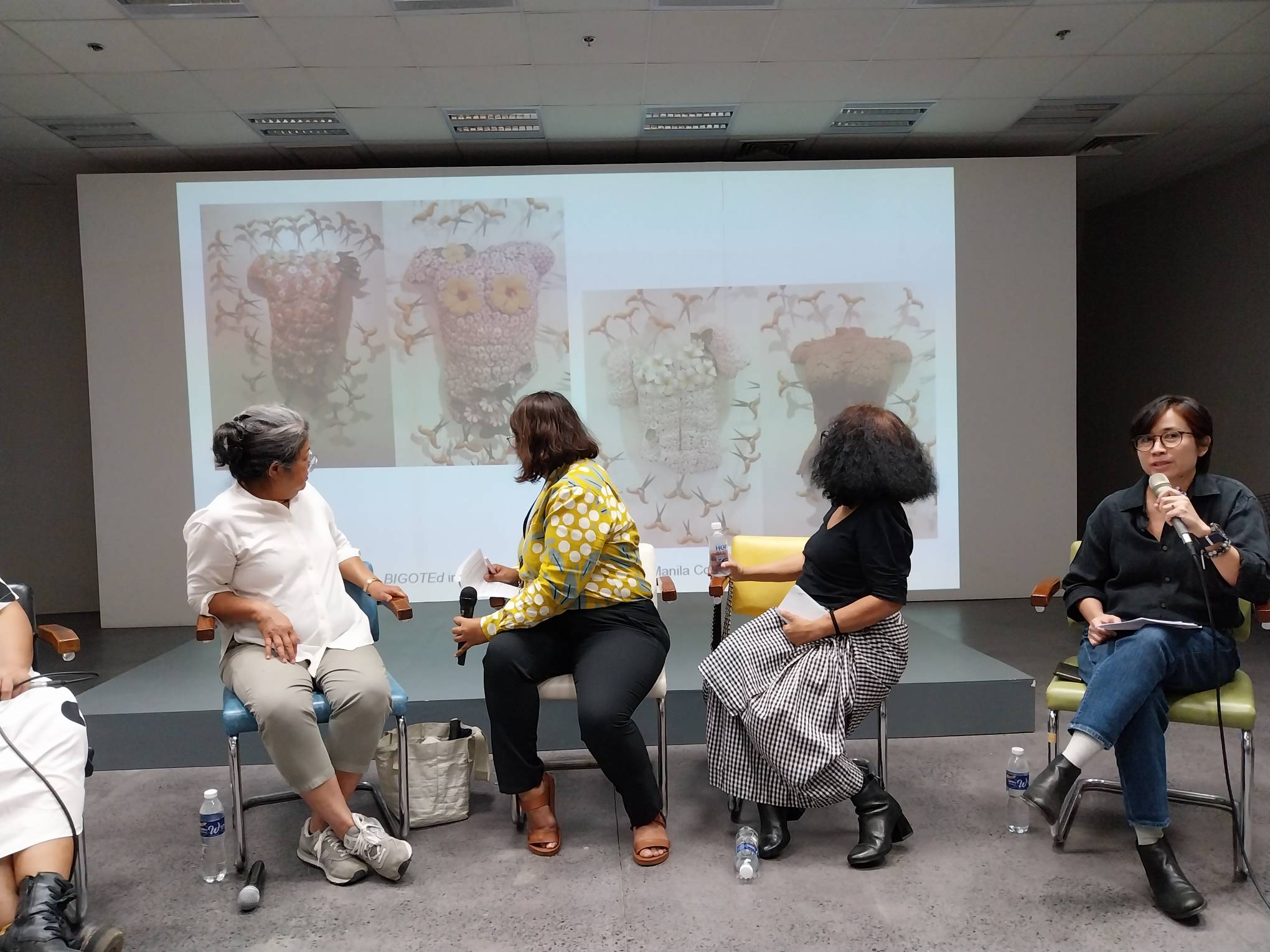
(from left) Maria Cruz, Kristine Michelle Santos. Julie Lluch, and Lee Paje during “Gender and Creative Practices.” Photo by Elle Yap.
Her exhibit in 2013 Bigoted, for example, played around with the image of a bigote due to a mustached Senator’s opposition to the SOGIE Equality bill at the time. She also had a project, Pagpamulak, in UP Diliman where she showed gendered body parts outside of the context of the body as a way of making a point that they were all just body parts.
Advertisement
Struggling Against Societal Standards
Despite whatever privilege any of the female artists had, many still had to struggle to be recognized by their peers. Maria Cruz detailed how she had to assert herself to her professors to enter the classes that she wanted.
Tanya Villanueva, meanwhile, found herself struggling against the patriarchal and colonial standards of our society. She found herself having a hard time making her art visible to the public due to the constraints of society.
And yet, even with how society marginalizes her, Villanueva says that her womanhood also gives her the strength to identify new areas for her art to flourish. “Women have an easier time subverting” because of their ability to move in between spaces, she said.
Advertisement
Support Systems and Communities for Artists
An interesting pivot to the discussion is the creation of communities for women artists. While Lluch was apprehensive about it (she prefers to work alone), this stands in contrast to Villanueva’s perspective of making sure women artists have platforms to work together. Paje, meanwhile, was more interested in the need for more artists residencies and grants for funding so that they can focus more on the work instead of earning money for projects.
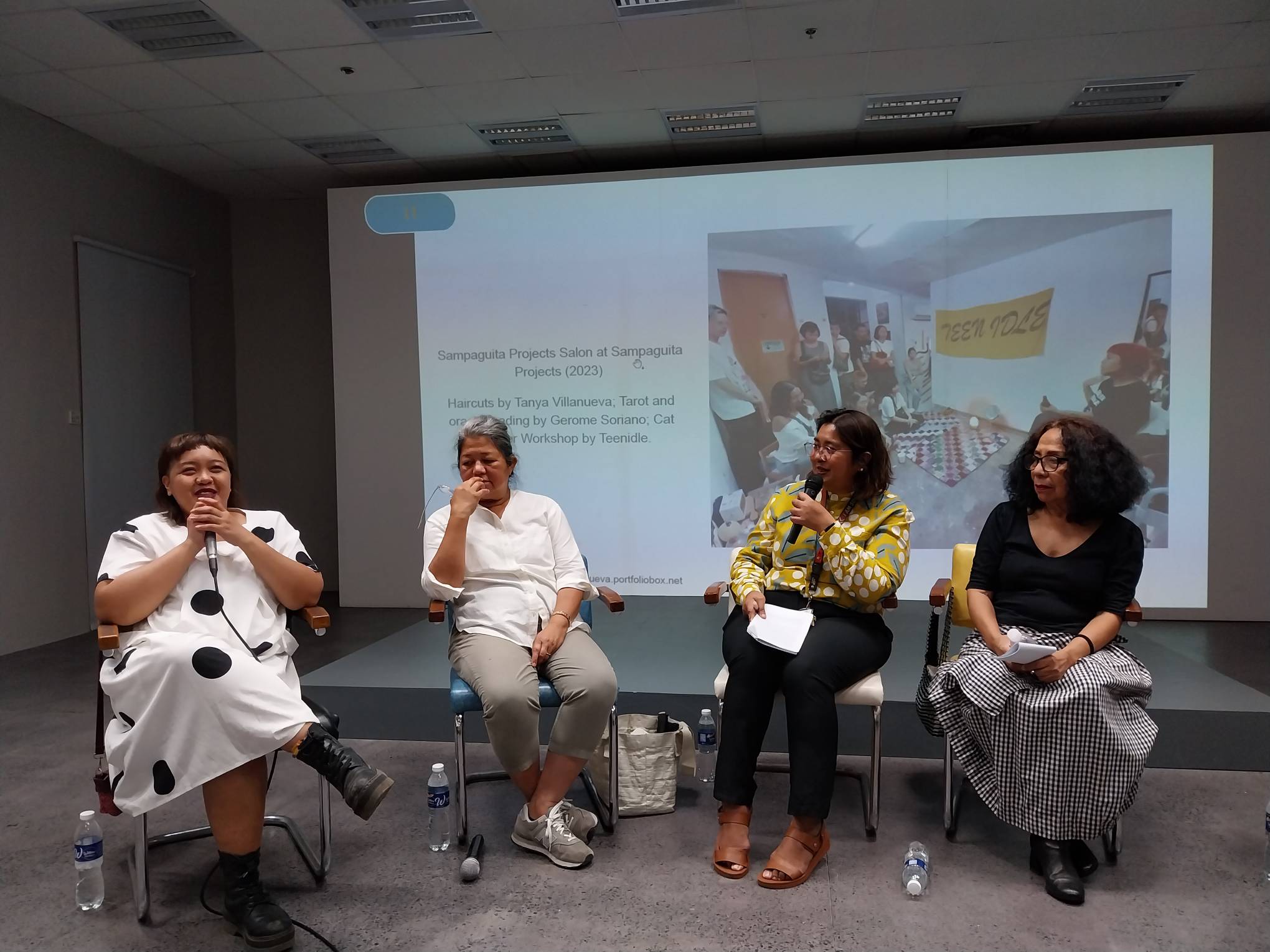
(from left) Tanya Villanueva, Maria Cruz, Kristine Michelle Santos, and Julie Lluch for “Gender and Creative Practice.” Photo by Elle Yap.
The idea of community as a necessity circulated for a while. Villanueva herself said that she built an art school salon as a more inclusive environment for people to learn art. This sprung from her inability to continue painting due to mental health reasons. Because of this, she found new ways to channel her creativity forward. She said that she studied hairdressing so that it could be a legitimate salon, and that she wants her project to explore the idea of beauty and beauty standards through this project.
Building communities is necessary for female artists. It is especially necessary as—Villanueva noted—elder artists misuse their influence to create unbalanced relationships with younger female artists. The need for community allows women to discover themselves inward, and helps them push forward to what they could do in the future.
Advertisement
The Androgynous Artist
(from left) Tanya Villanueva, Maria Cruz, Kristine Michelle Santos, Julie Lluch, and Lee Paje. Photo by Elle Yap.
Forum talks like Gender and Creative Practice are essential because they dissect art to its most basic parts. These discussions also show how complications arise from progress and how we can move forward from them. Julie Lluch noted during the forum the Virginia Woolf quote, “Great minds are androgynous.” As society continues to talk about the gendering of art, the hope is for all female artists to one day be seen on the same ground as male artists by art critics, historians, and appreciators all the same.
Denise de Castro, Principal Architect of DEQA Design Collaborative, believes that designing with equity in mind means starting at the workplace. Values and practices that your studio or office espouse inevitably filter down to the work that you do. Equitable design ensures that people with different needs and different backgrounds are supported through fair access, […]
Across Metro Manila, residential developments are increasingly designed around proximity. As cities grow denser and mobility becomes more complex, new housing is often positioned near transport nodes, commercial districts, and educational institutions. This approach reflects a broader shift in urban planning. Mixed-use environments allow residents to live closer to daily necessities—reducing commute times while supporting […]
Luxury in design is undergoing a quiet shift. Where once luxury was measured primarily through visual opulence, today it is increasingly defined by responsibility—through the way spaces are built, the materials selected, and the impact those decisions leave behind. At the Philippine World Building and Construction Expo (WORLDBEX) 2026, this evolving definition of luxury takes […]
For more than nine decades, Fisher & Paykel has approached design with a simple but exacting belief: that the best living environments are those shaped by people, place, and purpose. Rooted in New Zealand and deeply attuned to island and coastal living, the brand’s philosophy centres on quiet performance, material honesty, and appliances that integrate […]
At Helm, dining unfolds as choreography. An open kitchen anchors the room, allowing guests to witness the precision behind its Michelin-starred fine dining menu. Designed by Kevin Nieves of Headroom, the 24-seat restaurant reflects that same discipline in its interior design. Tucked within Ayala Triangle Gardens in Makati, Helm brings together culinary recognition and architectural […]
Exhibition designer Baby Imperial of All At Once shaped the spatial strategy of ALT ART 2026, its largest edition to date. The fair occupied Halls 1 and 2 of SMX Convention Center Manila, expanding in both footprint and ambition. Organized by the ALT Collective—Artinformal, Blanc, The Drawing Room, Galleria Duemila, Finale Art File, MO_Space, Underground, […]
Download this month's BLUPRINT magazine digital copy from: