Culture in design does not always announce itself through a recognizable motif, material, or symbol. It can also be embedded in the relationships designers build, the knowledge they listen to, the materials they choose, and the decisions they make in response to communities and their environments. This distinction emerged throughout the 2026 International Design Conference […]
Unique Philippine Contemporary Art Exhibits Shown This 2025 So Far



With how Philippine contemporary art moves at the speed of light, it takes so much to create something that most people would not have seen before. And yet, the ingenuity of human imagination surprises anyways, escalating different ideas into novel executions that would otherwise escape most people’s minds.
The strangeness is the point; it calls attention to how eccentric our world is. In a time where social media demands homogeny, BluPrint highlights the art exhibits whose uniqueness exists in how they execute their subject matter.
‘Hair tied together, embodied we speak / Pinagtaling buhok, kinatawang bigkas’
This group exhibition at Calle Wright functions as a meditation on our colonial systems while presenting new ideas on creation and artistry that feels explicitly severed from those colonial systems themselves.
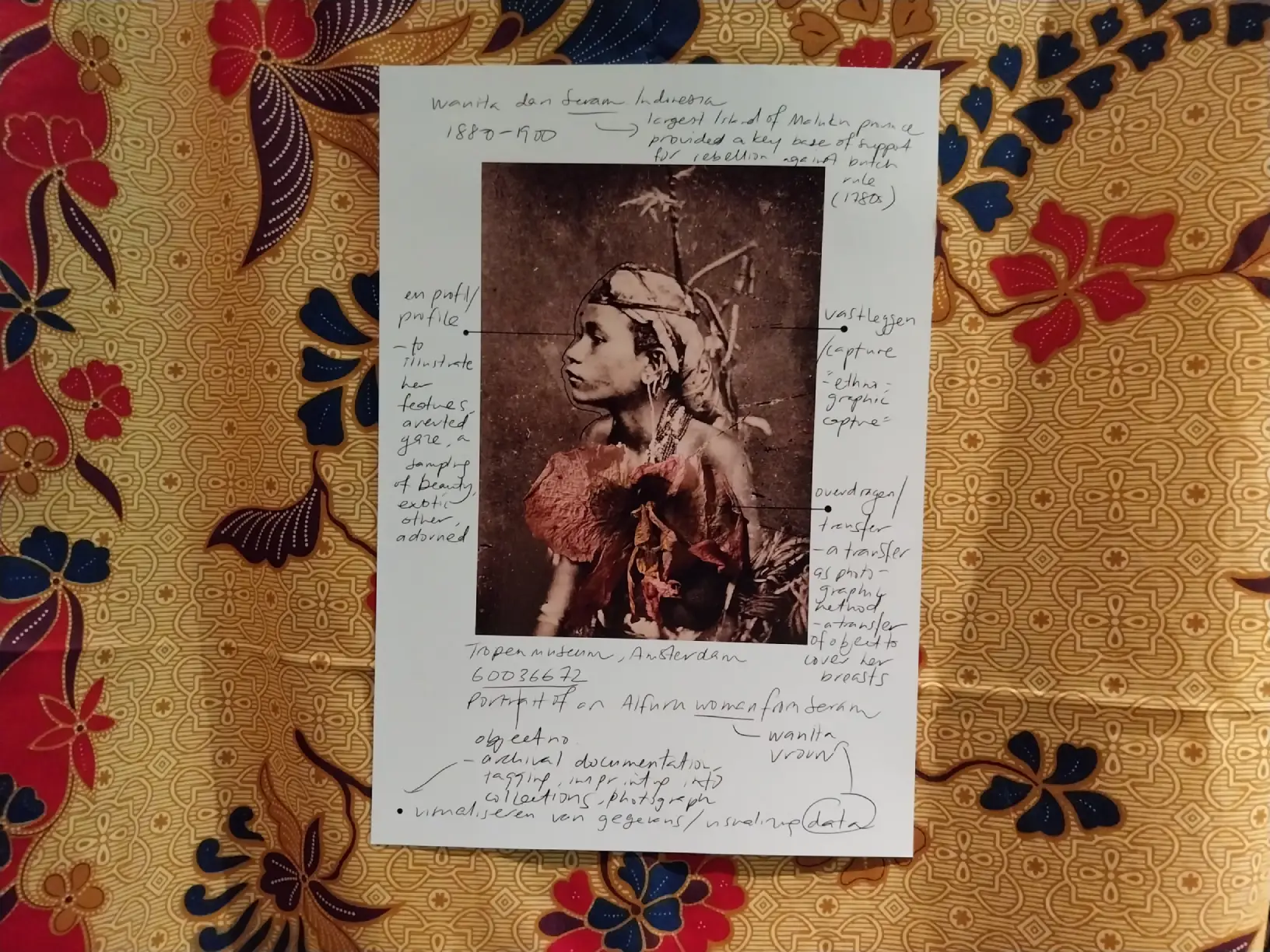
This exhibit contains an eclectic collection of Philippine contemporary art made from organic elements. There’s a rattanRattanA flexible, climbing palm native to tropical Asia, whose strong, lightweight canes are woven and bent into furniture, baskets, and lighting. The Philippines, especially Cebu, is renowned for rattan craftsmanship,Go to Rattan Glossary basket woven by Isola Tong, a large and thick abaca rope from Patricia Perez Eustaquio, and a batik fabric with archival and personal photographs pasted on it created by Nurul Huda Rashid.
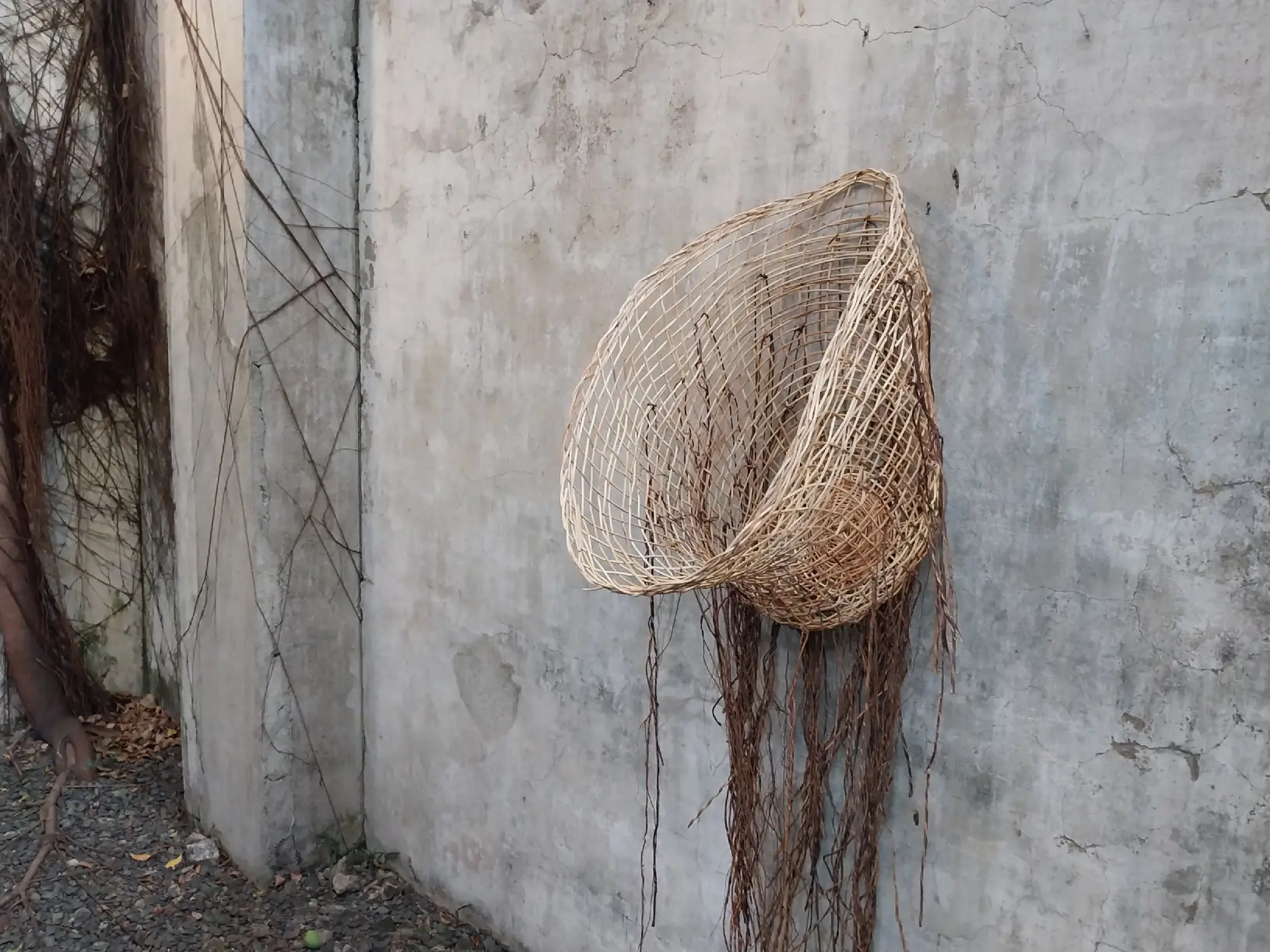
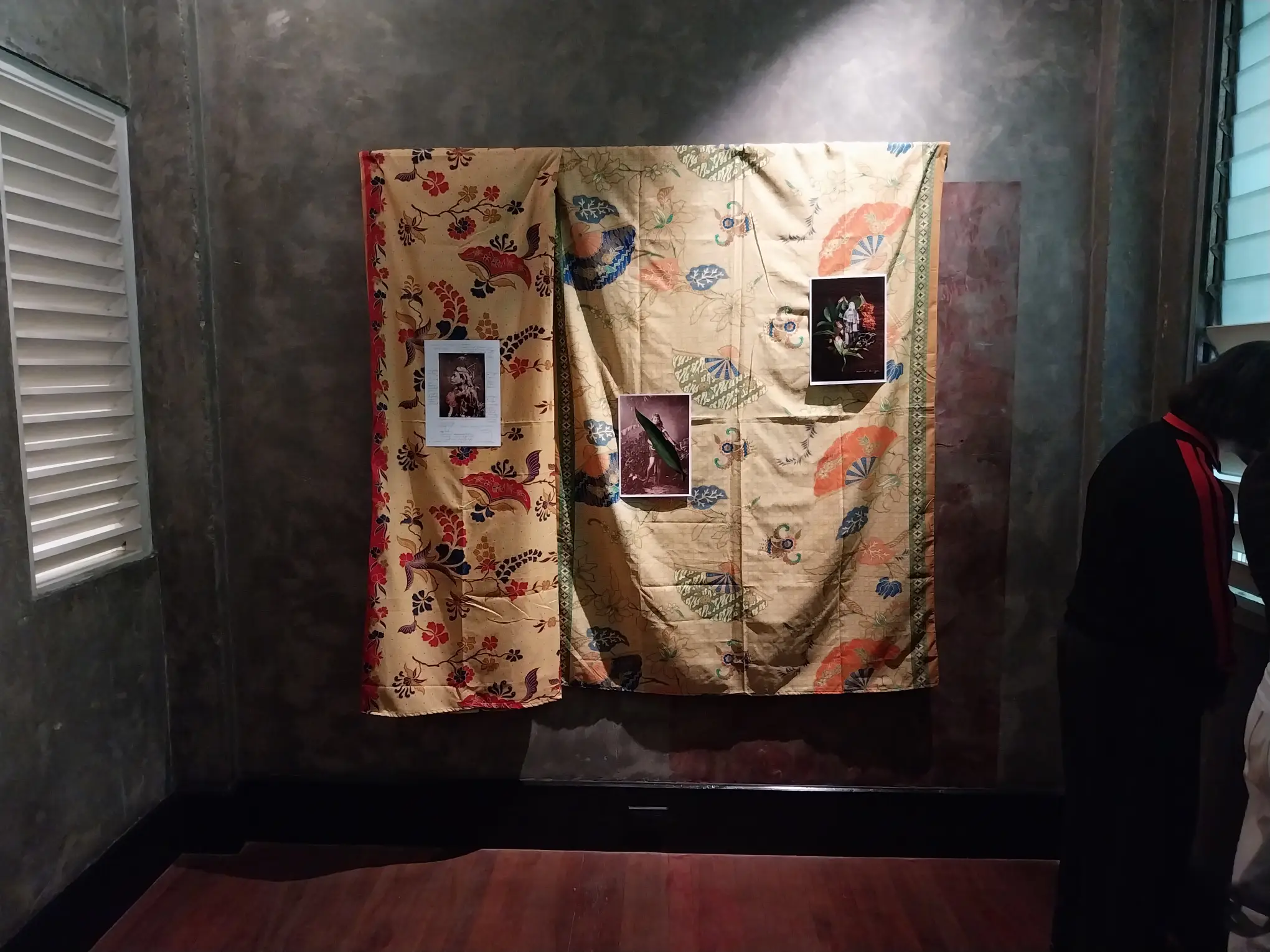
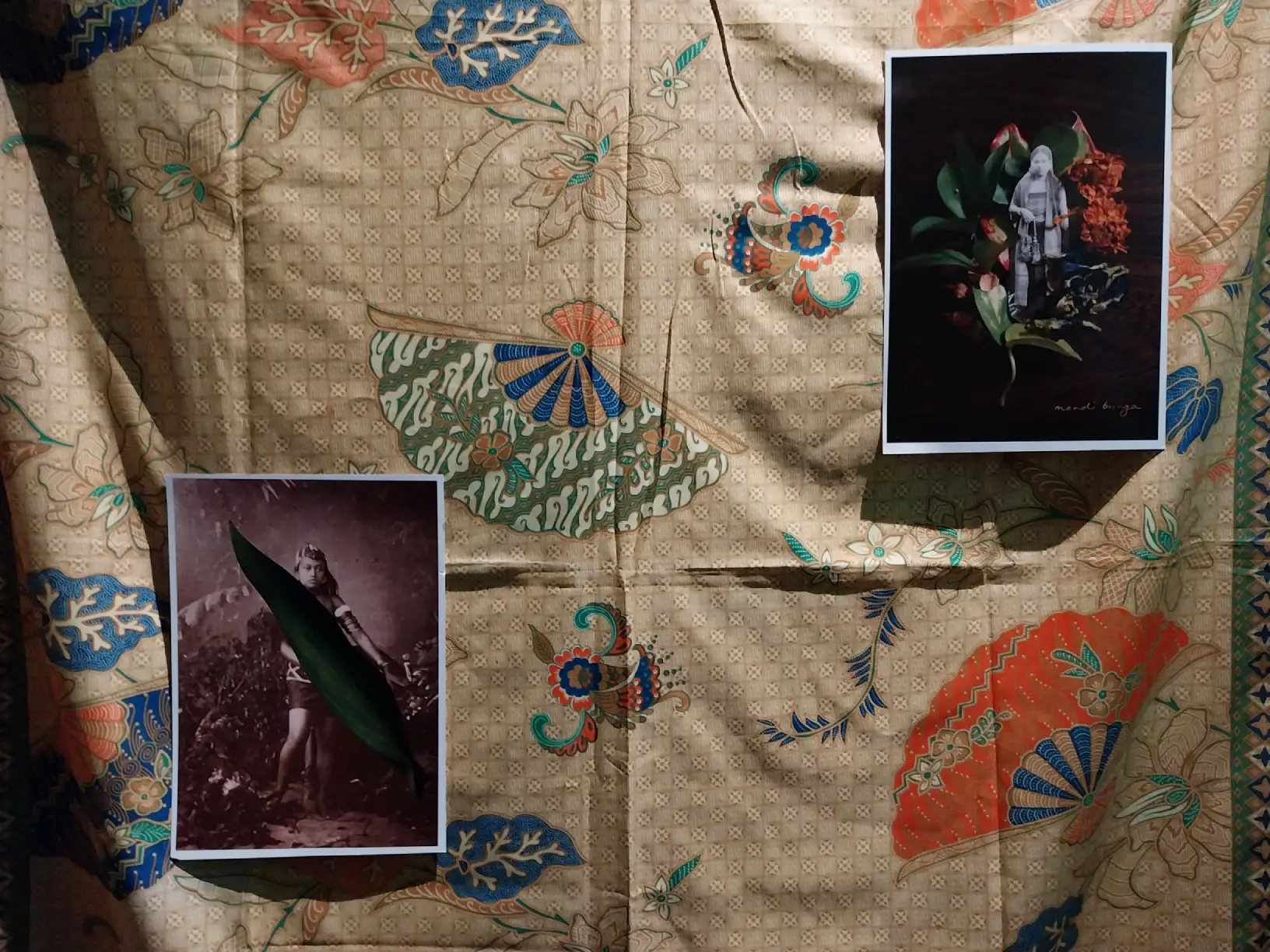
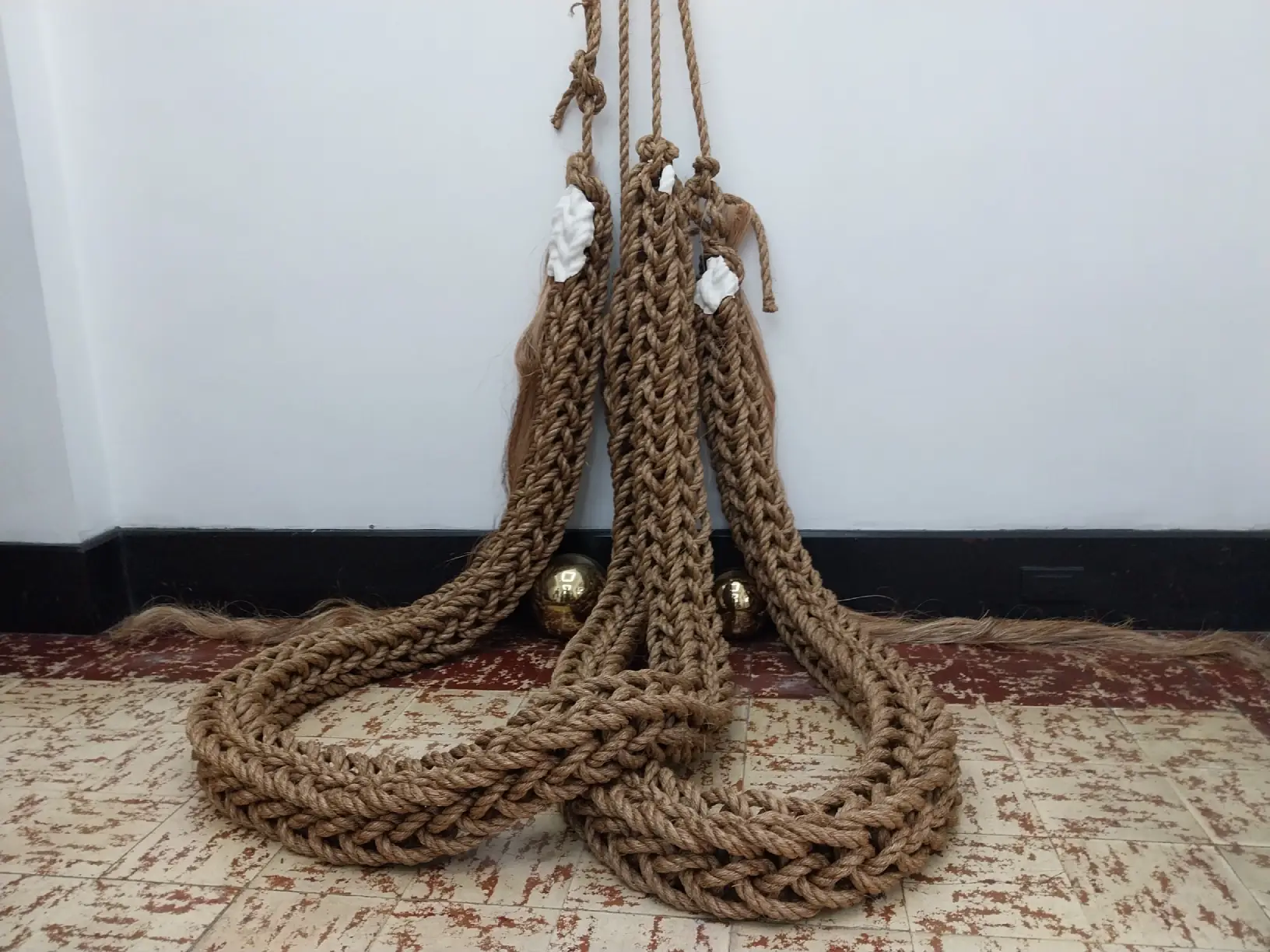
As a part of the thesis of exploring colonialism, the inclusion of these works allow for an examination of indigenous materials and its links towards art. In our industrial world, what does it mean to return to nature and tradition?
For artworks like Tong’s, the labor itself and the usage of compositions and materials from our ancestors connects us to them. By allowing themselves to work through that process, the artists and the audiences get an inkling of understanding of its meaning. It expands our mind to knowledge that wouldn’t be easily attainable had we stayed in our modern boxes.
Reformatting Archival Work into Personal Narratives
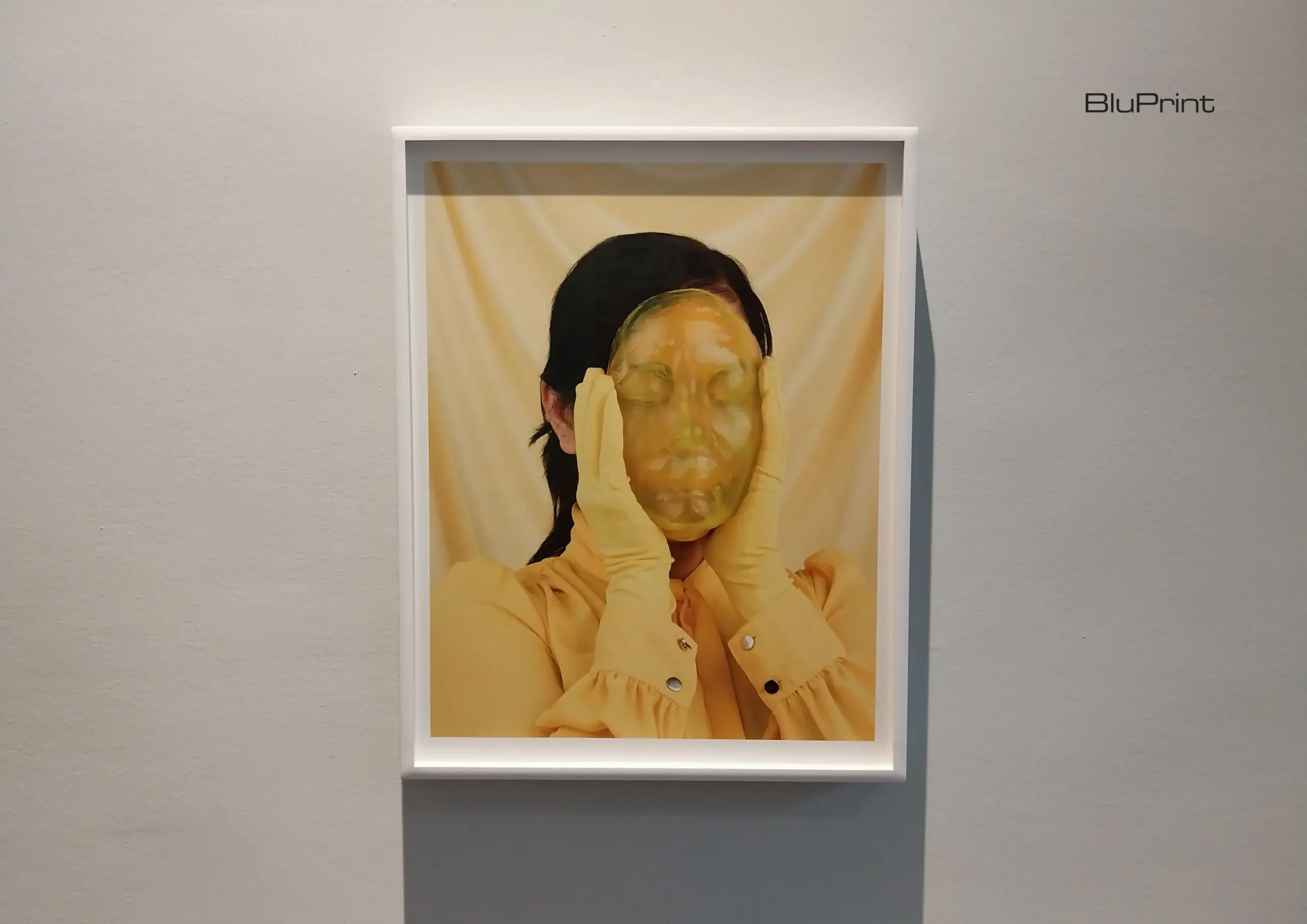
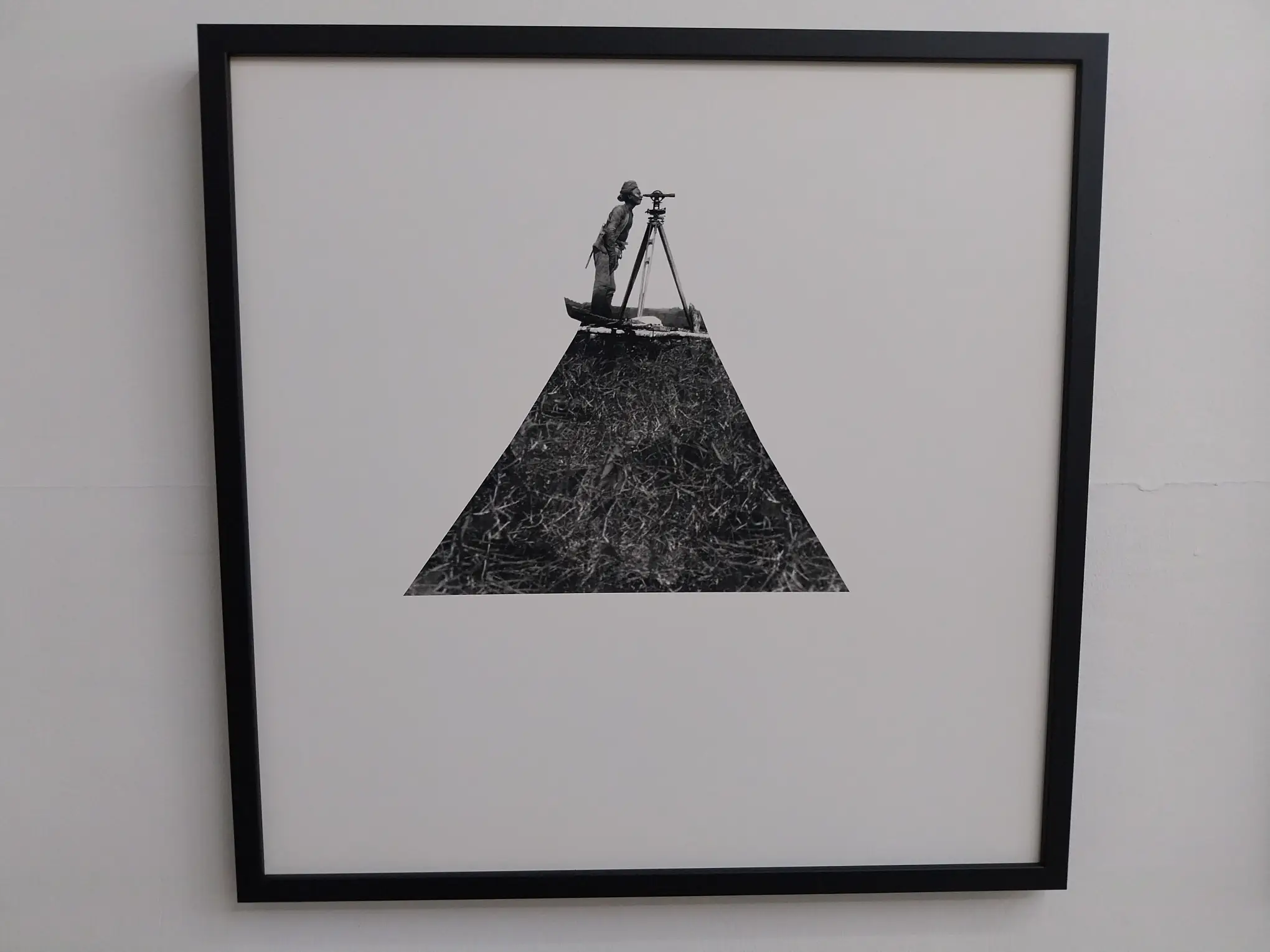
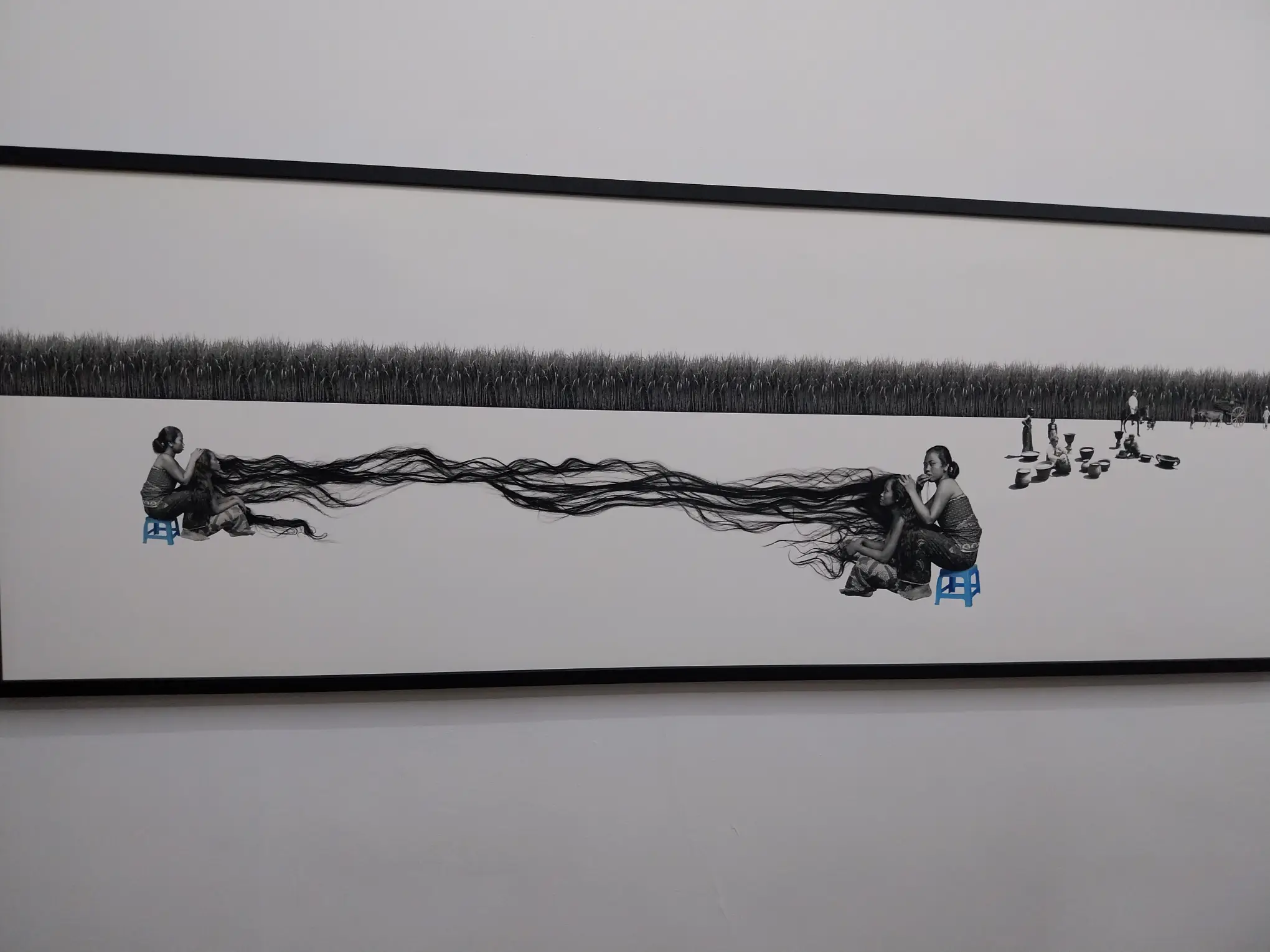
Beyond those more organic works, other methodologies explore the effects of colonialism within the realm of different mediums. For example, Yee I-Lann contributes two photographs of indigenous people during colonial times, composed to emphasize the imagery of hair. There’s a representation of conquest here, the fields of harvest and the hair creating parallel meanings of freedom found in practicing traditions of the tribal past.
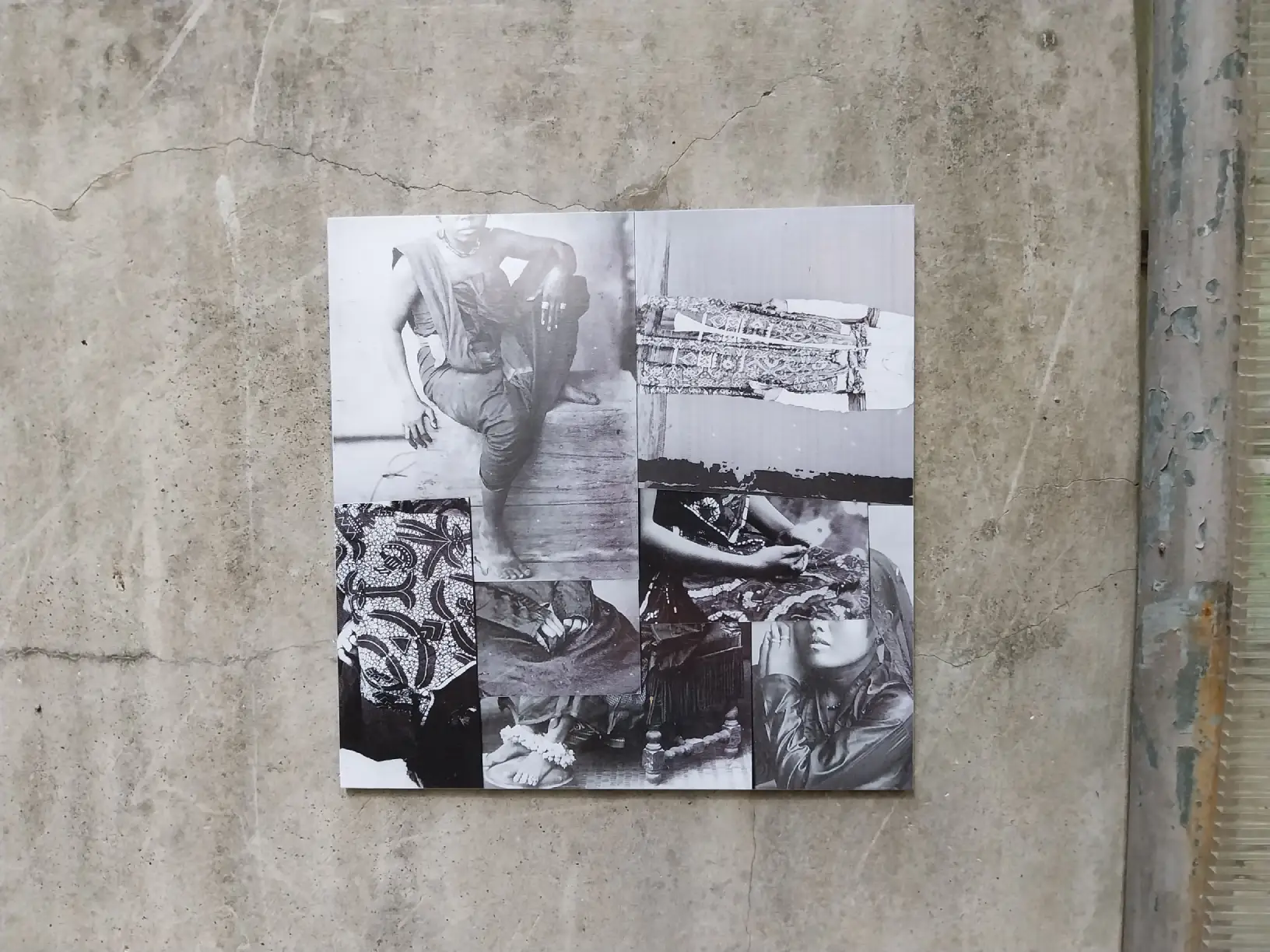
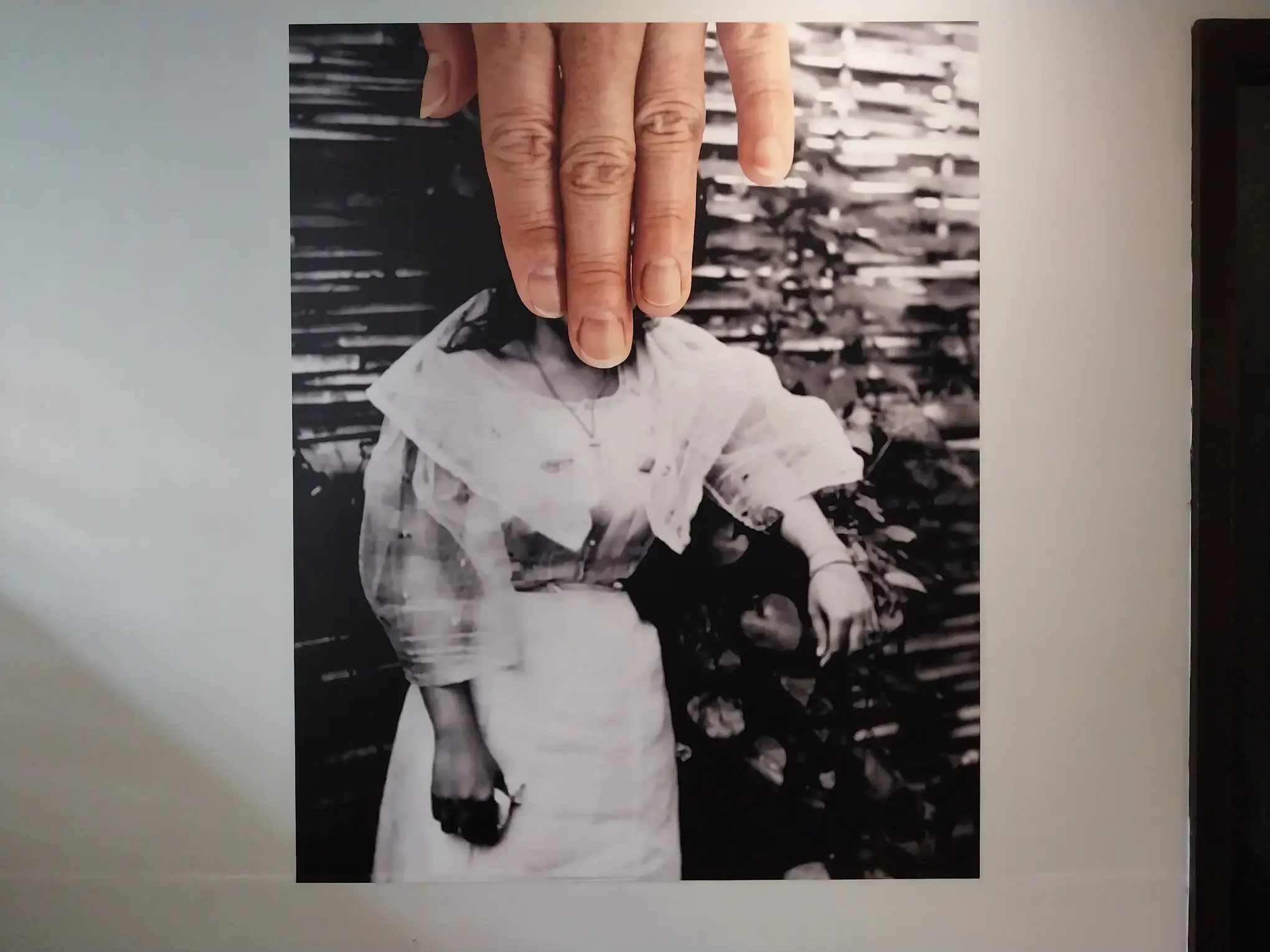
Combined with the fabricwork, Rashid also has a diptych of printed photographs with what appears to be journal writings, and an audio accompaniment of her journey through different foreign archives to document her past. It’s an interesting way of reckoning with what seemed to be a deleted history, only learning from the perspective of the colonizer what they wiped away.
“Each terrain and strategy shared in the exhibition are not discrete—artist methods, spaces, forms, voices of unbridled potential—artists writing their own contexts, narratives, and symbolic logic,” the exhibit write-up said.
‘furball ex machina | old farts, new shit’
Modeka Art’s group exhibit functions as a referendum to the technological age, a commentary on people’s reliance on automation by elder artists who have lived through shifting eras.
“furball presents new work, all in cathode-ray tube television sets,” the exhibit write-up said. “[It finds itself] raging against the planned obsolescence of our technologies, the ravages of middle age, and the comforts of a comfortable life making paintings instead.”
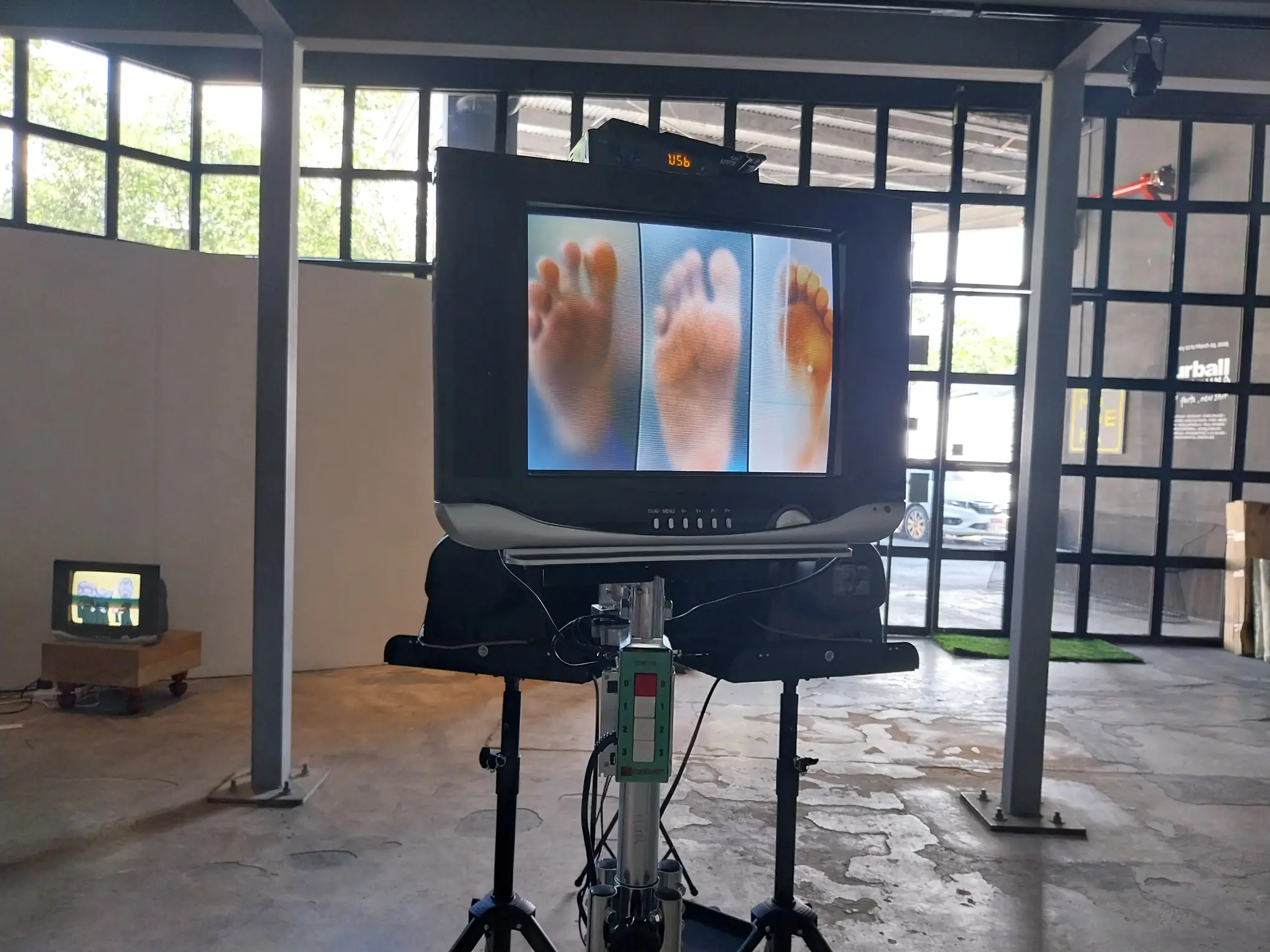
The group works adhere to an analysis of the past television age, finding inventive uses to craft the images in the exhibit. One work, for example, mimics a classroom during the elections, with the yellow ballot box containing a fuzzy television in it.
Cleverness and Adaptability
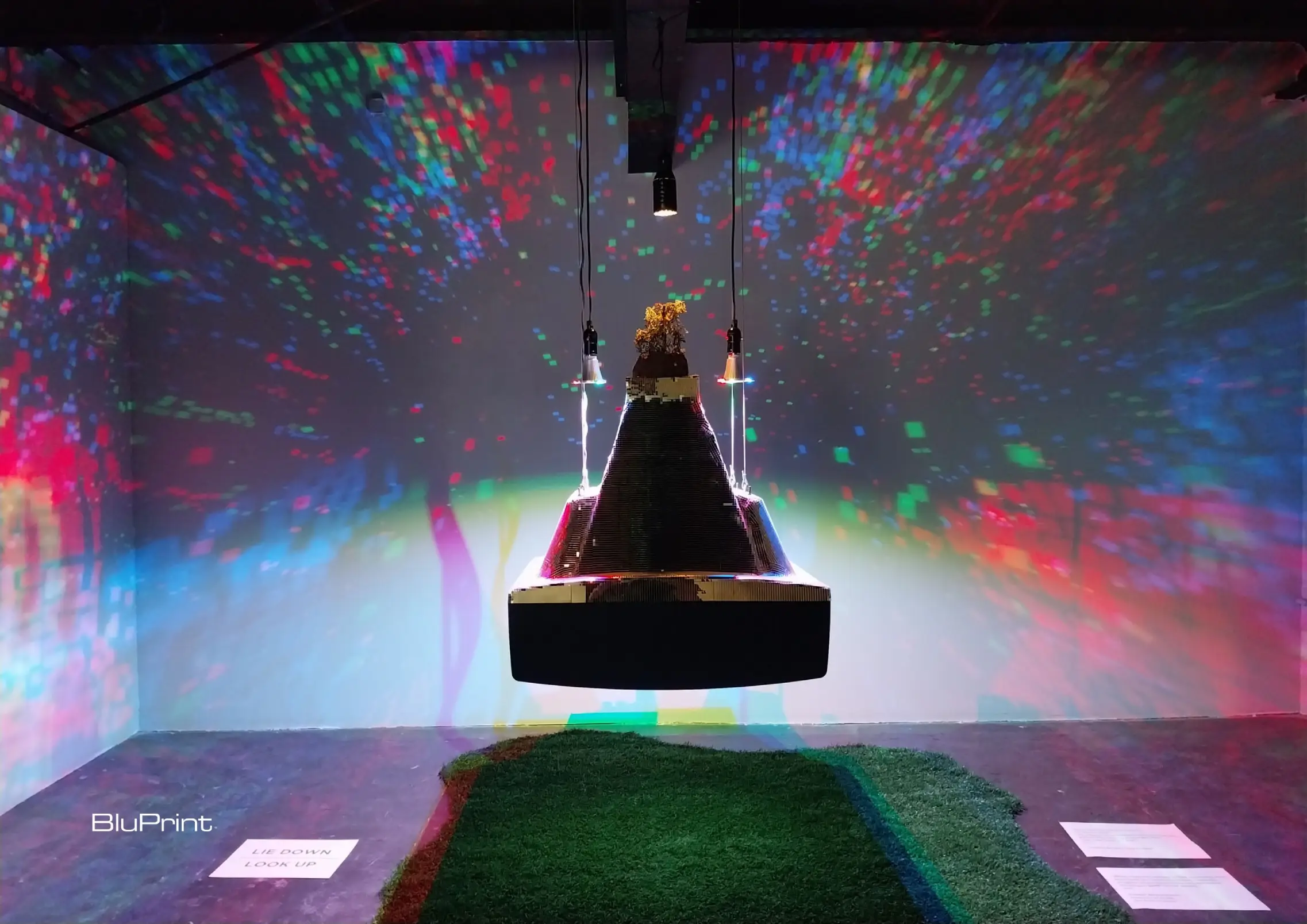
Another work has a wooden foot repeatedly and mechanically kicking an old CRT television. A different work has footage of feet on the screen while the television, attached to a jerry-rigged electric fan, spins around the exhibit. The most interactive work has you lying down in faux grass as you watch a screen above broadcast a strange assortment of images.
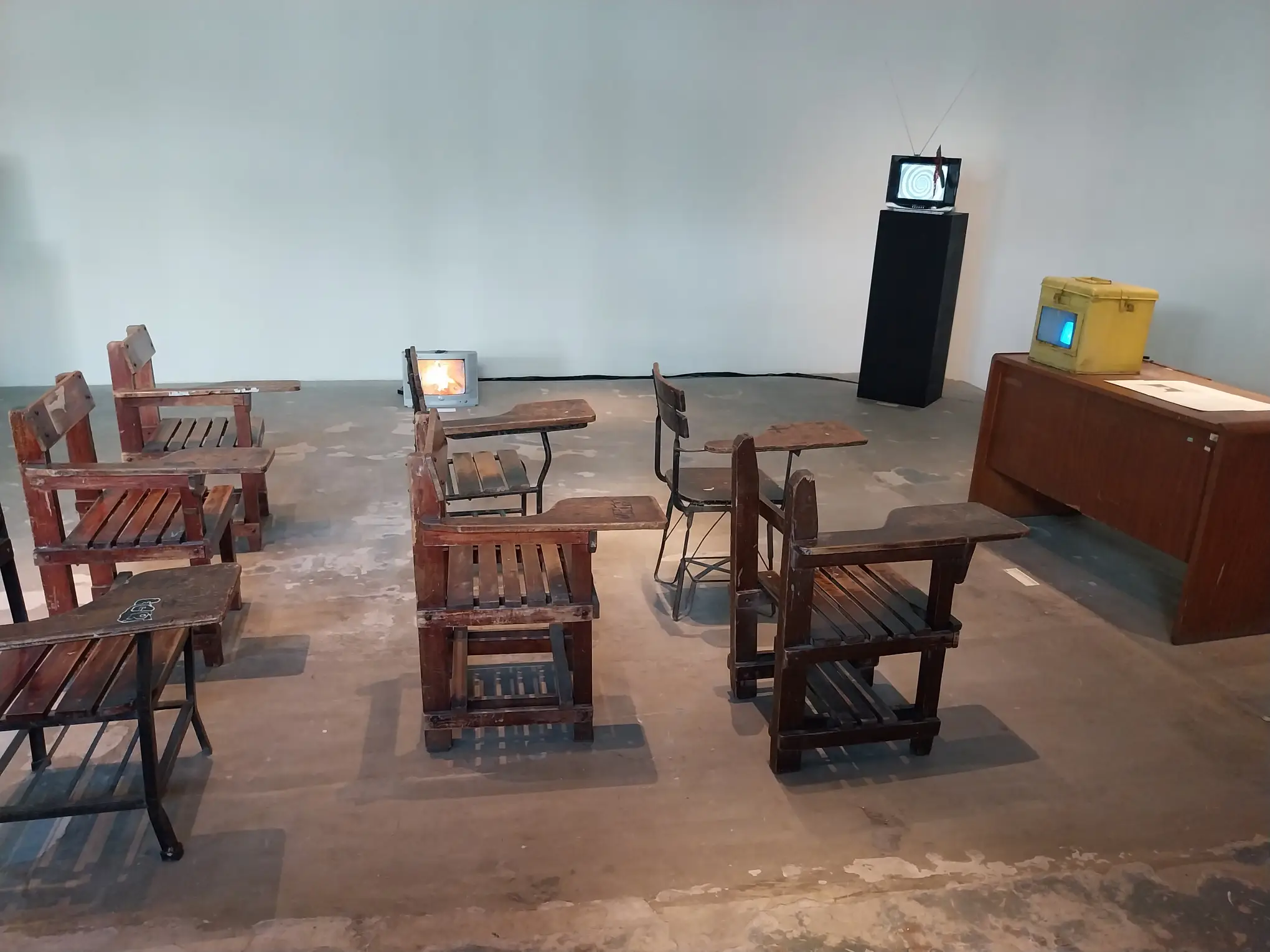
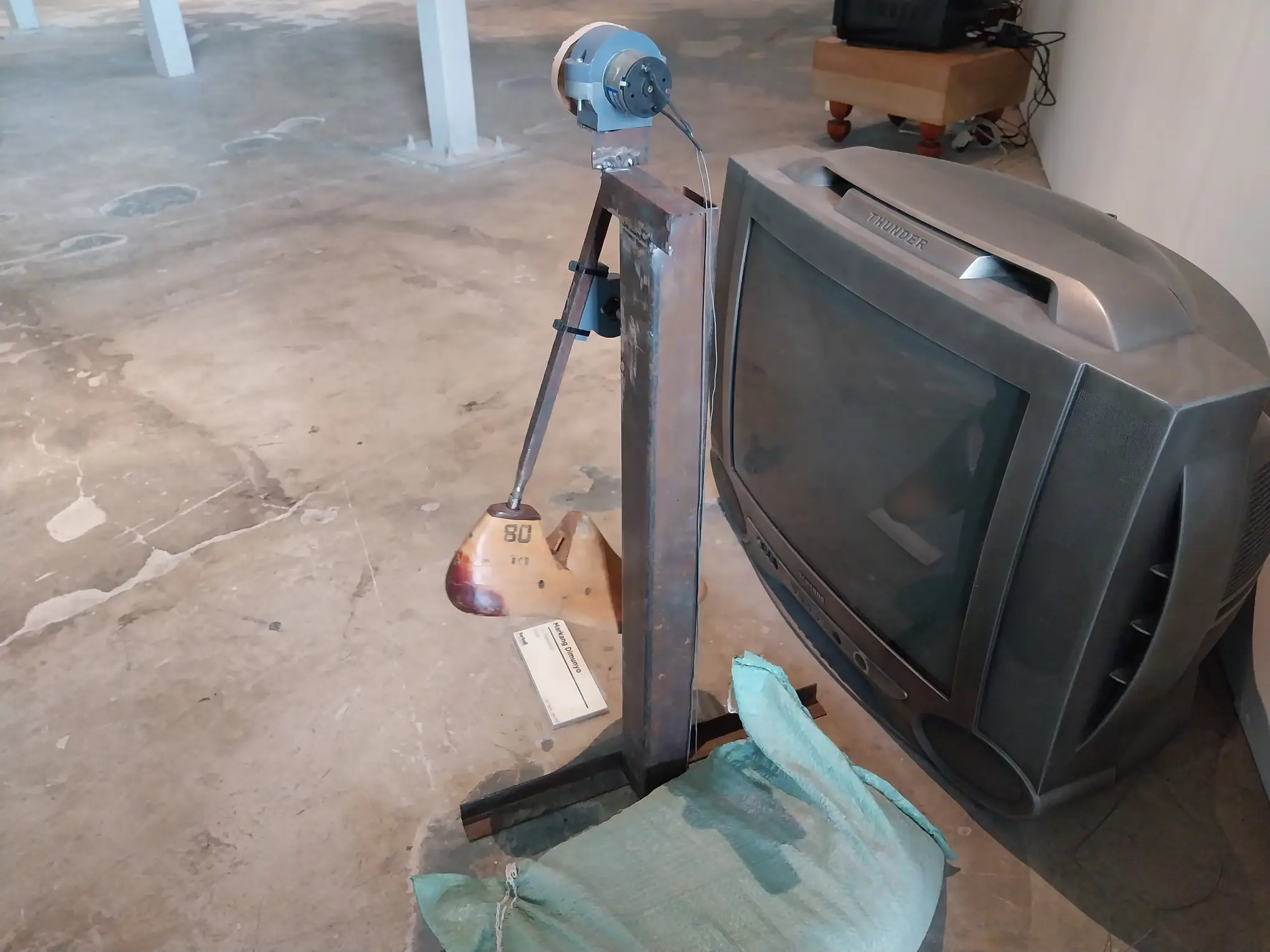
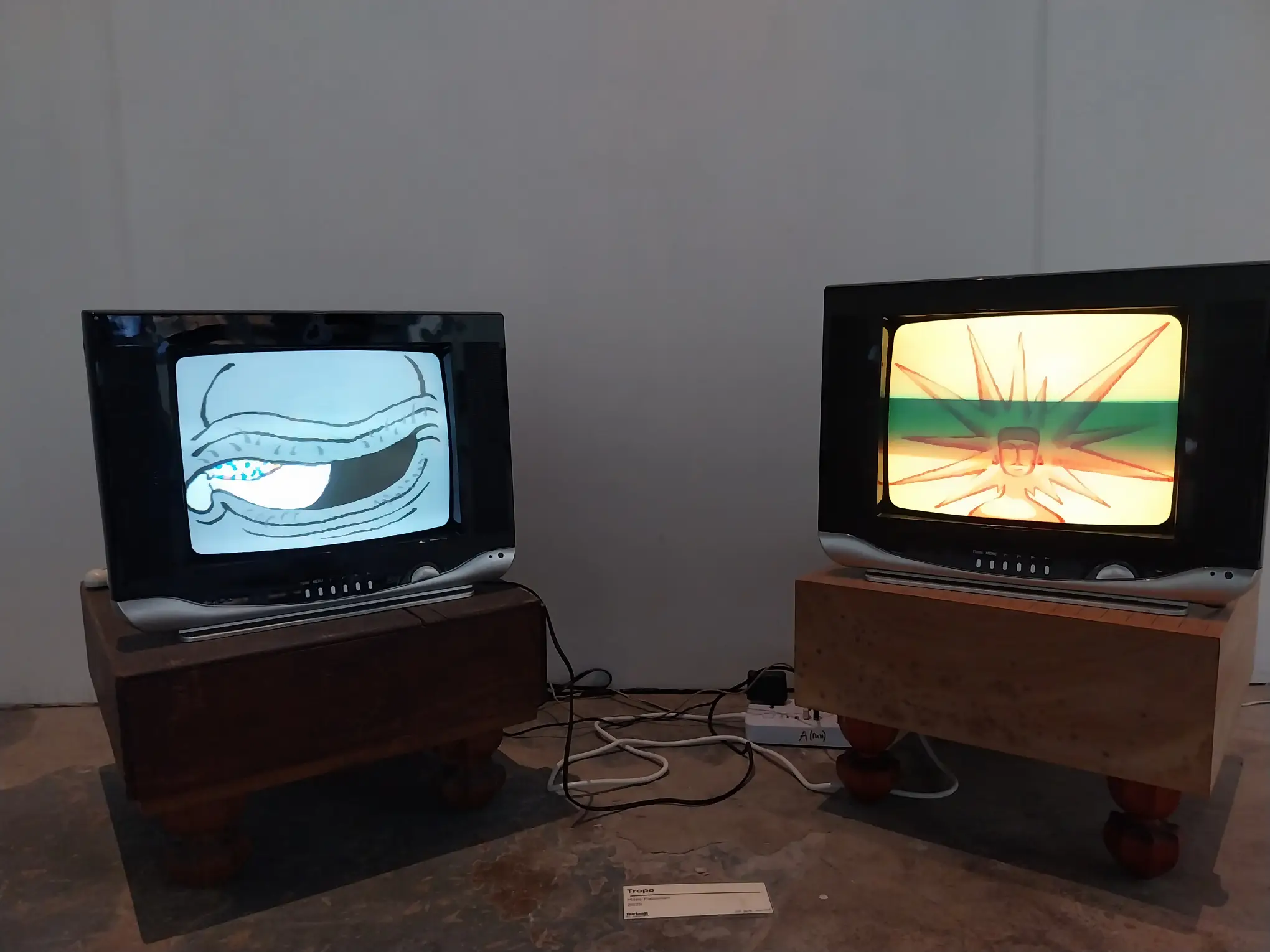
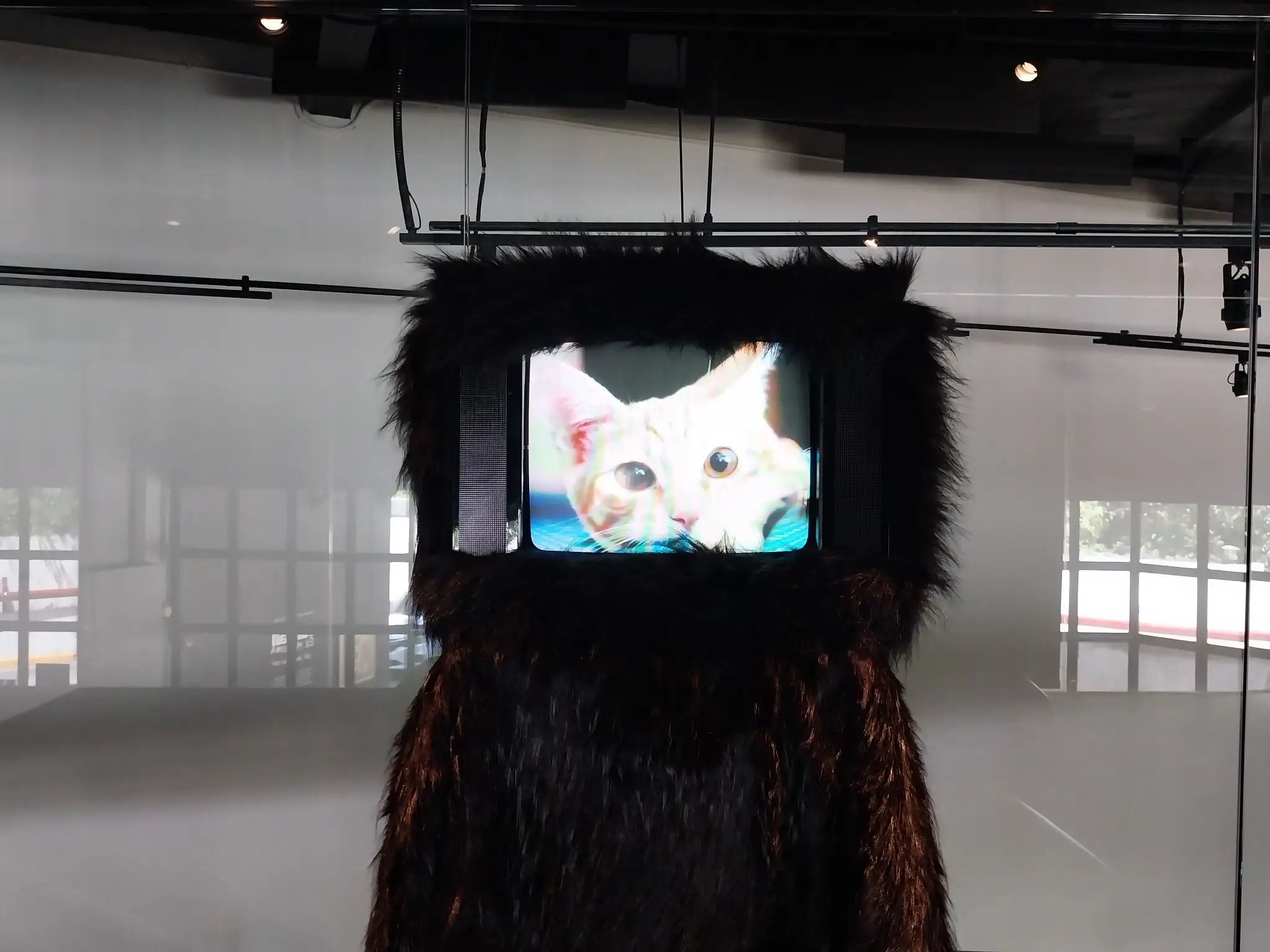
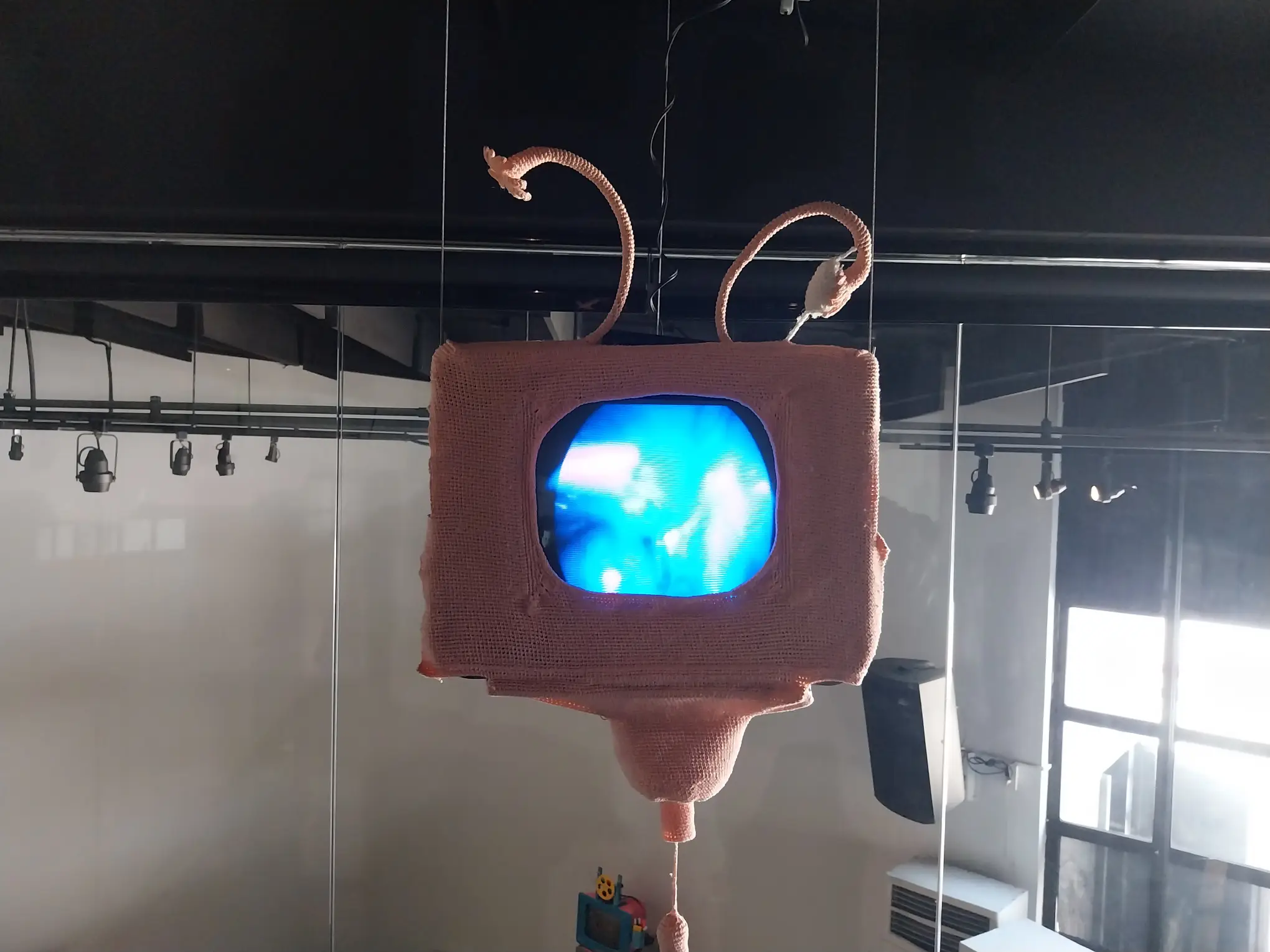
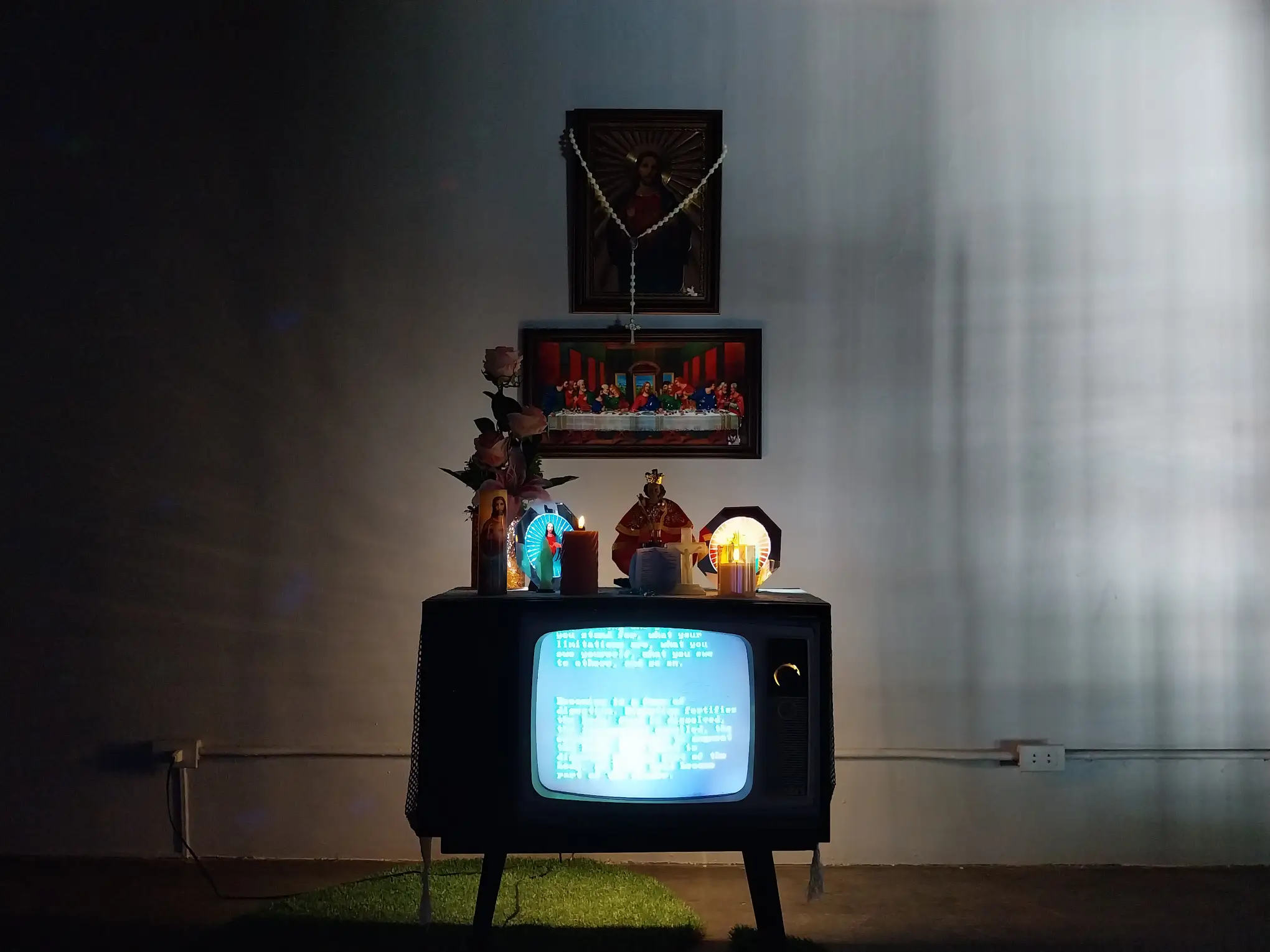
All of the works are clever and biting to our reliance on technology that will eventually become useless as we continue to evolve. But there’s also a sense of understanding that these “outmoded” televisions aren’t actually useless; they’re all still functional, we’ve all just moved on to shinier, faster technologies.
One comes away here thinking of how nothing is really outmoded or extinct. All technologies can still be useful, but only if we use it and maintain it still. And it works same as a metaphor for the artists: they may be up there in years, but they can still harness their skills for some interesting artworks and biting, witty commentary if they get the venue to do so.
‘Membranes’
For Nicole Coson, our world’s interconnectedness and the infrastructures that lie behind them complicate our lives. How does one see what is “local” and what is “foreign” when our global mechanisms have effectively blurred the lines of both through centuries of imperialism?
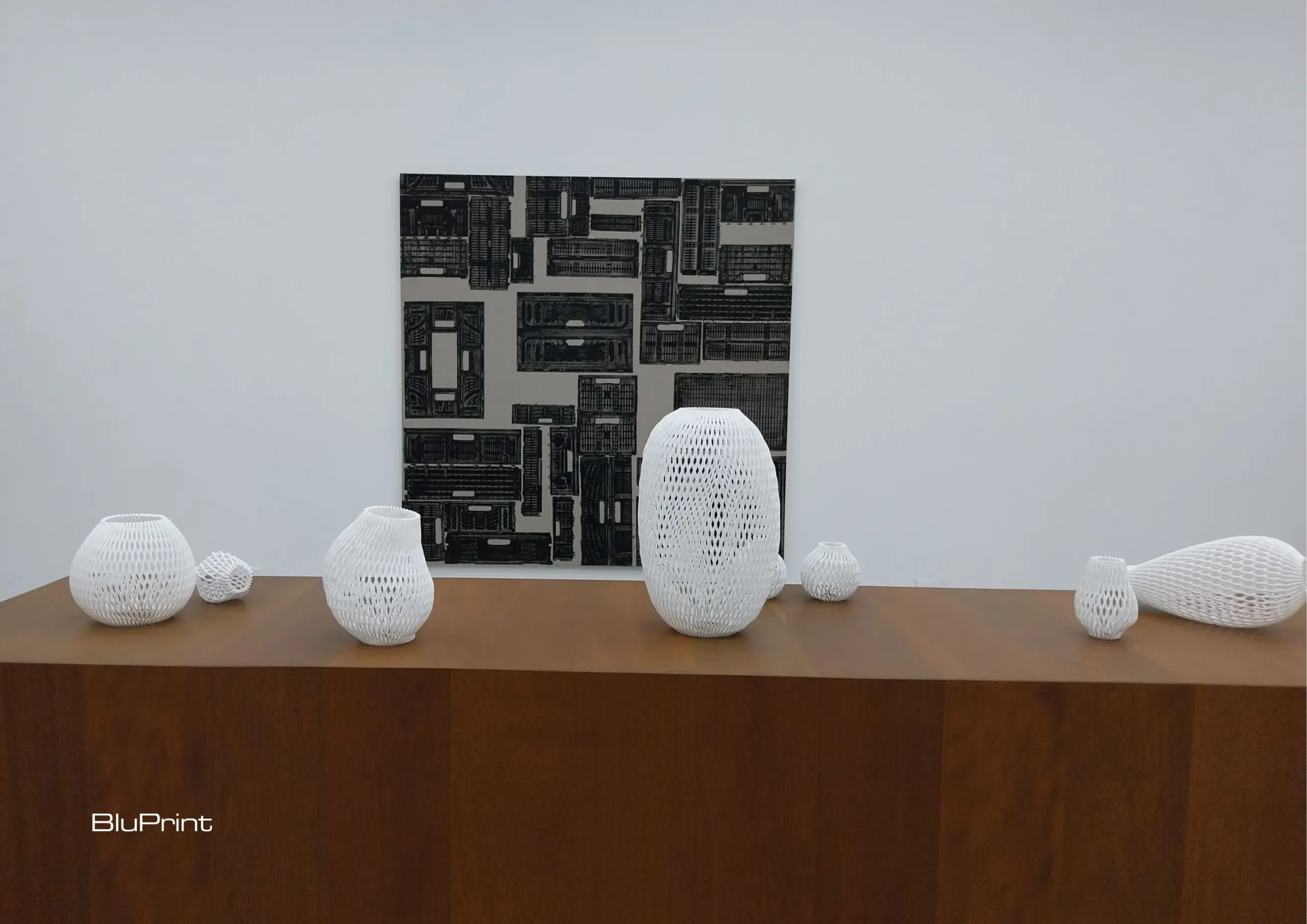
For this Silverlens exhibit, Coson uses styrofoam mesh casings to mold different fruits found in the Philippines like papaya, dragon fruit, and macopa as a representation of how colonizers take our resources, talents, and values to repackage them for their benefit, leaving us with a synthetic shell of who we are.
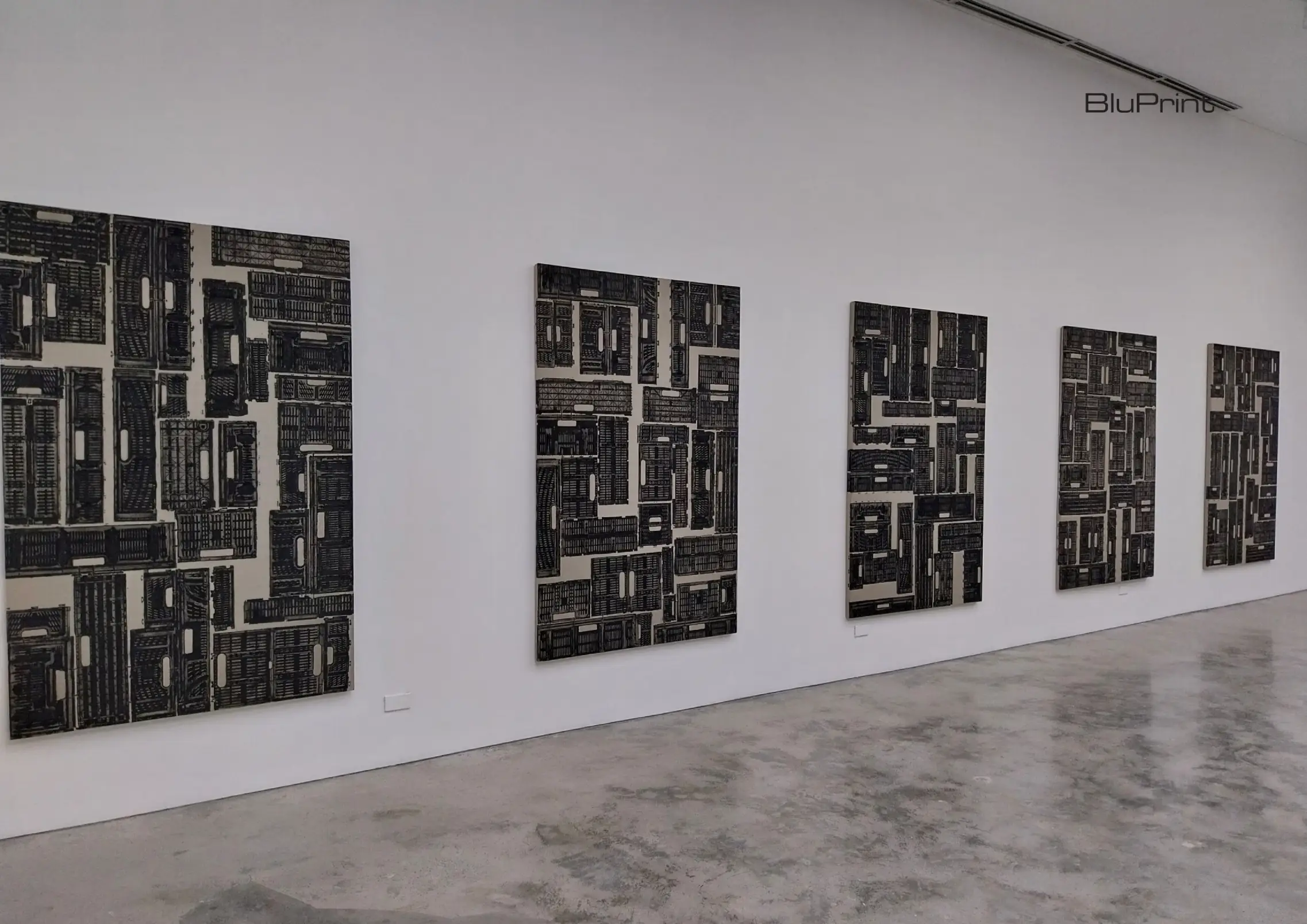
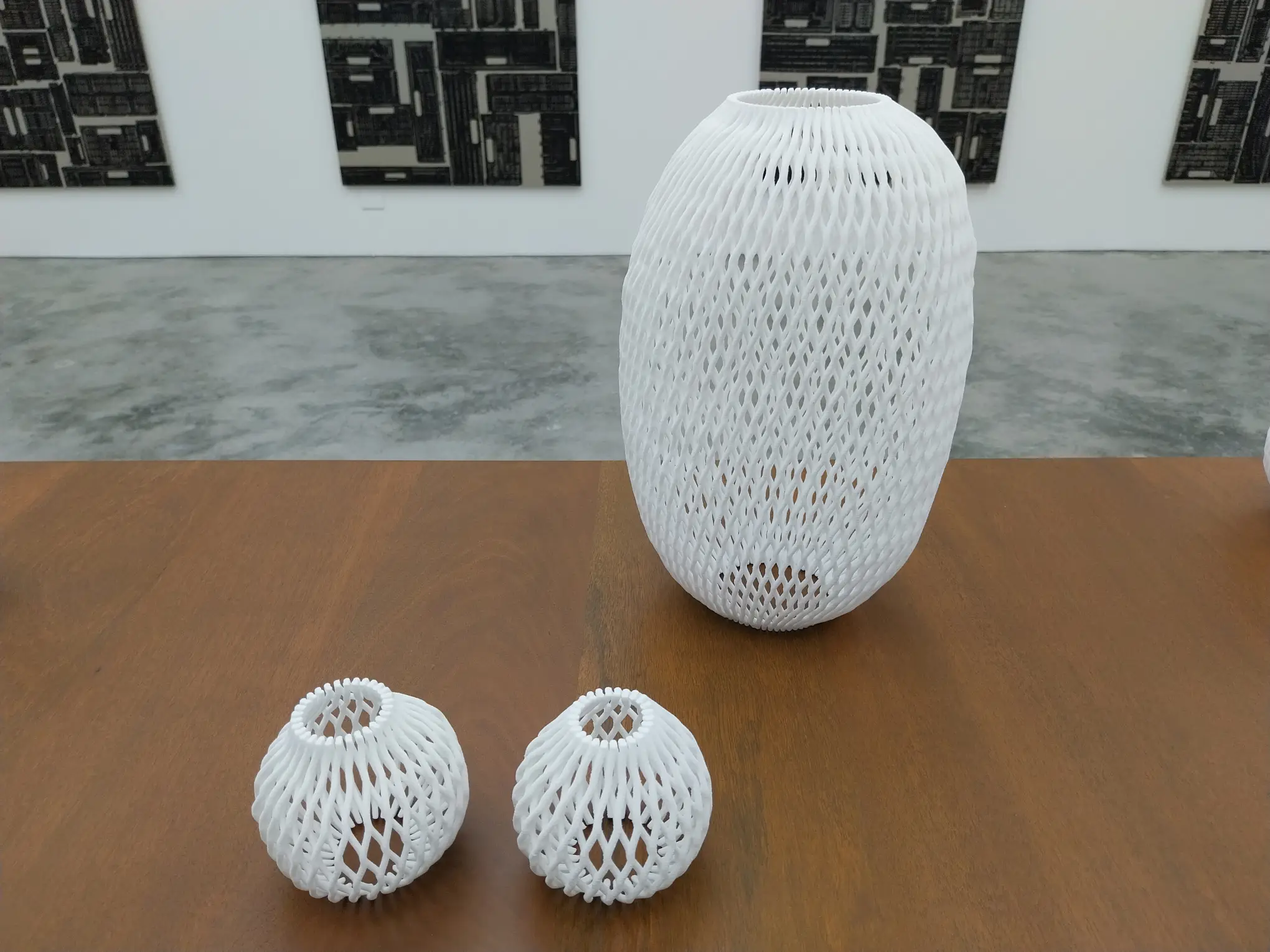
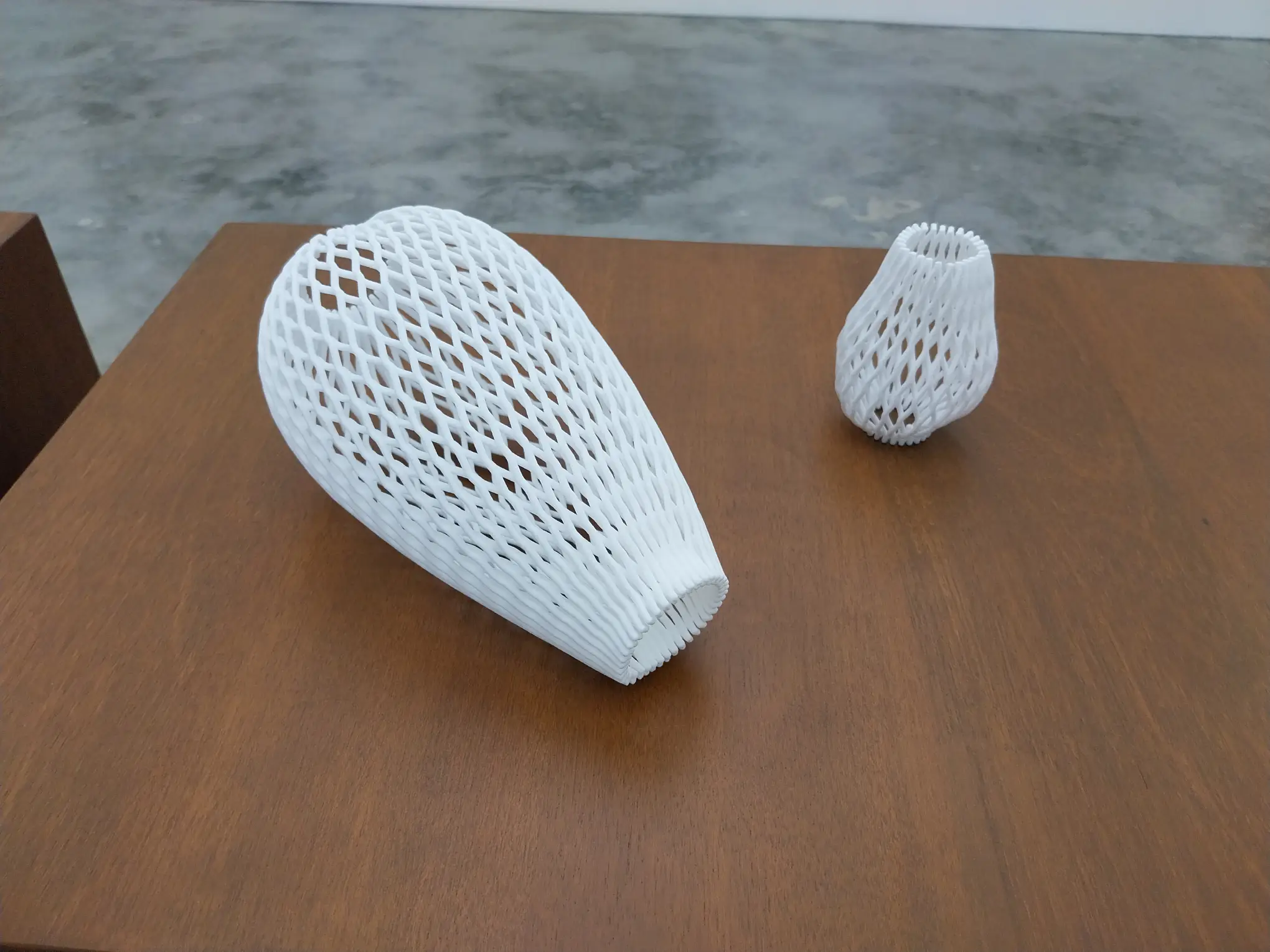
Here, she analyzes the materiality of those ideas, extending that metaphor to showcase the emptiness of the promise of consumerism in today’s world. A society like the Philippines can have similar goods and luxuries as imperialist countries in Europe and North America; but in the end, it is hollowed-out, giving us no true power or comfort in the grand scheme of this global project.
‘Tomato Tomato’
Another group exhibit, this one is the thesis presentation of students in the UP College of Fine Arts Graduate Program. Shown at UP Fine Arts Parola, it centers around a theme of ekphrasis, or the verbal description of an artwork. But, according to the write-up, it became “an academic exercise gone delightfully rogue, where the task was not to write about art, but to make it again—differently.”
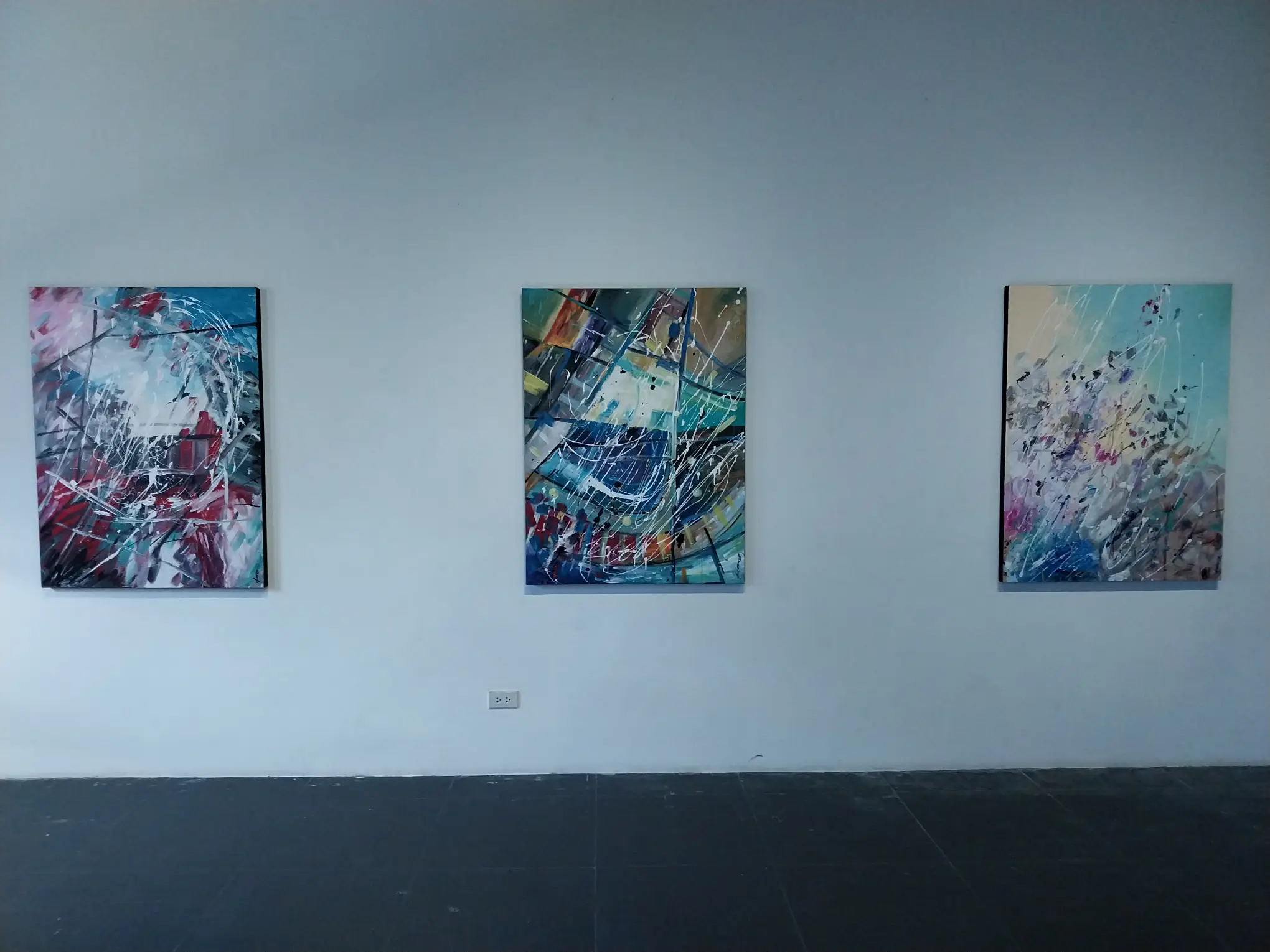
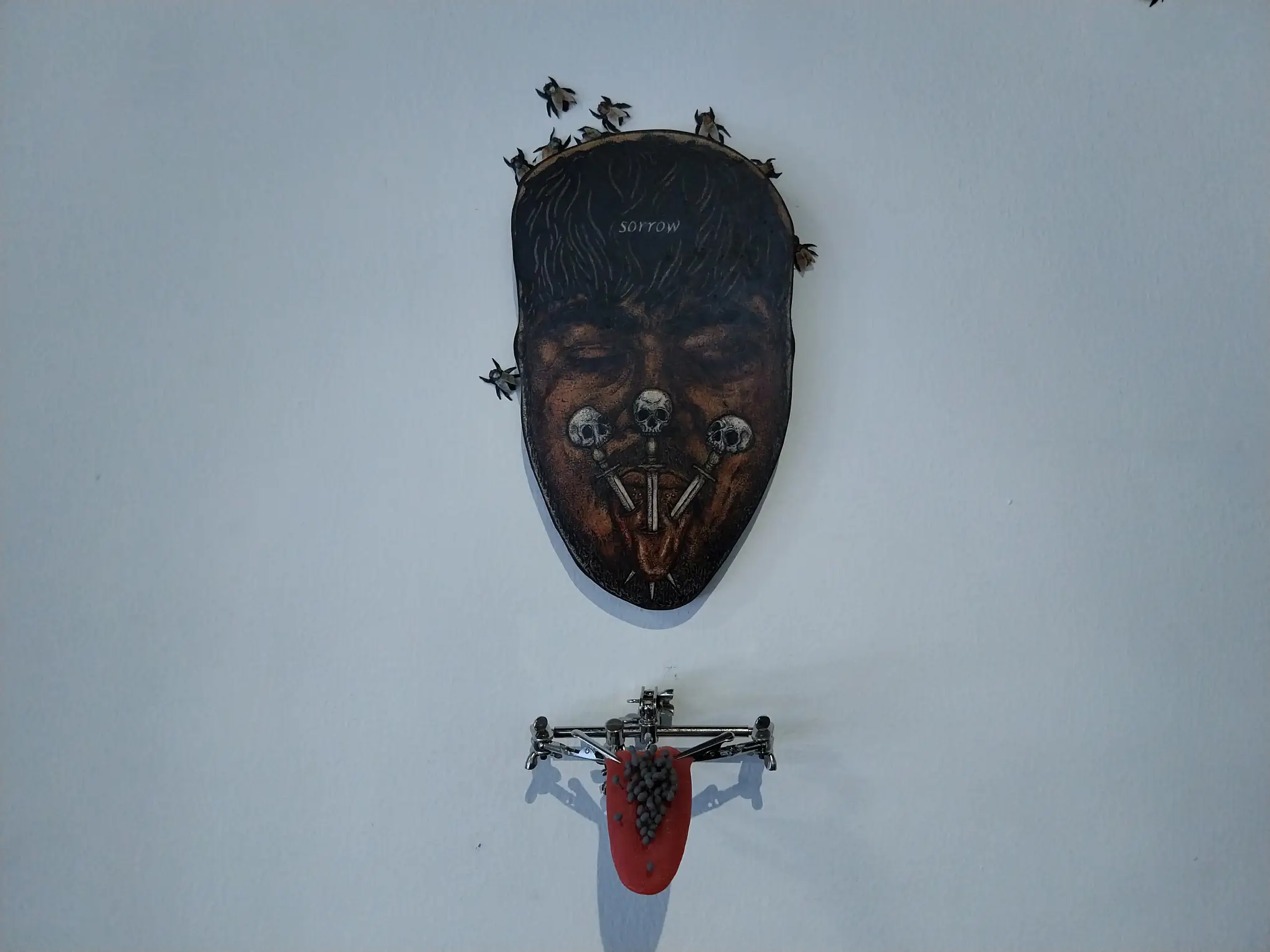
And so we see multiple creations retranslated again for a gallery exhibition. Among the unique standouts is a fake disembodied tongue made by Jeff Carnay where the artist jams fifty-three needles into their tongue to represent 53 violent years in the Philippines, from the Martial Law era to the present.
Another work by Bryan Quesada contemplates the meaning of the written word through a giant collection of “painted palimpsestic journals” containing no words but still attempting to convey meaning and story through its abstractness. And there’s also IC Jaucian’s strange moving machine that utilizes a compass in an attempt to find stillness while the Earth rotates—adjusting itself constantly to find that stillness.
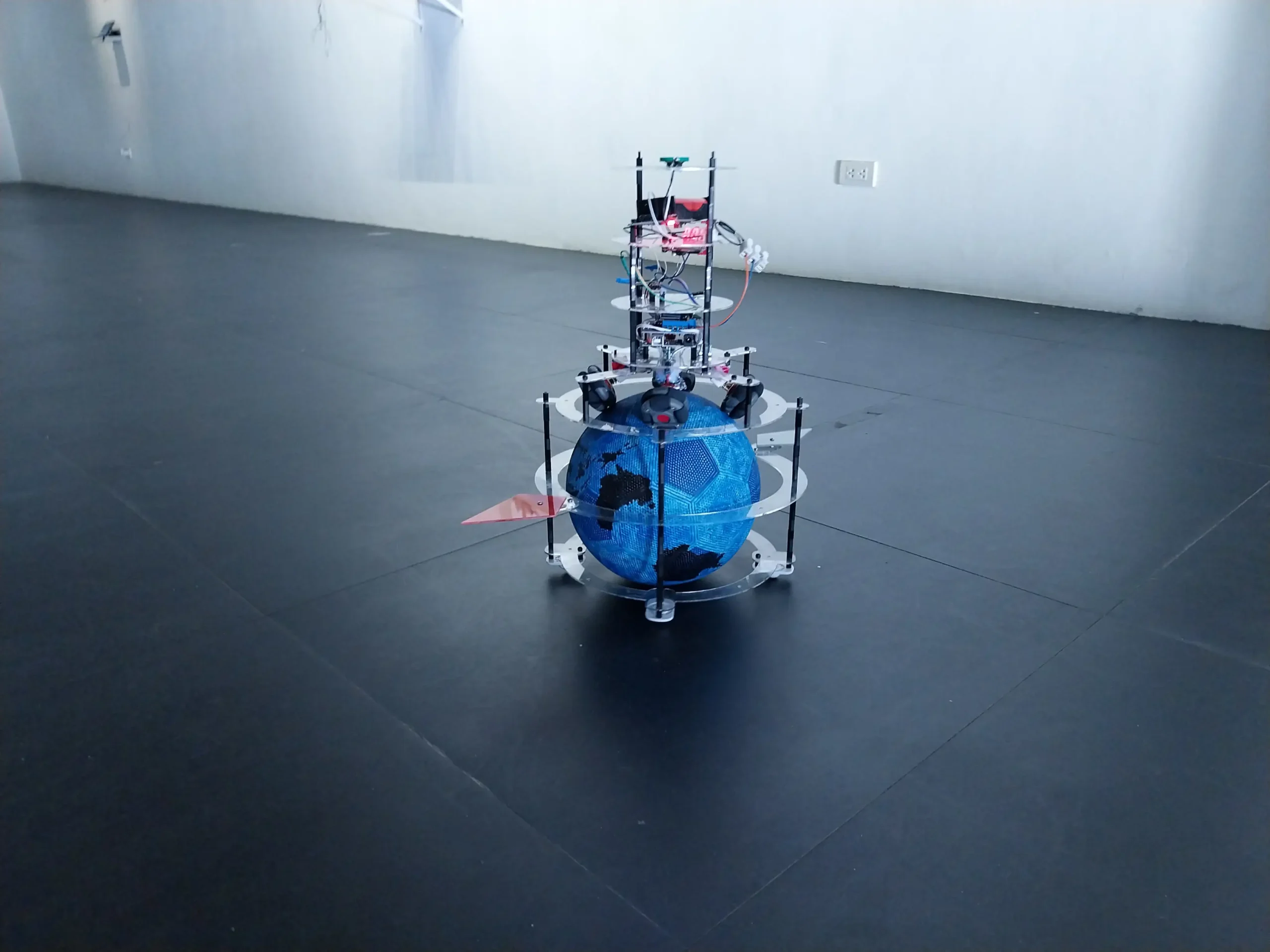
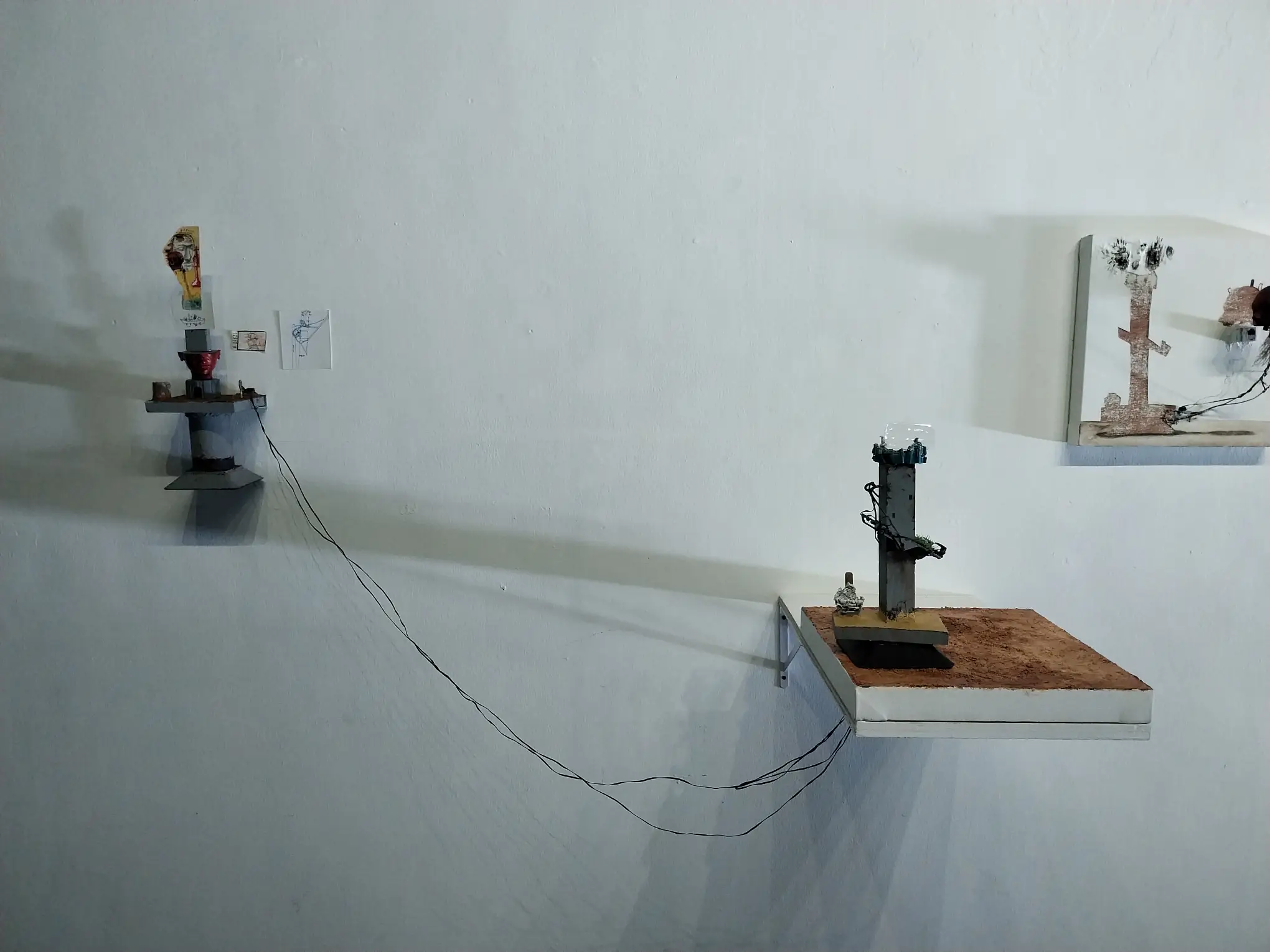
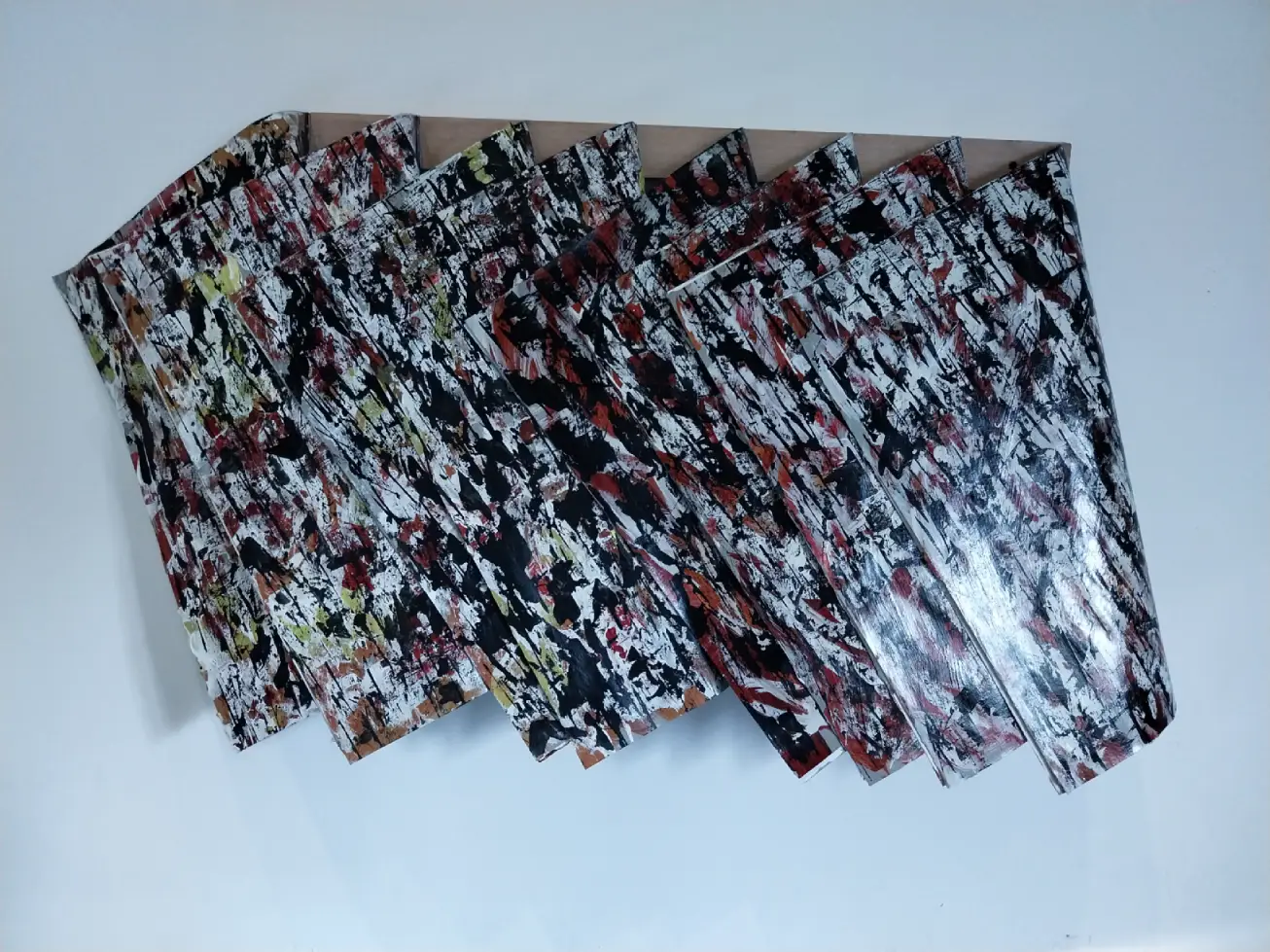
The artists themselves, in attempting to recreate their works, uncover different meanings and connections to it. This exercise of ekphrasis turns artists into interpreters, identifying new angles as age and experience change their approach on the subject.
Self-Reinterpretation
Carnay, for example, found renewed meaning to his work due to the continued silencing of activists, journalists, and Martial Law victims leading to another Marcos ascending to the Presidency today. The profundity of the work only increased for him as he recreated the tongue for the exhibit as a “potent visual artifact—both a receiver of oppression and a bringer of complicity and silence.”
In terms of methodology, Quesada said that the reinterpretation made him test new mixes and materials to better convey the point he was making, and in the process made him question what books actually were.
Through his own words, he called it “a meditation of the meaning between the visual and the verbal,” digging through the metatextual meaning of words as symbolic representations of ideas, with their own accompanying sounds alongside it. That works questions that core value: if the symbols are abstract, what meaning is conveyed through the stories?
“What’s the difference between a copy and a response?” the exhibit write-up asked. “Between quotation and authorship? Between knowing and remaking? The original works aren’t here. That absence is intentional. What you see is what remains after influence has been metabolized: works that stand on their own, even as they carry the ghost of something else.”
‘A Bench in a Park’
For this MO_Space group exhibit curated by Nicole Tee, a similar theme to Tomato, Tomato emerges: the attempts to capture a place in time. But while the UP Parola exhibit was more ruminative towards the meaning of copying past artworks, this exhibit is more concerned with the personal connection one has with a location in the past, and how that translates into artwork.
“These are not so much re-imaginations of locations as they are attempts to reference, recapture, and reckon with spaces charged with personal significance,” the exhibit write-up said.
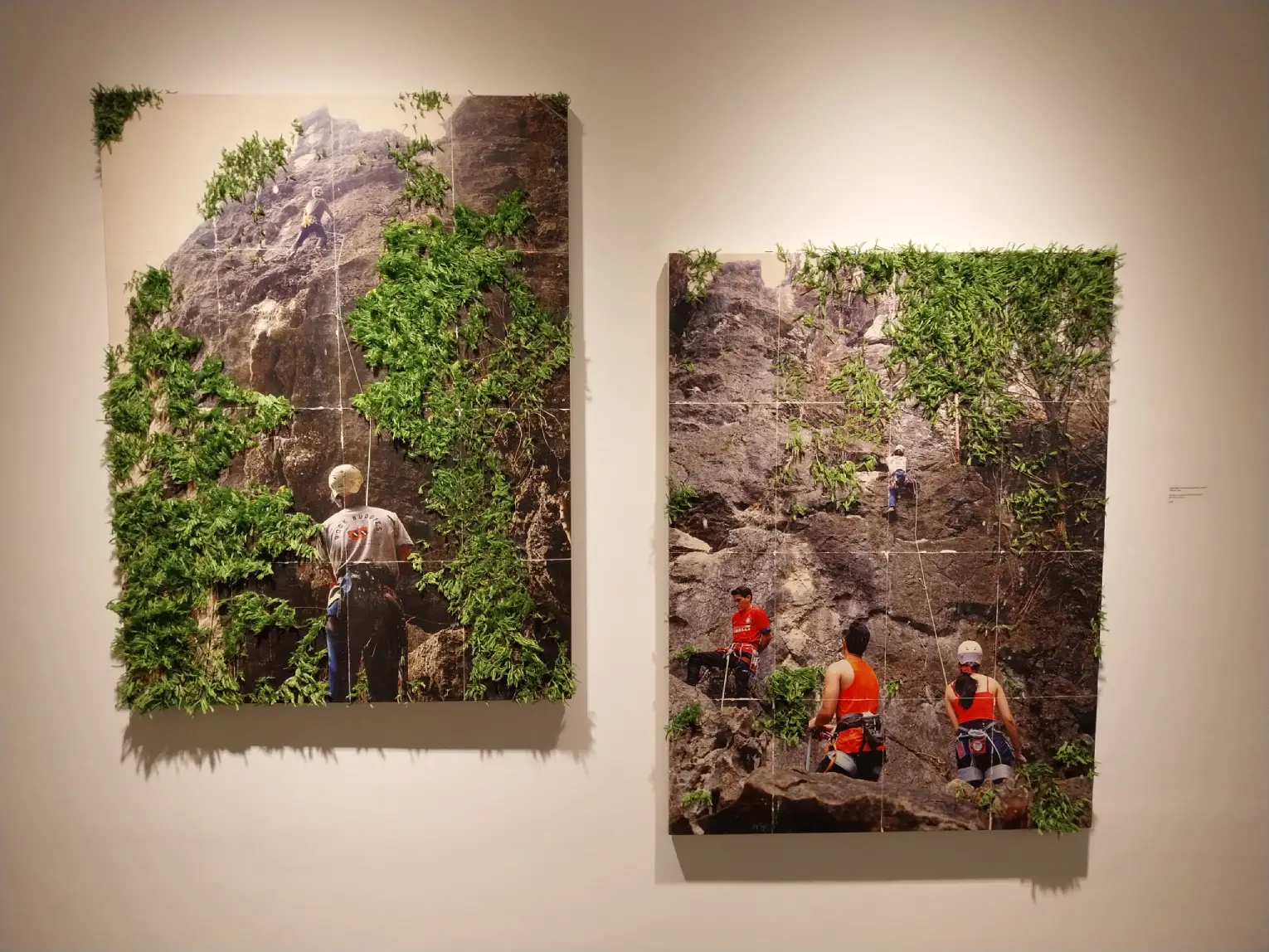
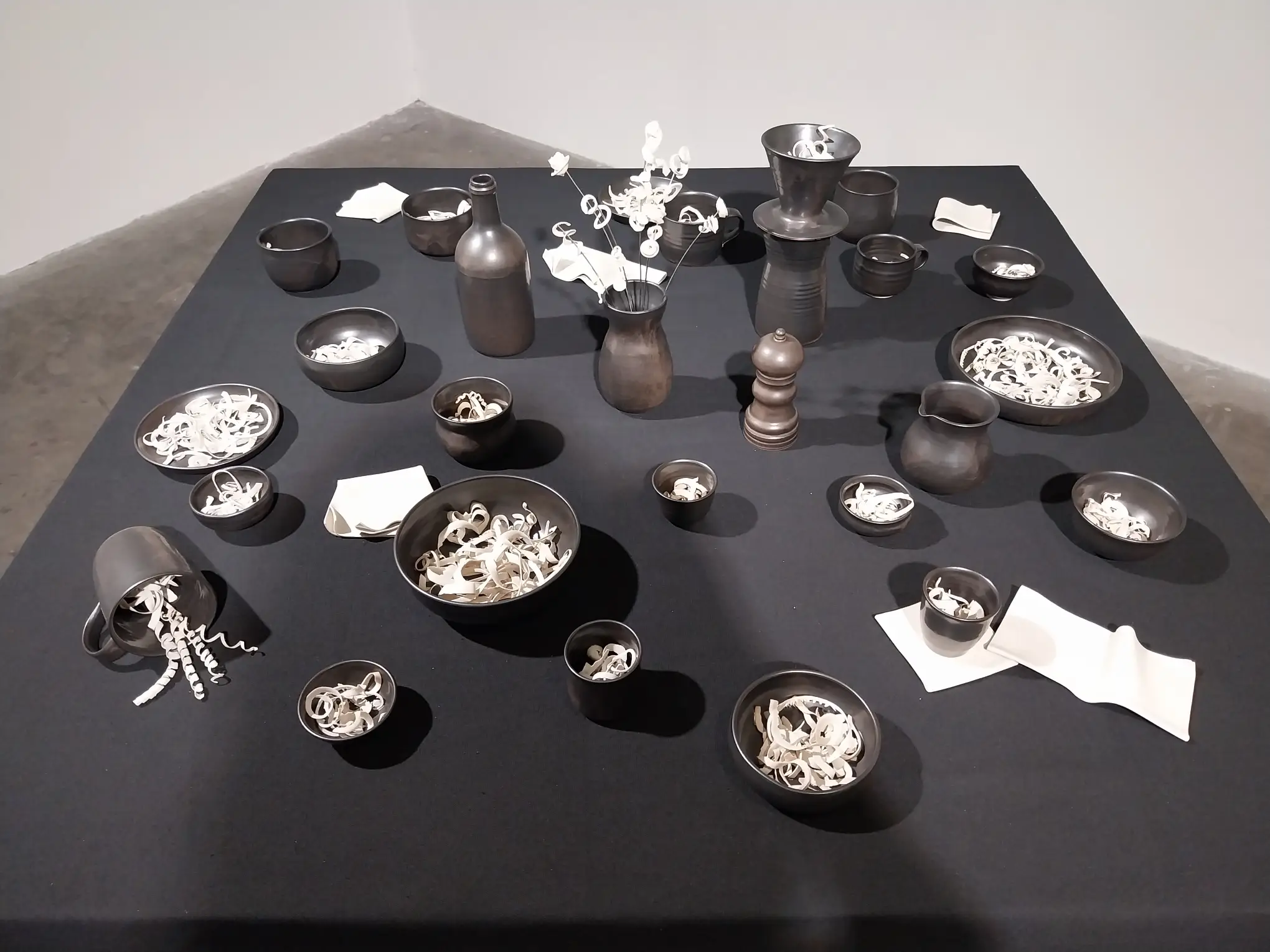
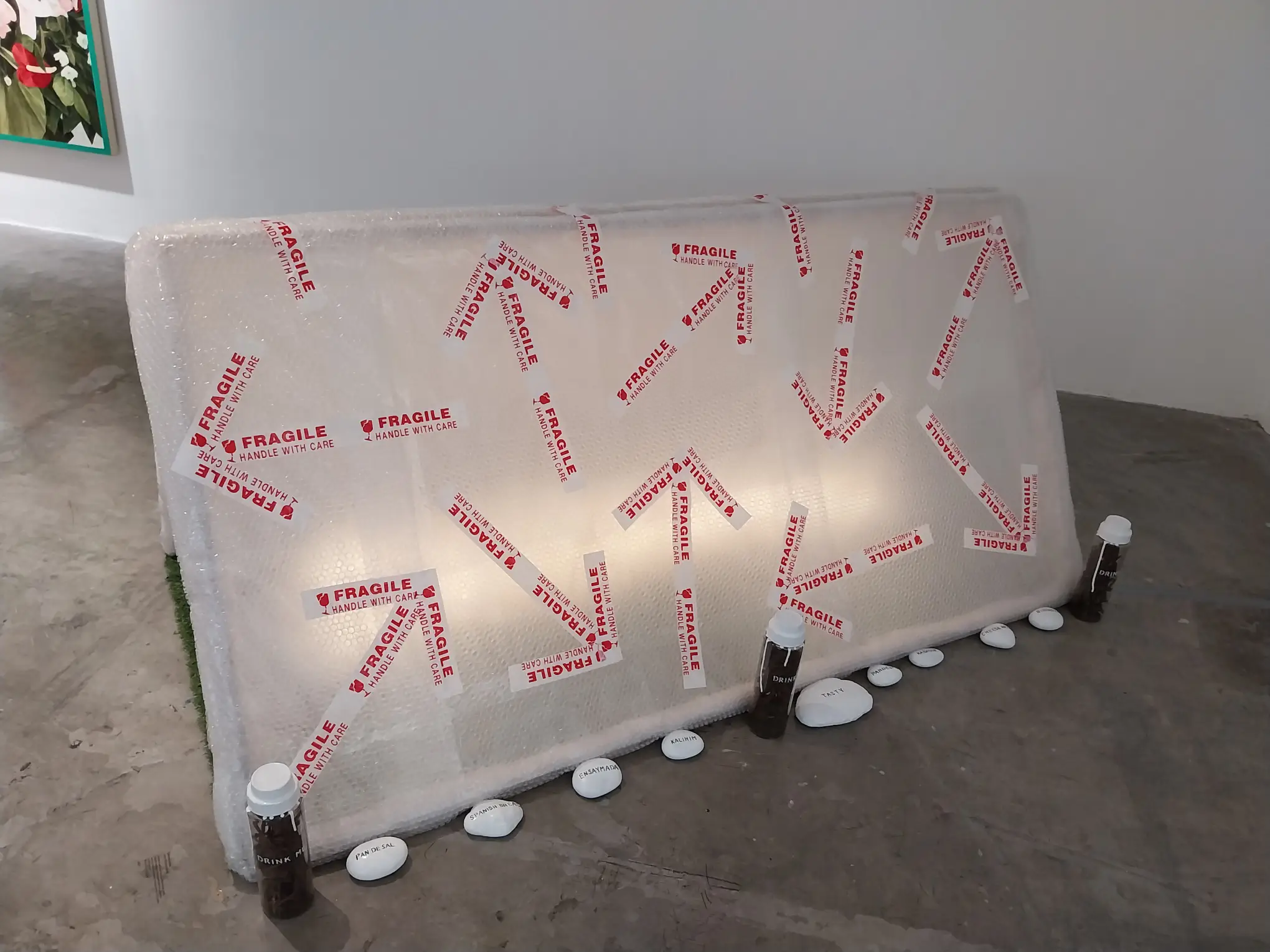
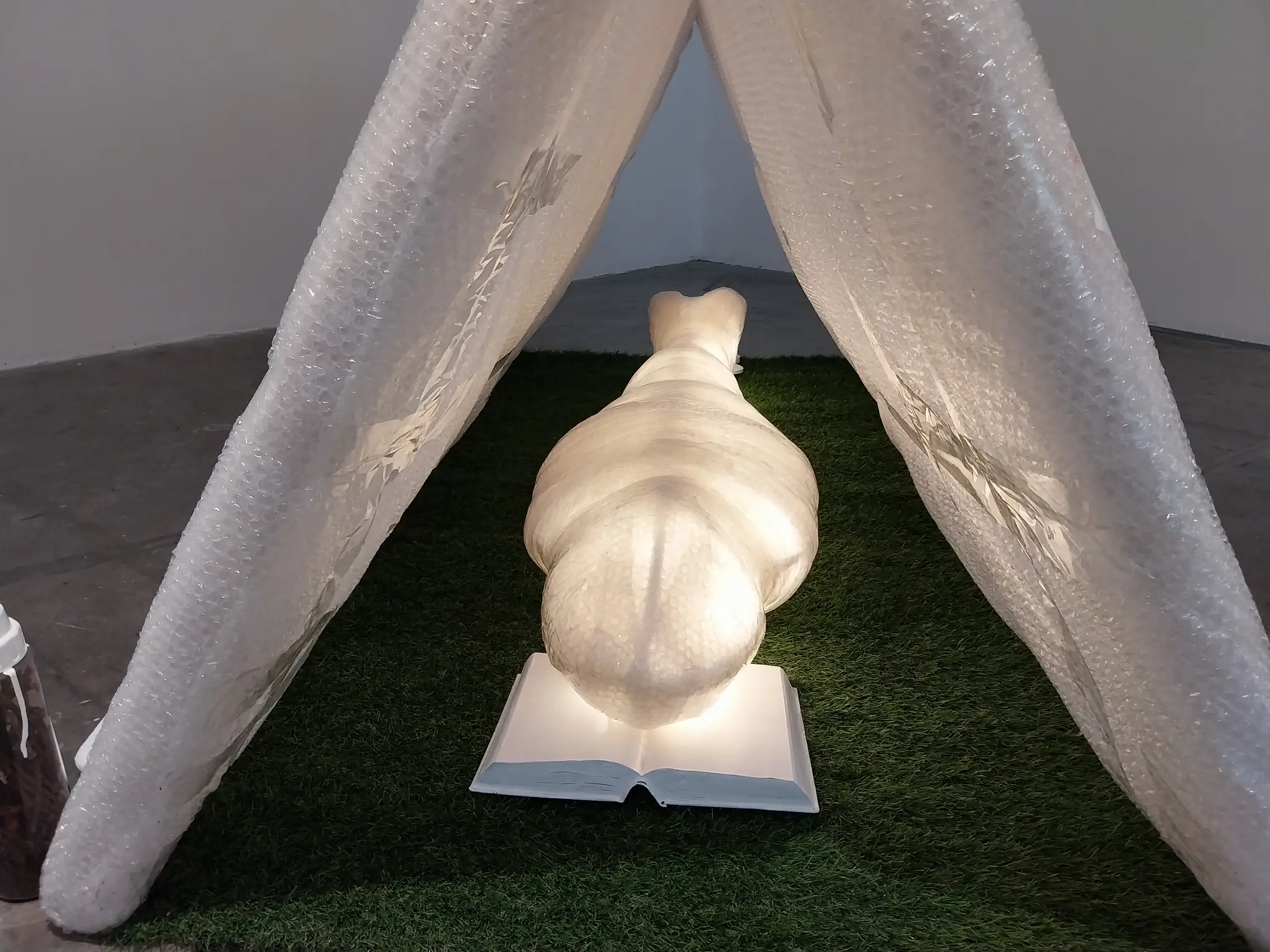
The artists interpreted that idea differently, depending on their sense of place. Ella Mendoza crafted a black dining table filled with dark cutleries and dishes, some of which contained bone-like remains. Juan Alcazaren III created a representation of the stresses of student life with a camping tent and a student made of bubble wrap with “fragile” tape around it, and embodiments of objects like coffee, food, and textbooks surrounding the figure.
New Perceptions of Place
Sam Bumanlag built a colorful, toy-and-trinket-filled wonderland that appeared to represent the innocence of the past. And for Henrielle Baltazar Pagkaliwangan, it was the bus tickets that brought her to and from different places.
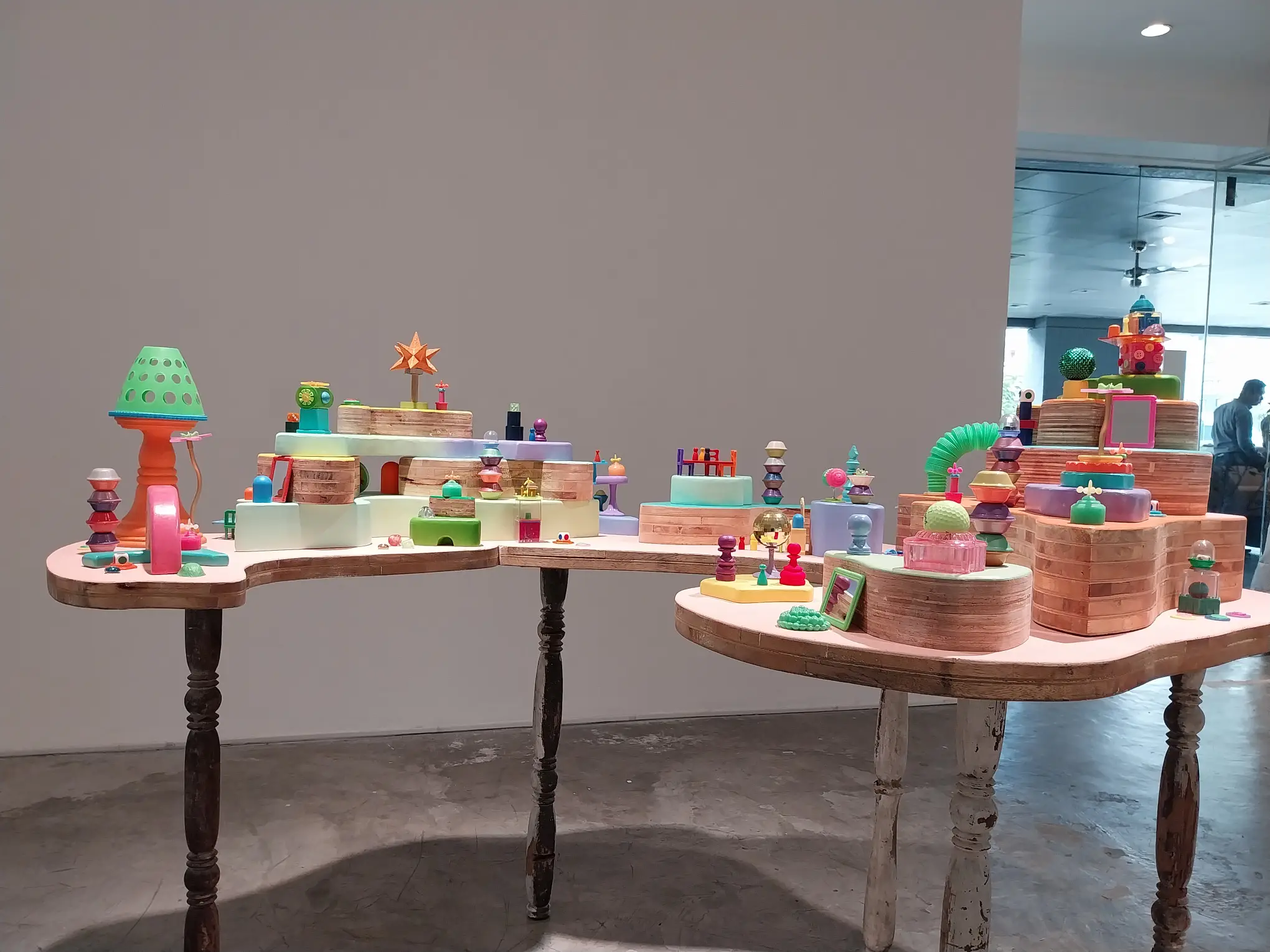
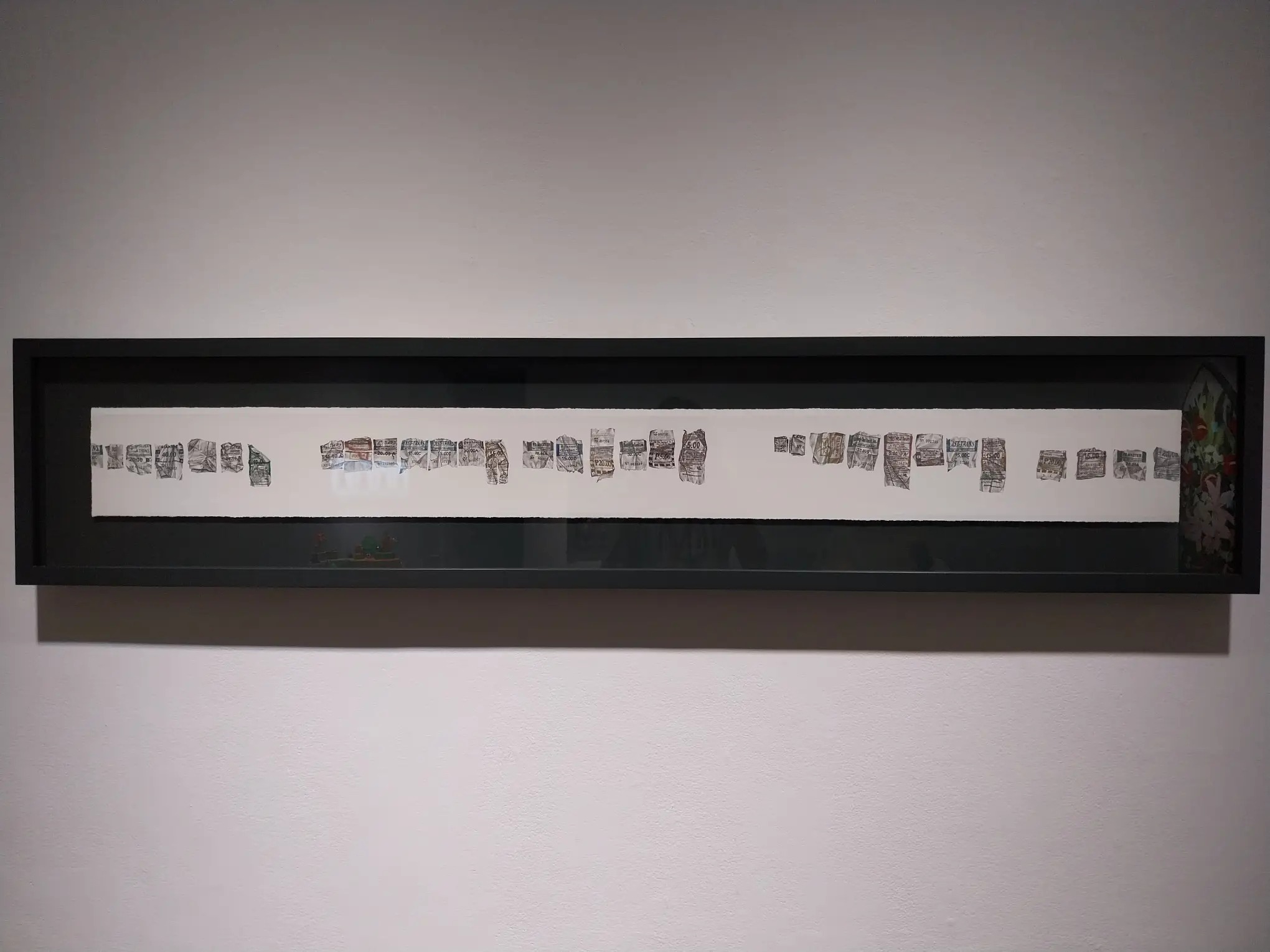
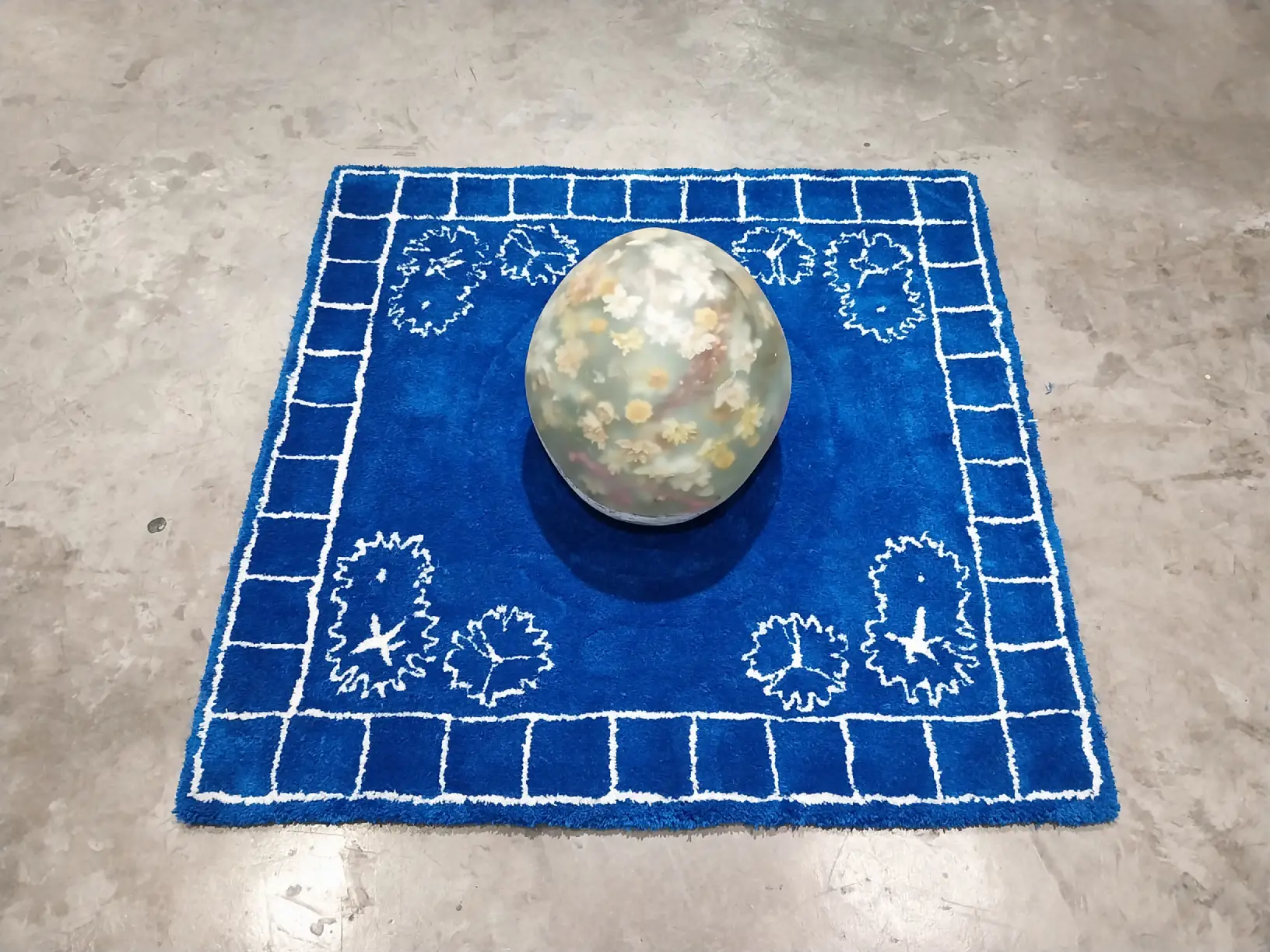
It provided audiences with an understanding that the important places in one’s world need not necessarily be fixed or concrete anywhere but the mind. We form our own connections with the world, the exhibit seemed to say, based on how we interpret the way we immerse ourselves in our surroundings.
“At times, this involves engagement with materials, with the physical environment as source and inspiration for artistic experimentation, straddling as it were, one’s home and work place,” the exhibit write-up continued. “For some, this requires a sensitivity to the process of transit.”
‘Still Point’
Philippine contemporary art tends to seek an exploration of the materiality of the objects around us. Mark Grecalda’s first solo exhibition at Art Camp Gallery gives viewers the opportunity to bask in the mixed media works that appear to look like wet sand on canvas.
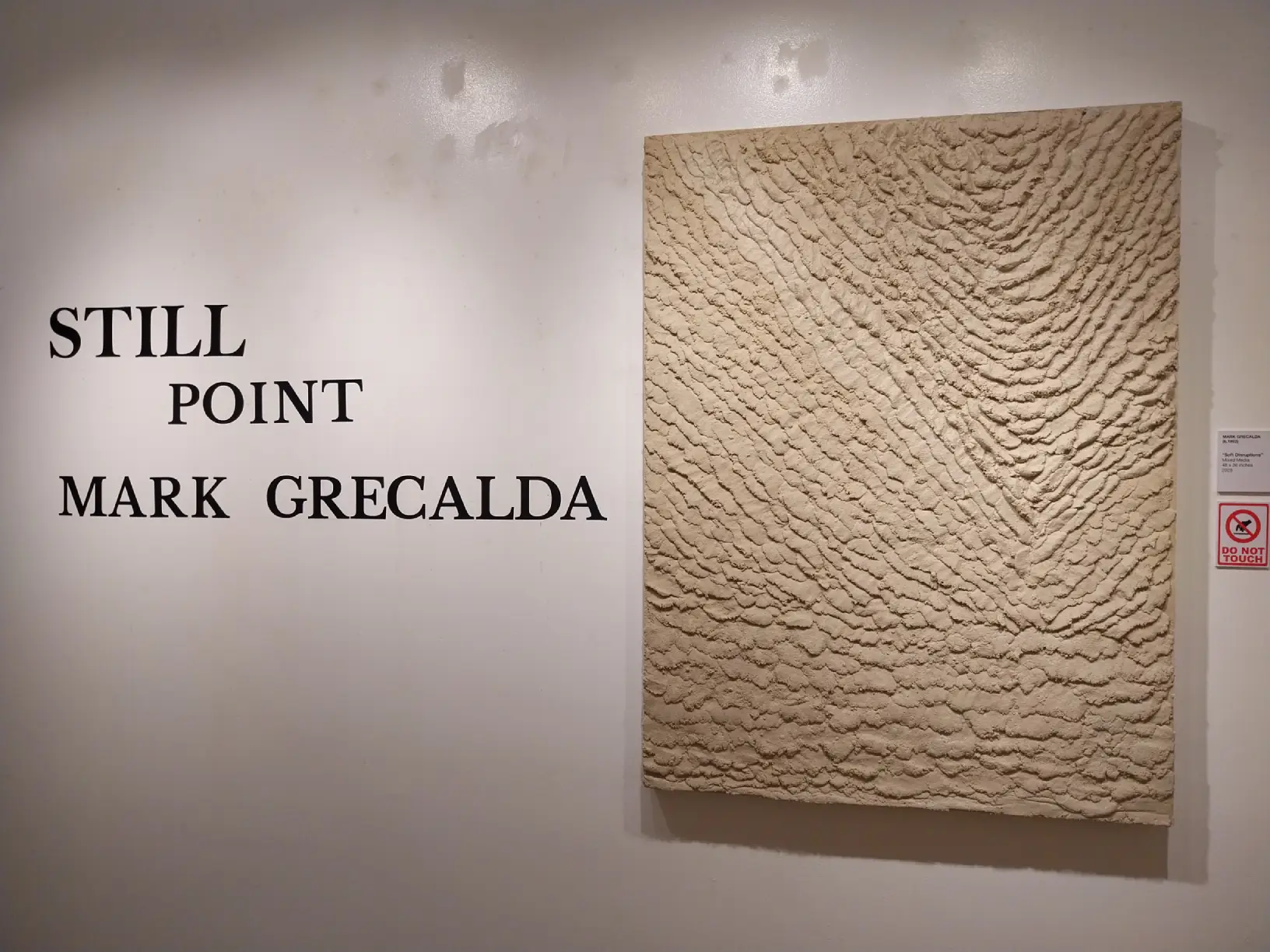
It is, of course, more complicated than that; the image that Grecalda evokes is more the crashing waves of the ocean as represented by sand-like textures. Layering them on top of each other, it creates this feeling of collapse that conjures thoughts of the destructive and reformative nature of our world.
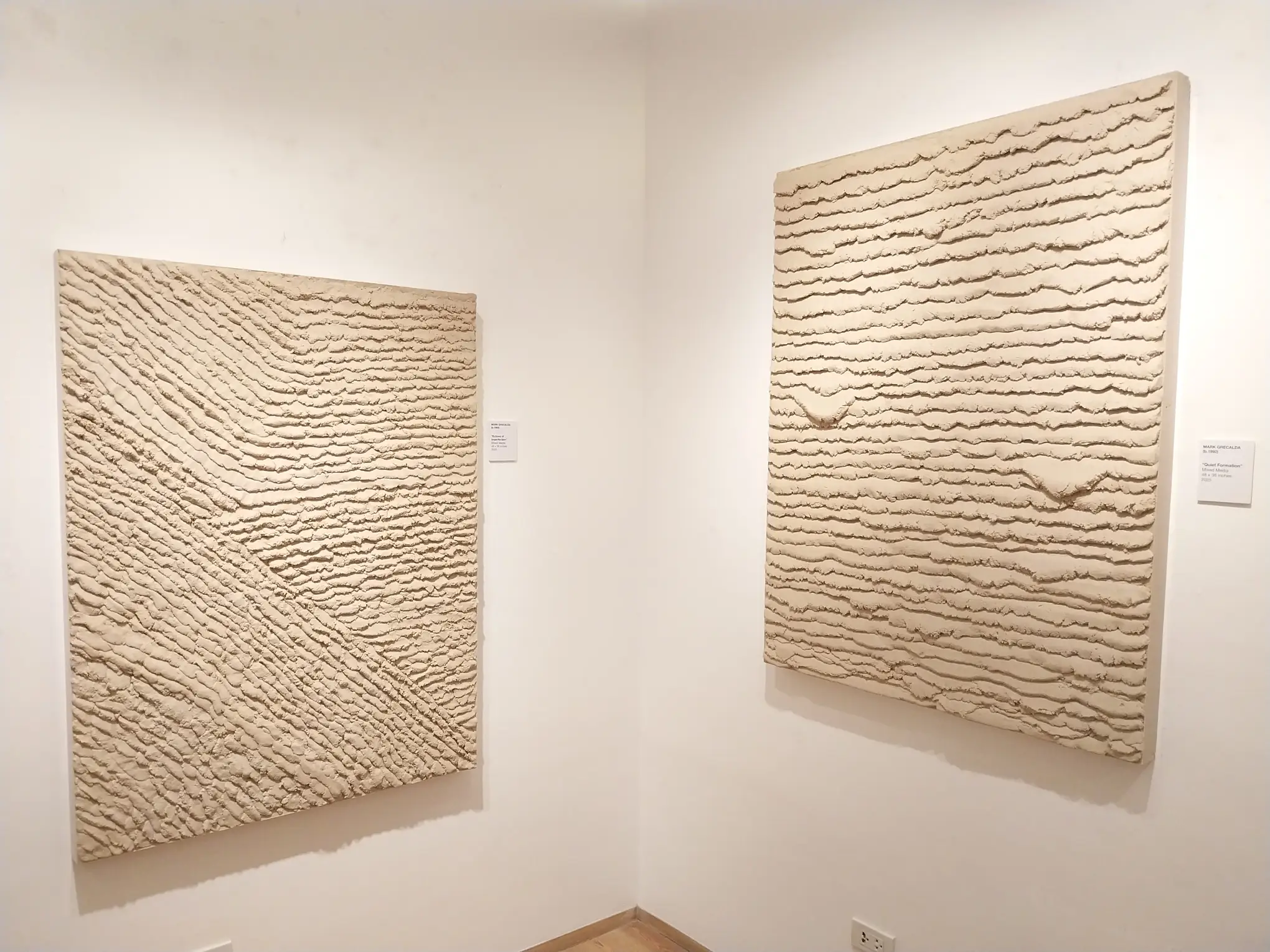
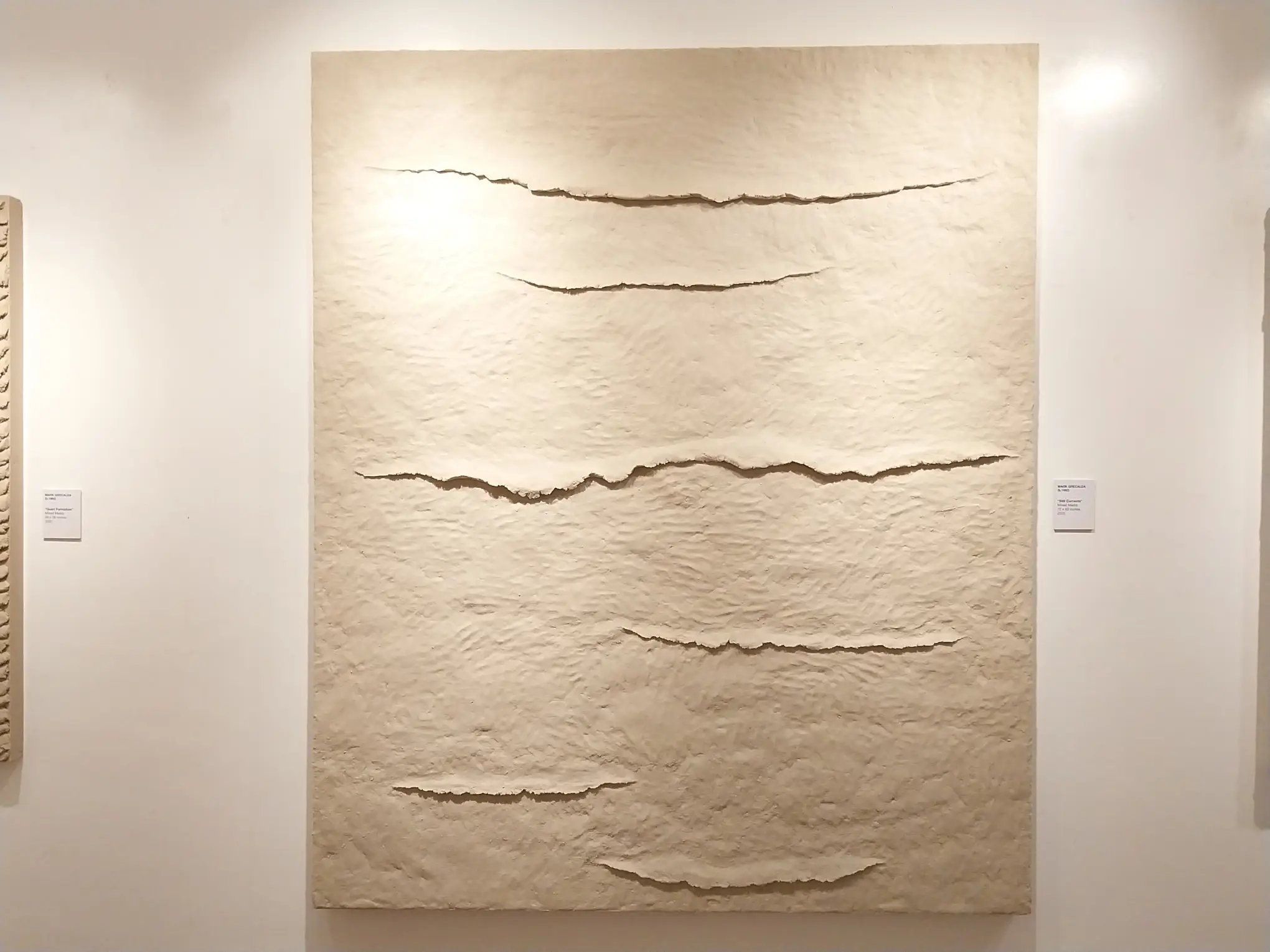
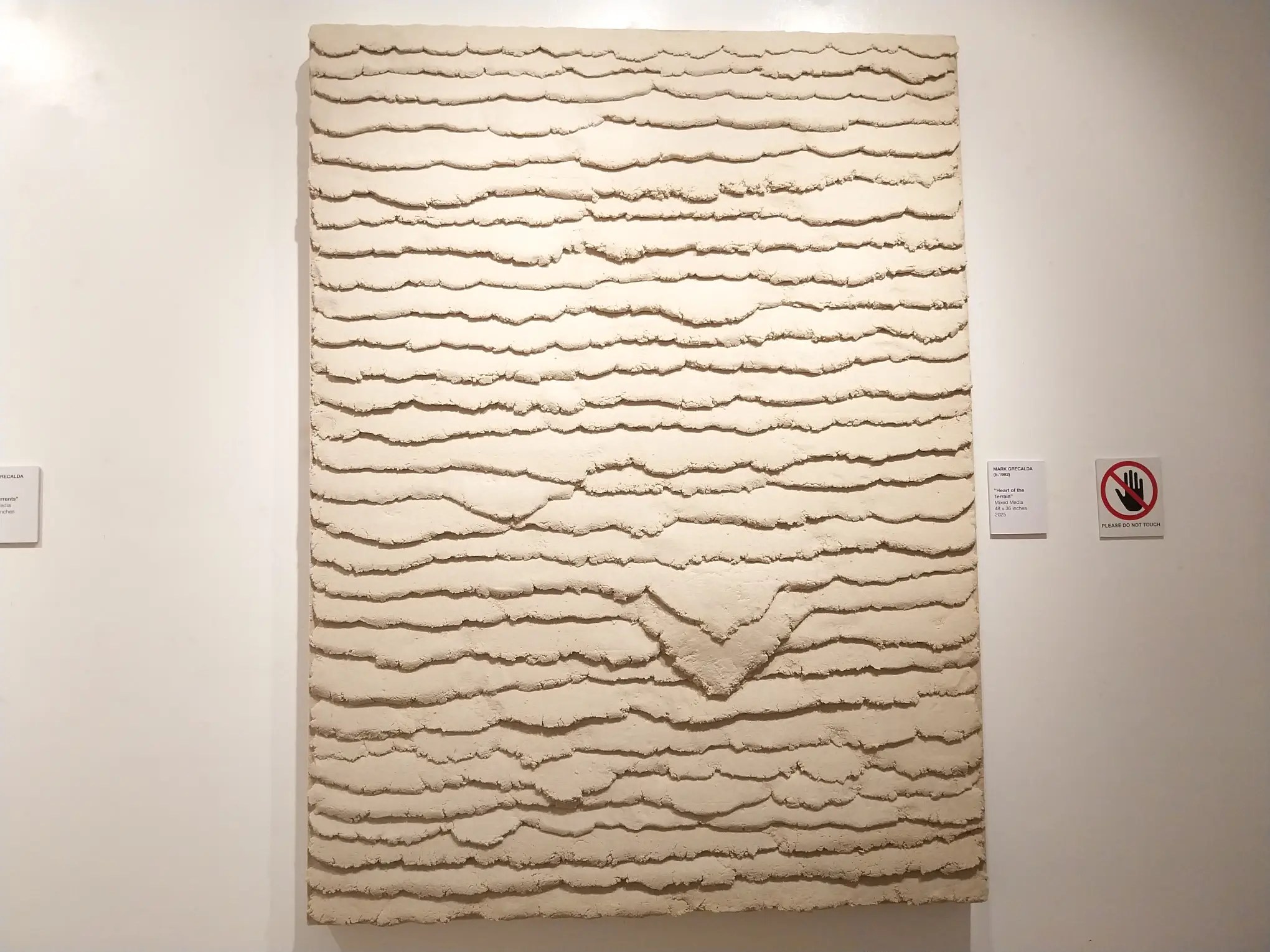
In that sense, a deeper meaning of our material world is conveyed here. At times, people think of things within their boxes, assigning attributes that they feel are immutable for the objects at hand. But by recreating water-like movements to solid, sand-like materials, it reminds viewers the transitiveness of attributes, and how the universe can use it as a way of balancing and connecting things to each other, even if they seem dissimilar.
“As the viewer moves through the space, there is a sense of rhythm and balance, of chaos held in suspension, of time stilled,” the exhibit write-up said. “What emerges is a deeper connection with the ephemeral and the eternal—an experience that resists resolution but resonates long after.”
‘How to Move Beyond the Landscape’
Pope Bacay’s exhibition at Finale Art File are landscapes of familiar vistas like mountains, forests, and suburbias, filtered through the imagination of the artist and their perspective of the world at large. It’s not a perfect renderingRenderingA realistic or stylized image that visualizes a proposed design before it is built. Produced with 3D modeling and visualization software, renderings show materials, lighting, furniture, and context, helping architectsGo to Rendering Glossary of a vast scenery in front of us; rather it is a minimalist—almost primitivist—rendition of skies and forests and farmlands, suggesting the beauty of the world without having to portray it realistically.
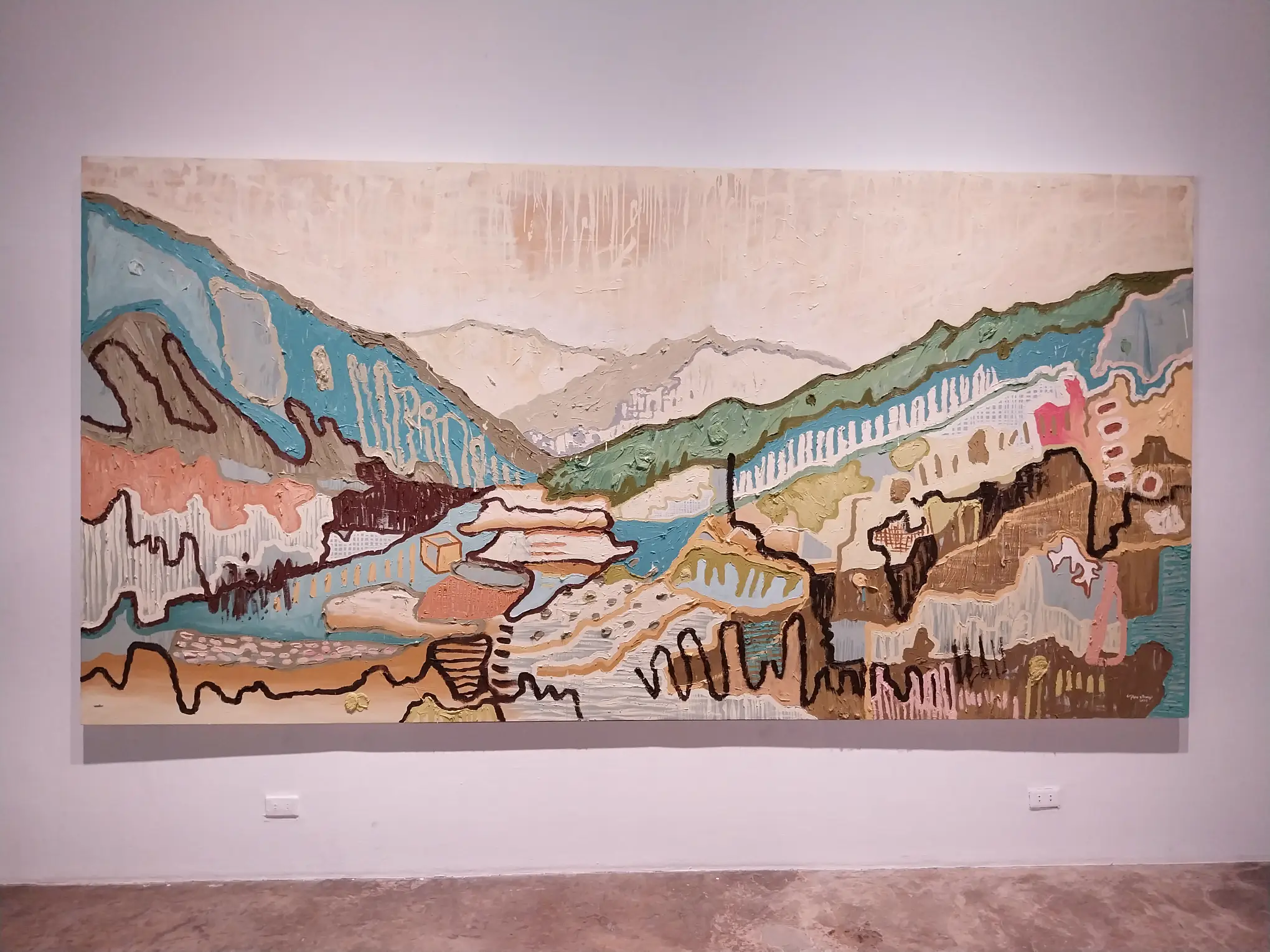
Their works here almost function like a free jazz composition, adding lines and off-color tones and wriggly brushstrokes here and there to create the landscapes as it looks in their head. An attitude of defiance exists within the works as they reinterpret the rules of visual representation in their works.
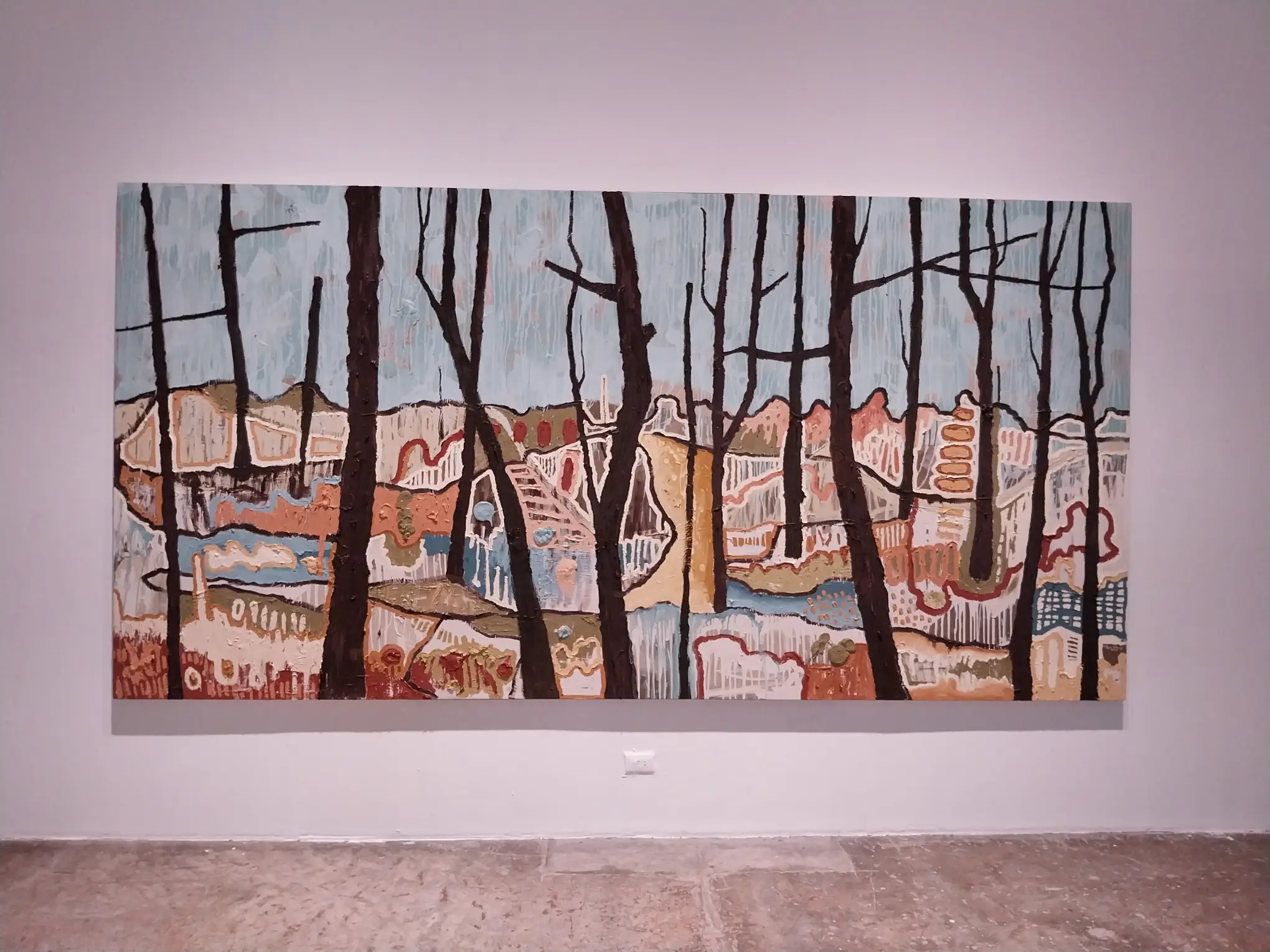
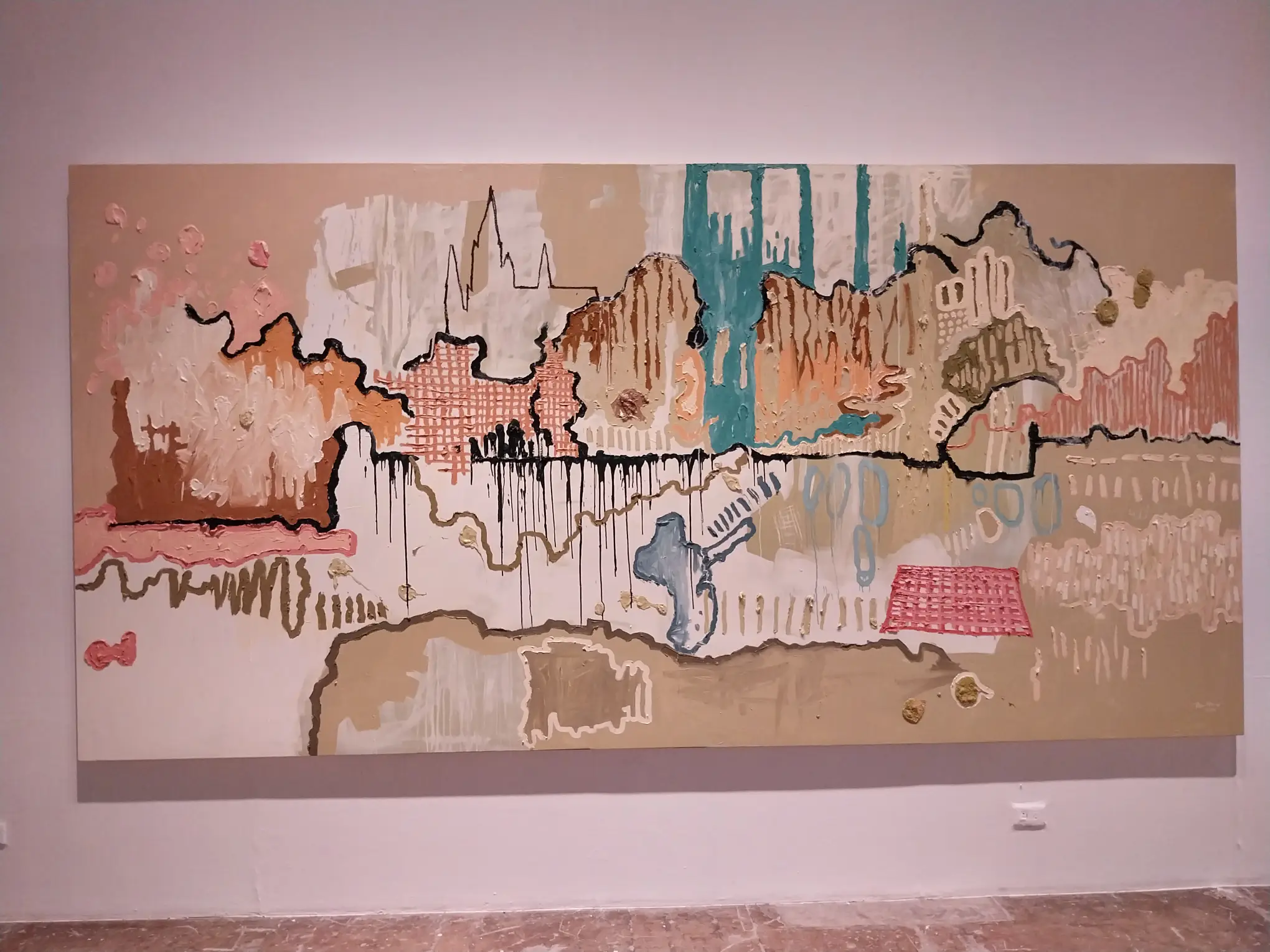
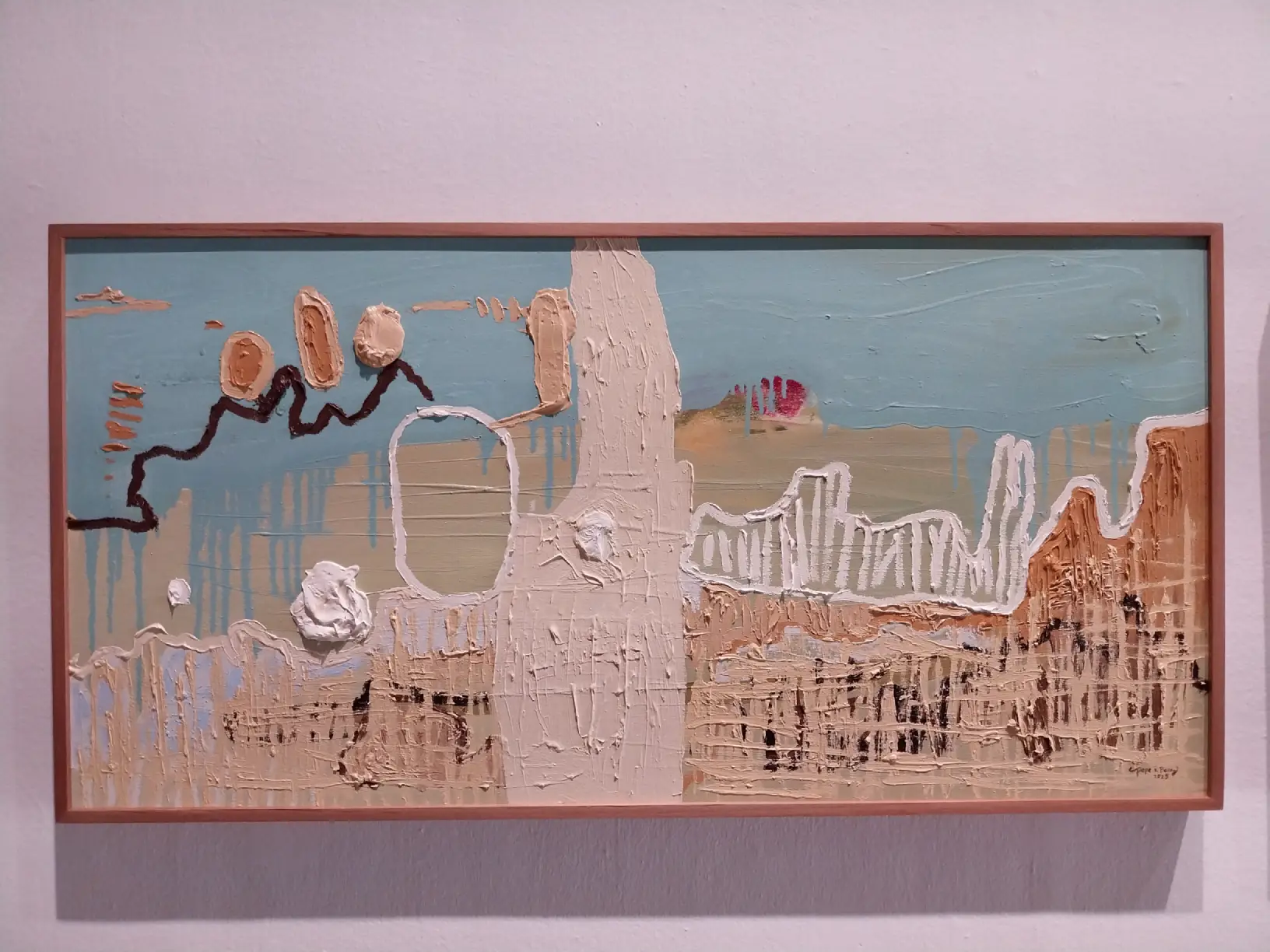
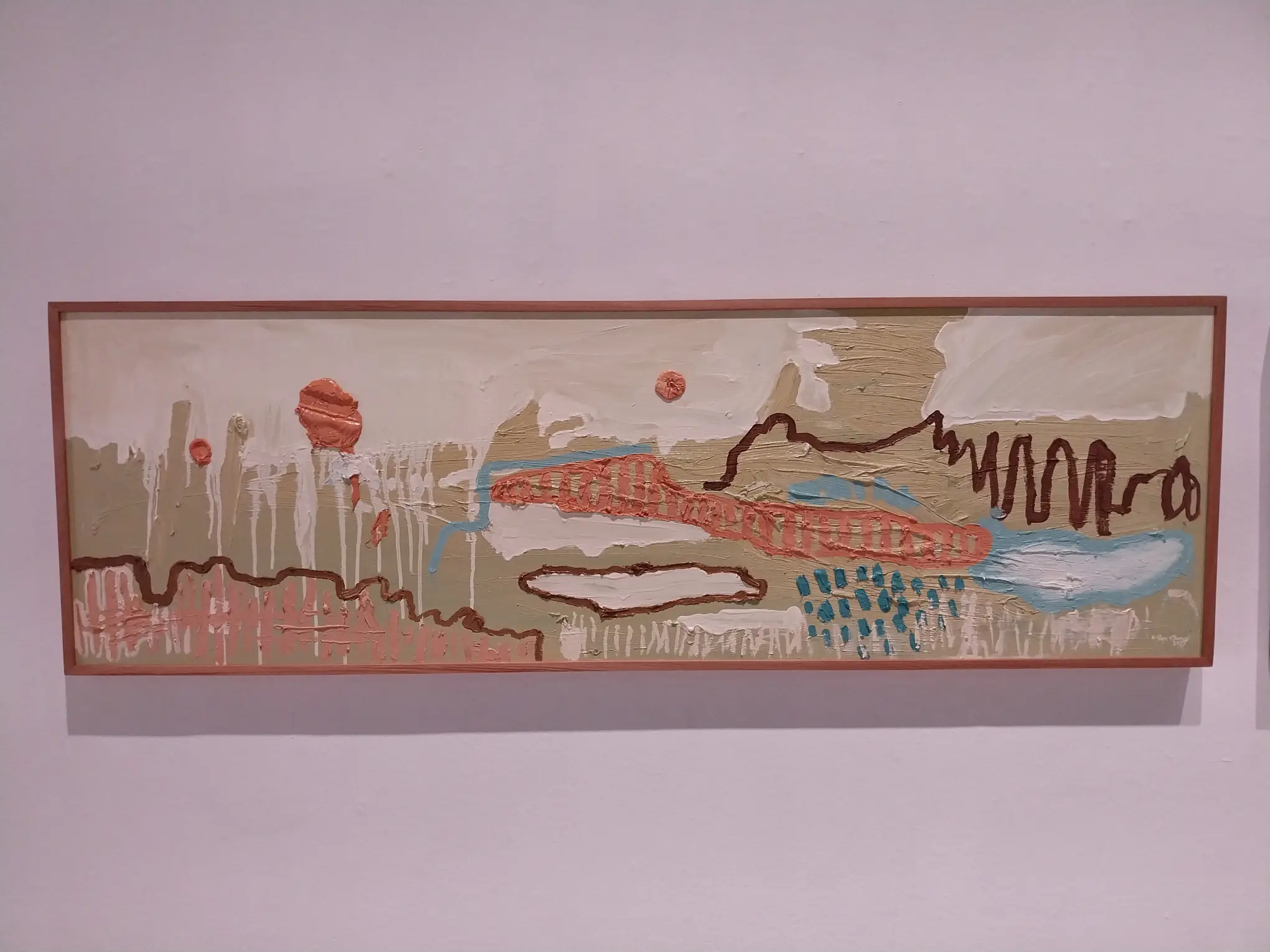
“Culled from different moments through time, and itself suspended in time, the paintings may still elicit familiarity despite their strangeness,” the exhibit write-up said. “Bacay is primarily intent in evoking a particular kind of attention, one apart from the incessant buzz of the modern world. A kind closer to stillness. He confesses to finding the world too loud. To paint is to slow down attention, and to offer the same possibility to the viewer should they choose to.”
The Exploratory Nature of Philippine Contemporary Art
In the end, these unique examples of Philippine contemporary art do in fact display the uncommonness of not just the individual artist’s minds, but of Filipino culture as a whole. Our artists reinterpret the world, the country’s trauma and experiences through a different lens, and escape with a new perspective to chew on, allowing a better understanding of us as a people and a culture.
Photos by Elle Yap.
Related reading: Art Roundup: Exhibits Exploring Spatial and Environmental Curiosity
Frequently Asked Questions
The group exhibition titled ‘Hair tied together, embodied we speak’ uses organic elements like rattan, abaca, and batik fabric to reconnect contemporary art with ancestral labor. By intentionally severing artistic creation from industrial colonial systems, the artists explore how returning to traditional materials and methods can provide a deeper understanding of indigenous identity and knowledge that is often suppressed in a modern, globalized world.
In this exhibit at Modeka Art, elder artists use outmoded CRT televisions to rage against the “planned obsolescence” of modern technology. The works serve as a metaphor for the artists themselves; though society may view both the technology and the aging artists as “outmoded,” the exhibit demonstrates that they remain functional and powerful tools for witty commentary and creative expression when maintained and given a proper venue.
In the ‘Tomato Tomato’ exhibition at UP Fine Arts Parola, Jeff Carnay presents a disembodied tongue pierced with fifty-three needles. This “visual artifact” represents fifty-three years of violence and silencing in the Philippines, spanning from the Martial Law era to the present day, serving as a visceral receiver of oppression and a symbol of the complicity found in forced silence.
Coson uses the synthetic materiality of styrofoam mesh—typically used to protect fruit—to mold local Philippine fruits like papaya and macopa. This serves as a critique of how imperialist systems hollow out local resources, values, and talents to repackage them for global benefit, leaving behind only a “synthetic shell” of cultural identity that offers the illusion of luxury without true power.
Instead of realistic renderings of mountains and forests, Bacay employs a minimalist and almost “primitivist” style characterized by wriggly brushstrokes and off-color tones. This “free jazz” approach to landscape painting is a defiant attempt to slow down the viewer’s attention in a world that is too loud, offering a sense of stillness and a perspective of the world as it exists in the artist’s imagination rather than a photographic reality.
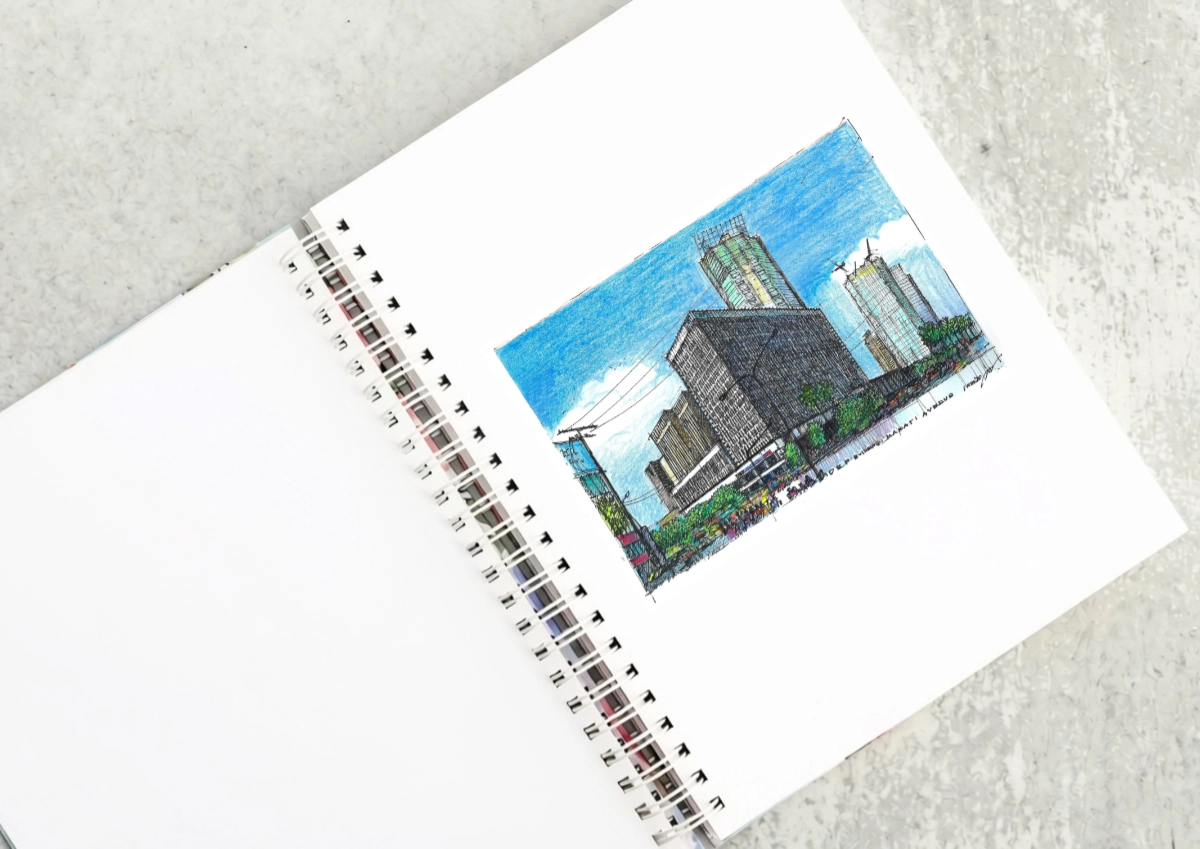
The DBP Building as a Landmark of the International Style At the corner of Sen. Gil Puyat Avenue and Makati Avenue stands a landmark of the Makati Central Business District. It is one of the last still standing that were built in the first wave of construction in district fifty years ago. The Development Bank […]
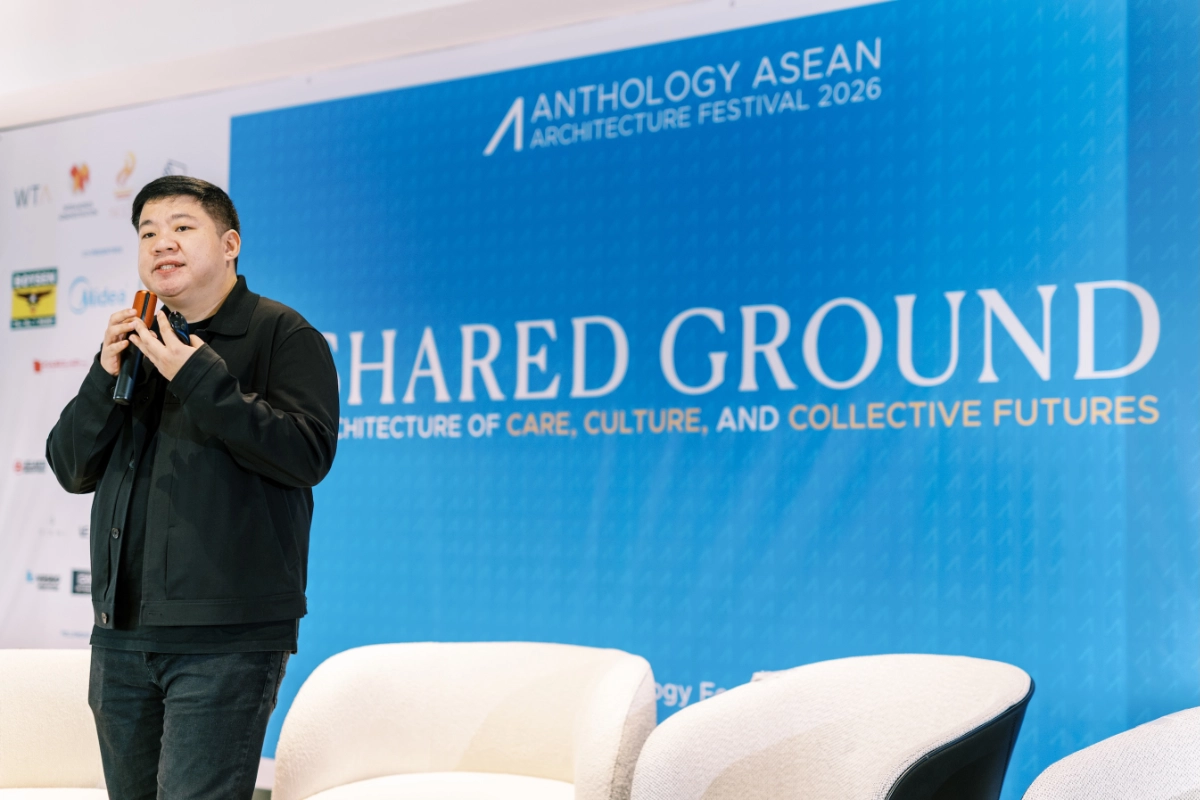
“Buildings only become architectureArchitectureThe art and science of designing and constructing buildings, structures, and spaces that are functional, safe, and aesthetically pleasing. It encompasses the planning, design, materials, and techniques used to createGo to Architecture Glossary when they are shared,” said William Ti Jr., founder of the Anthology Festival and WTA Architecture and Design Studio, […]
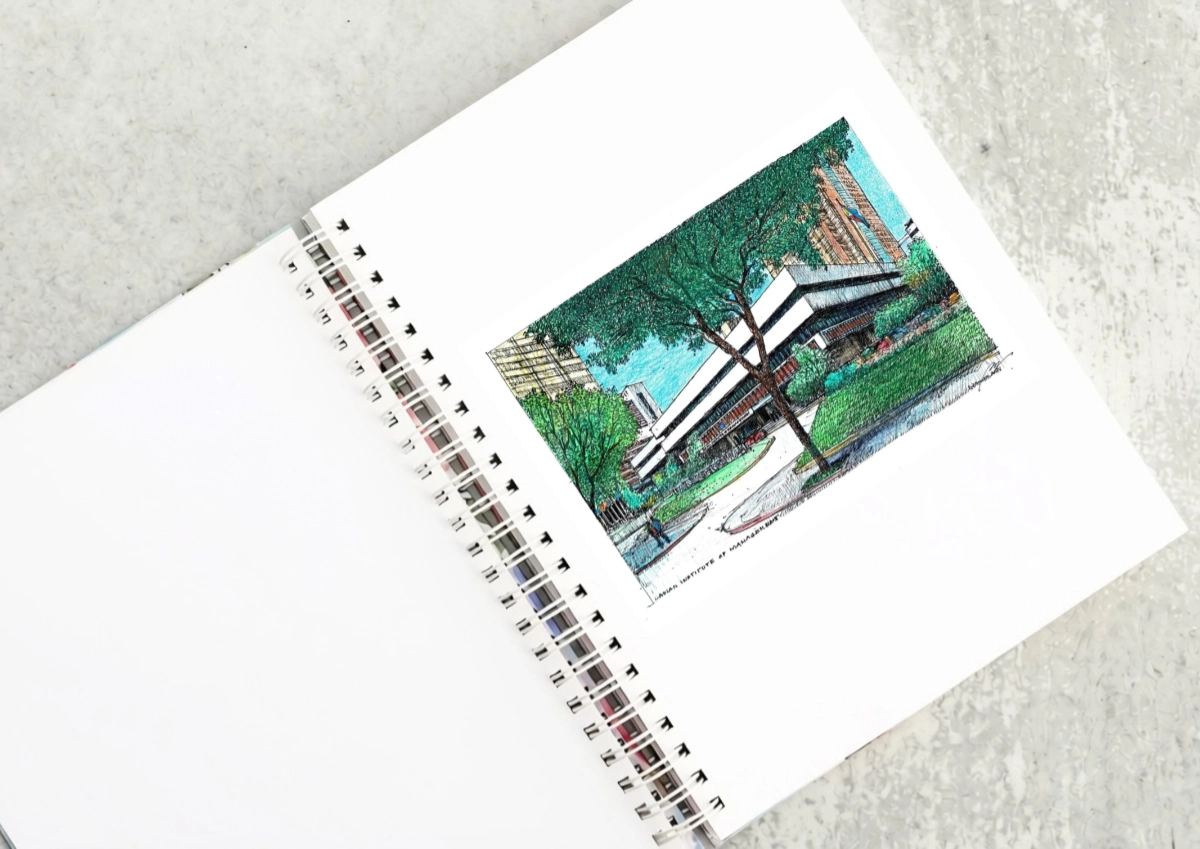
A Filipino Interpretation of Modernist Architecture Unlike the rest of Makati today, the northern end of Paseo de Roxas in Makati is anchored by a low complex rather than a tall skyscraper. This is the elegant Asian Institute of Management, designed by architect Gabriel Formoso and completed in 1971. In my opinion, the building is […]
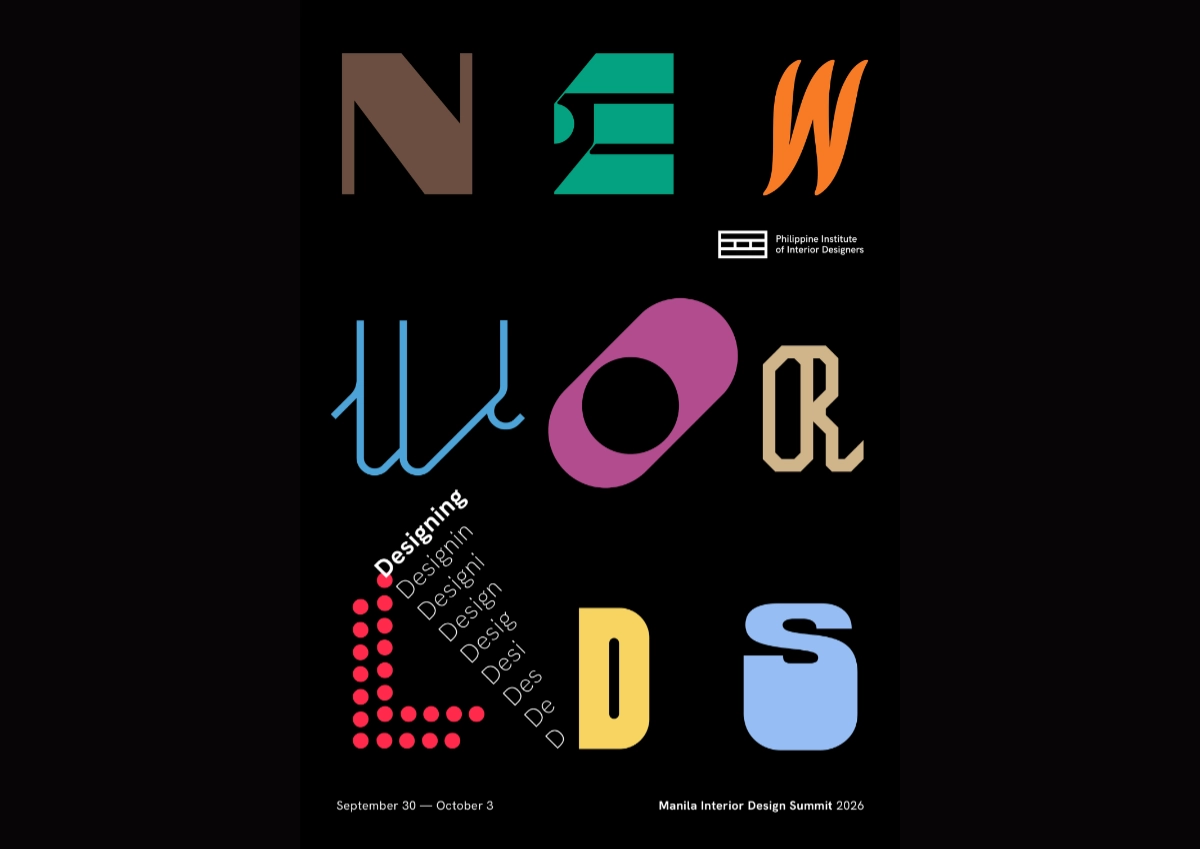
“Thailand has claimed urban creativity and livability. Singapore has institutional design leadership. Indonesia is emerging as a design hub. Vietnam is moving into design innovation. And the Philippines? Its position is not weak. It is simply unclaimed.” For IDr. Cecil Ravelas, National President of the Philippine Institute of Interior Designers (PIID), the challenge is not […]
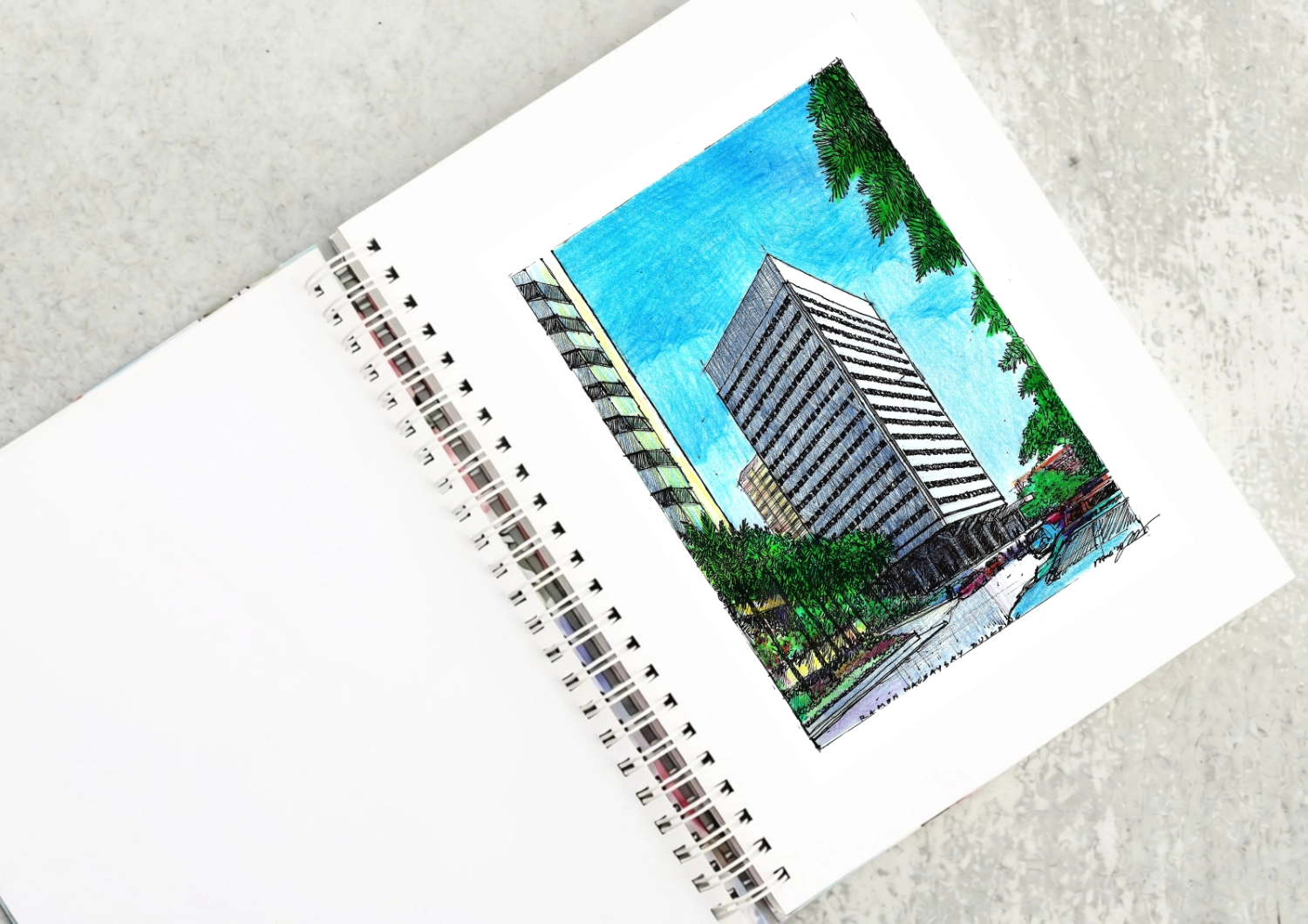
The Ramon Magsaysay Center as a Modernist Landmark Driving down Roxas boulevard from Rizal Park, what will catch your eye is the most elegant modernist structure in the country, the Ramon Magsaysay Center. Most established Filipino architects put it in their top ten lists of favorite buildings. It was designed by Alfredo J. Luz, who […]
Read the issues.

Collect the volumes.

Recommended Video
Tap to Unmute
Unmute
0:00
0:00