Mother/land, the new exhibit by Nicolei Buendia Gupit at Altro Mondo Creative Space, delves into the emotional scars hidden beneath the enduring stories of the Filipino diaspora. Our history with migration is filled with tense desires of seeking better economic opportunities abroad. While wealthy families have long sought opportunities abroad, it wasn’t until the Marcos regime in the 1970s that this trend intensified, evolving into the OFW-driven diaspora we recognize today. This started as economic resistance against Martial Law, but quickly morphed into our institutions today. A huge chunk of our economy today is reliant on remittances from exported labor to other countries.
“Mother/land” by Nicolei Buendia Gupit for Altro Mondo Creative Space.
Many stories tackle the struggle of Filipinos abroad. Gupit, however, comes at this from a different perspective: the offspring of a migrant who never got the chance to establish roots within the country. Her outlook showcases how the trauma of the Filipino diaspora and colonialism can be passed down through generations.
“My mom emigrated to the U.S., and so it meant that I was born in the U.S. after she emigrated,” she said. “I actually was going to school, an elementary school in the first grade in the Philippines in Rosario, Cavite, when suddenly my mom decided to bring me. Without any planning, or without any notice, she had me move and emigrate with her to the U.S.”
Advertisement
Excavating History
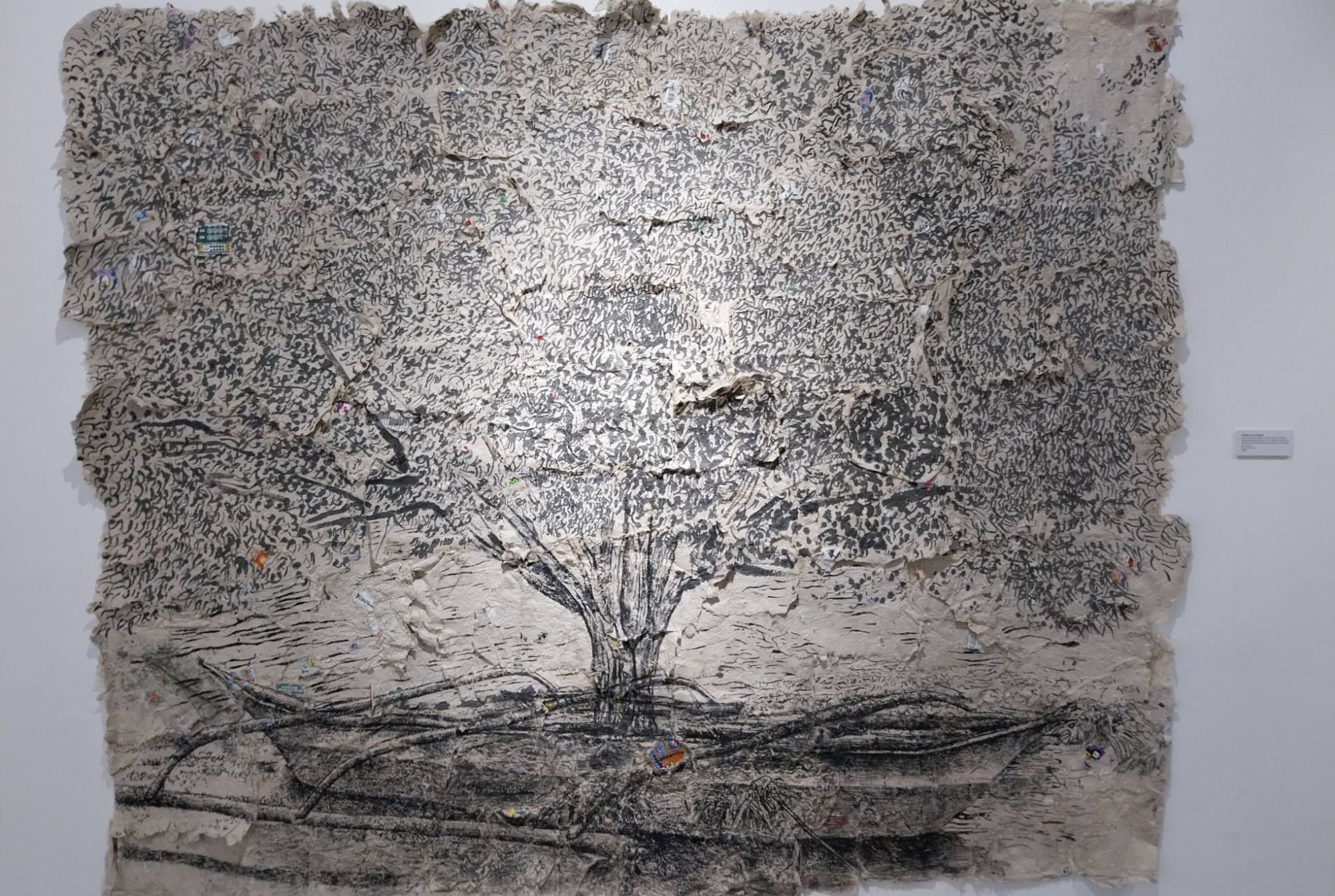
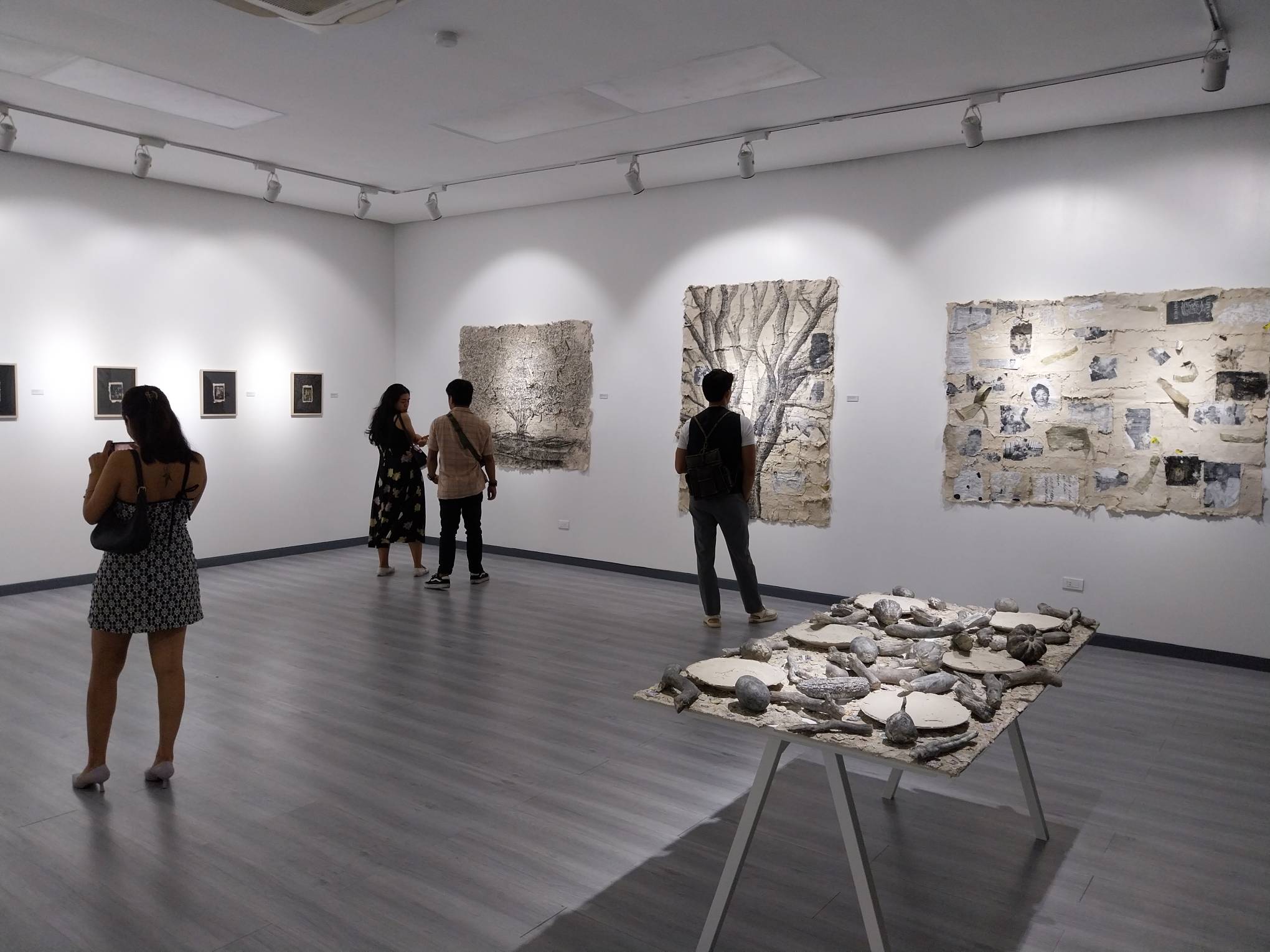
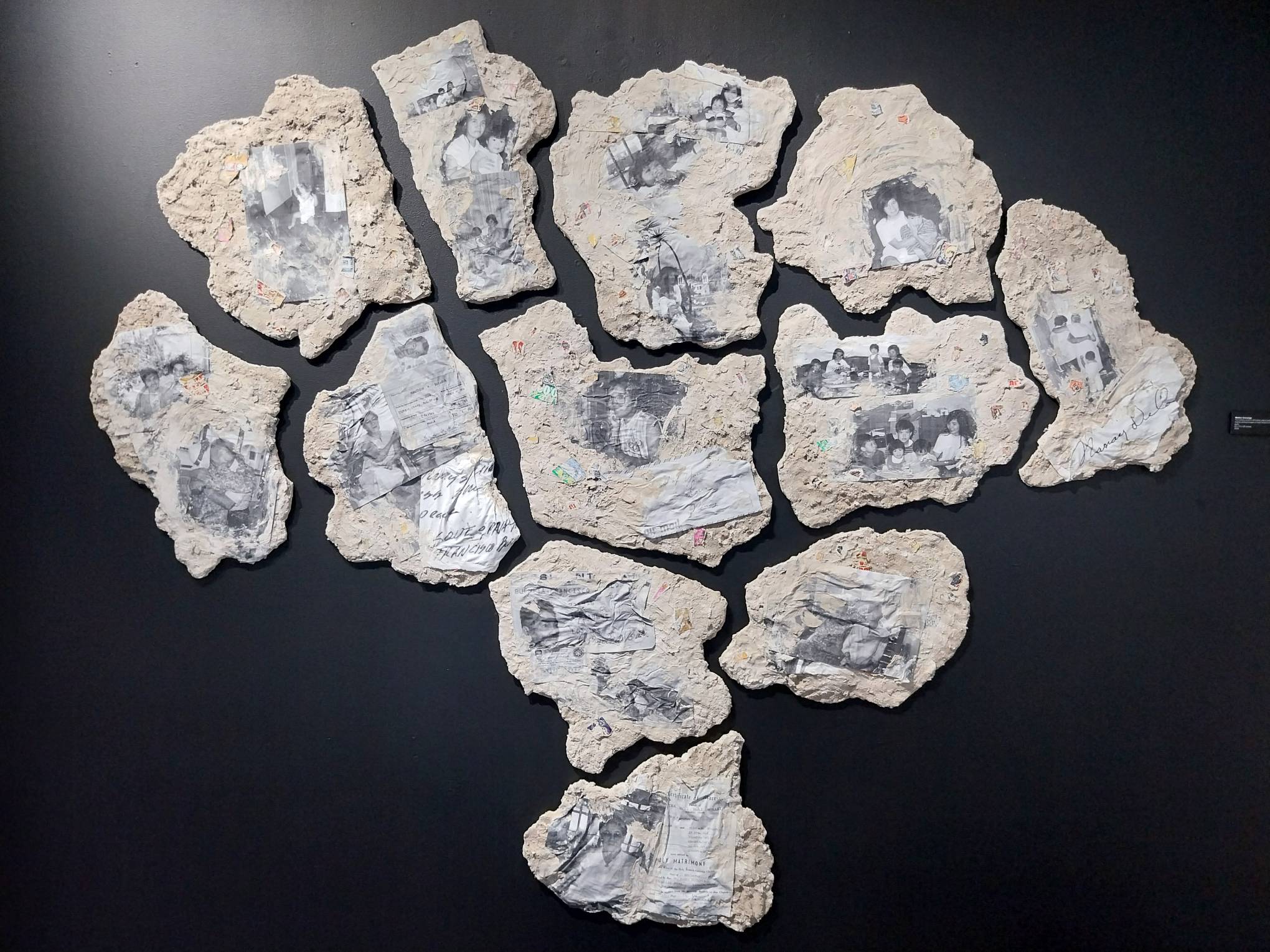
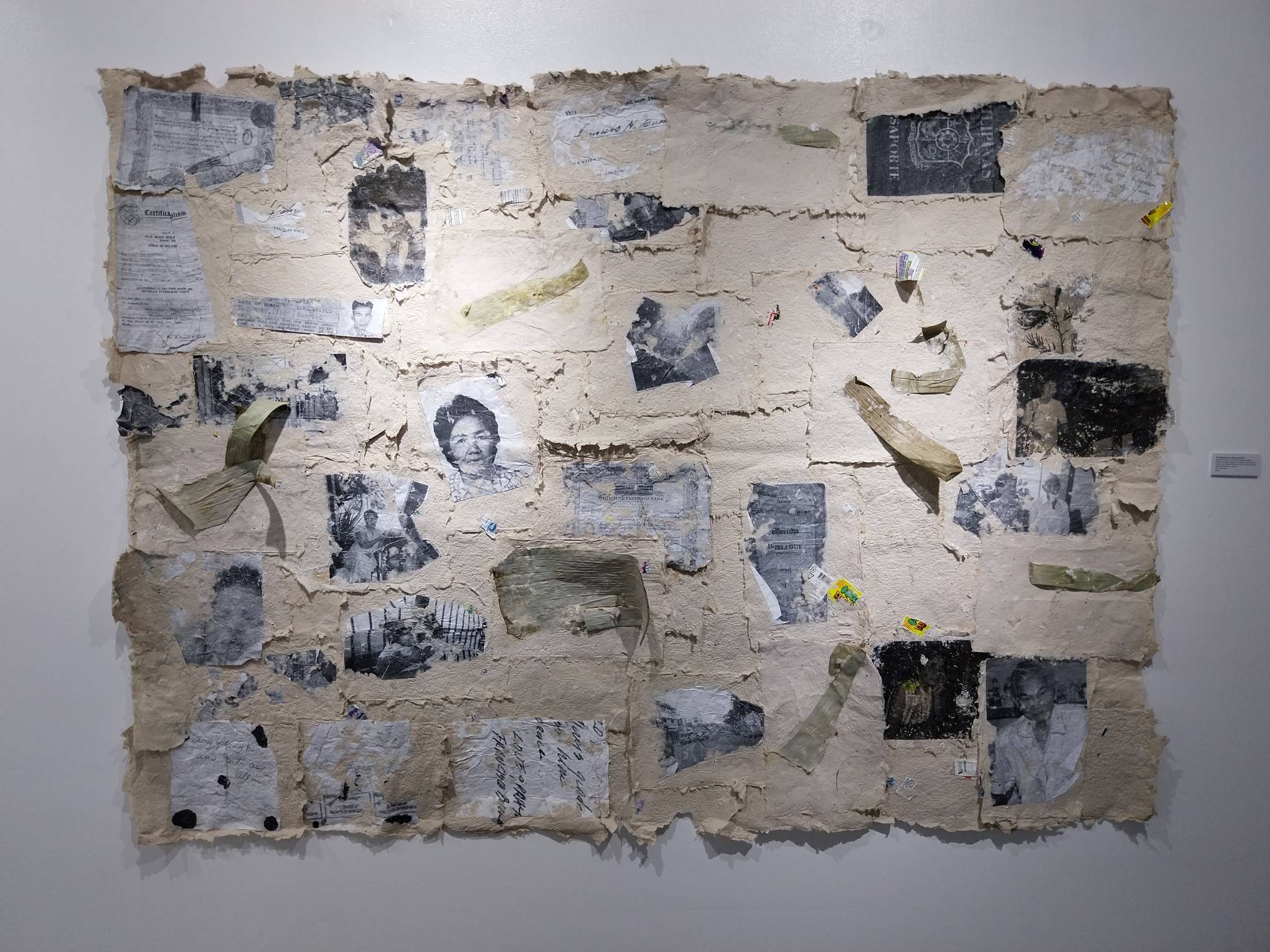
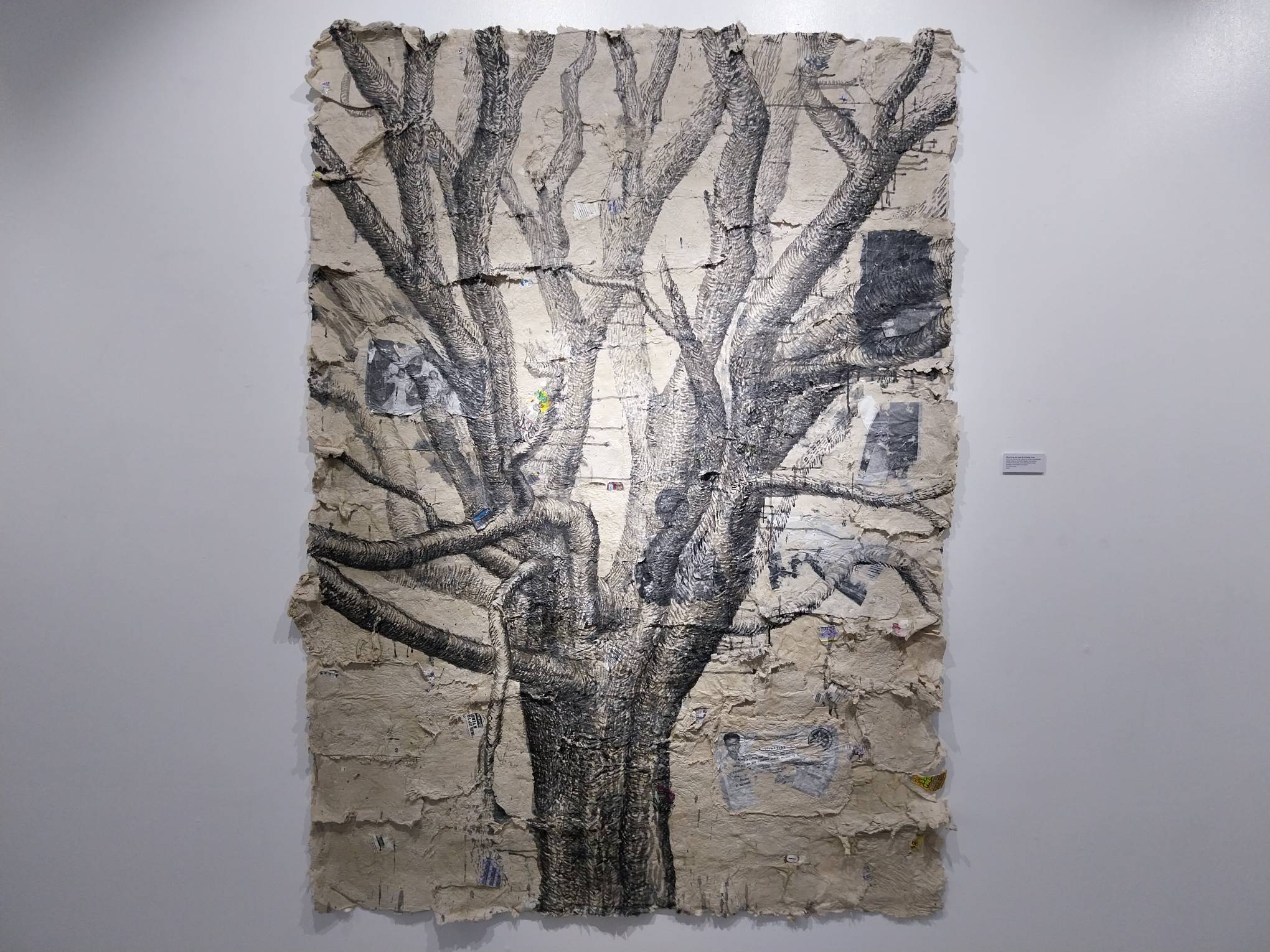
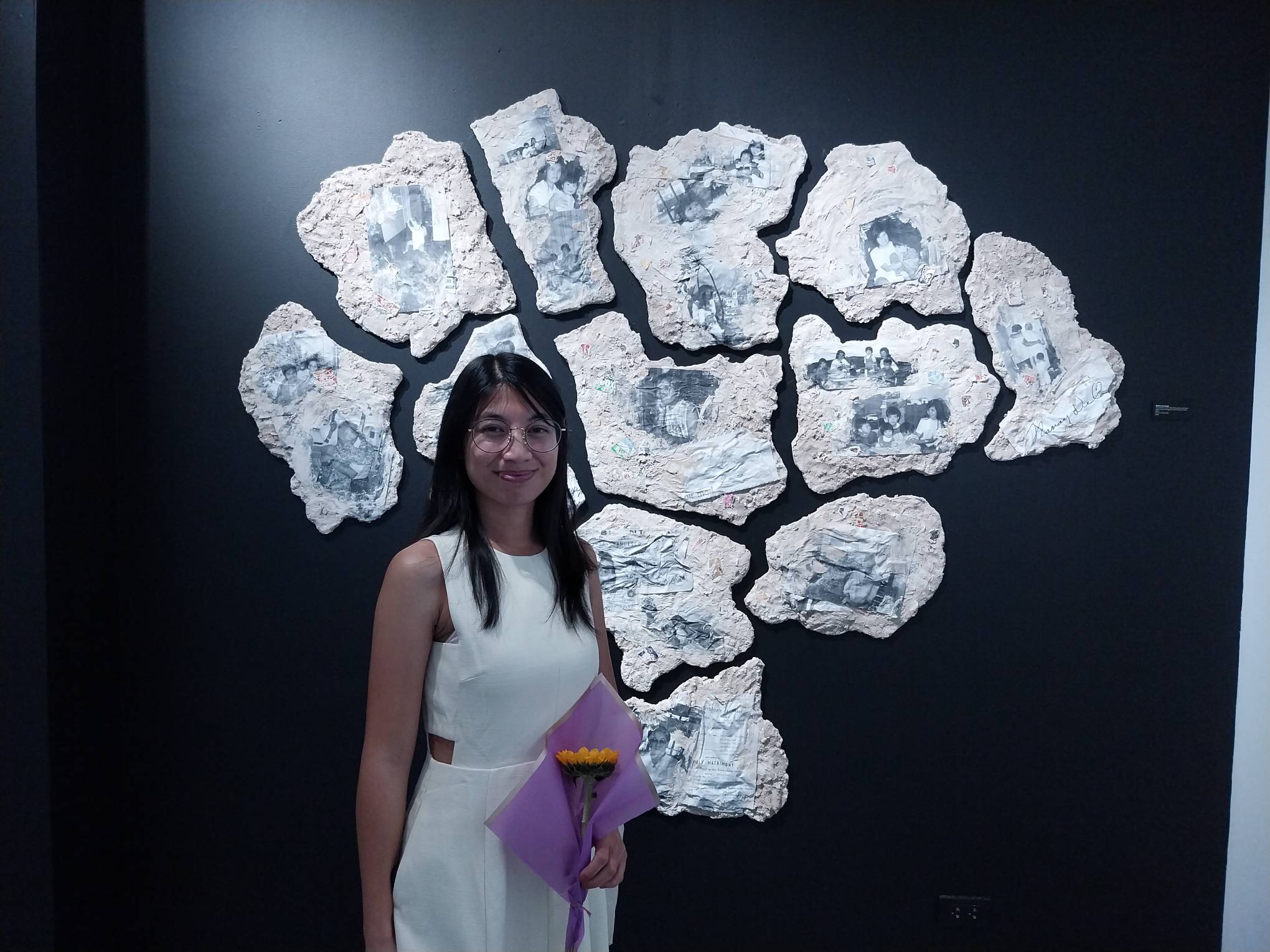
Mother/land is filled with interesting pieces that harken back towards the fracture within migrant families. Nicolei Buendia Gupit uses abaca fibers to attain the look of crumpled paper. She then adds found objects like family photographs and legal documents to create a chaotic collage that portrays the fragmented messiness of her past.
Some of the works appear wrapped and ready to be shipped abroad, akin to the Balikbayan boxes Filipinos are famous for. Others look ripped apart, shredded, and then glued together again to craft something that mimics memories in scrapbooks or photo albums.
That fragmentedness of her work is intentional: she feels that her link to the Philippines is tenuous at best. In our postcolonial world, she exists with a mangled identity. This leaves her unable to connect to her Filipino roots due to growing up with a different cultural identity. That severs her from her Filipino roots and her American upbringing, never fully one or the other.
Advertisement
Thus, the works here attempt to illustrate the “digging,” so to speak, that she has to do in order to connect with her motherland, to understand the connections that she missed out on when she emigrated to the United States.
“Basically, I use paper as a kind of metaphor for excavating history,” she said. “Through paper, I’m able to embed things like those [family] photos, but also lottery scratchers and other found objects into the paper. And then, I kind of stack them vertically, kind of like sediment, you know, layers of [information].
“It’s kind of like an archeological dig, me trying to bring back information about my family history, but there’s so many gaps, there’s so many absences that are part of it, too.”
Advertisement
Fragmented Families
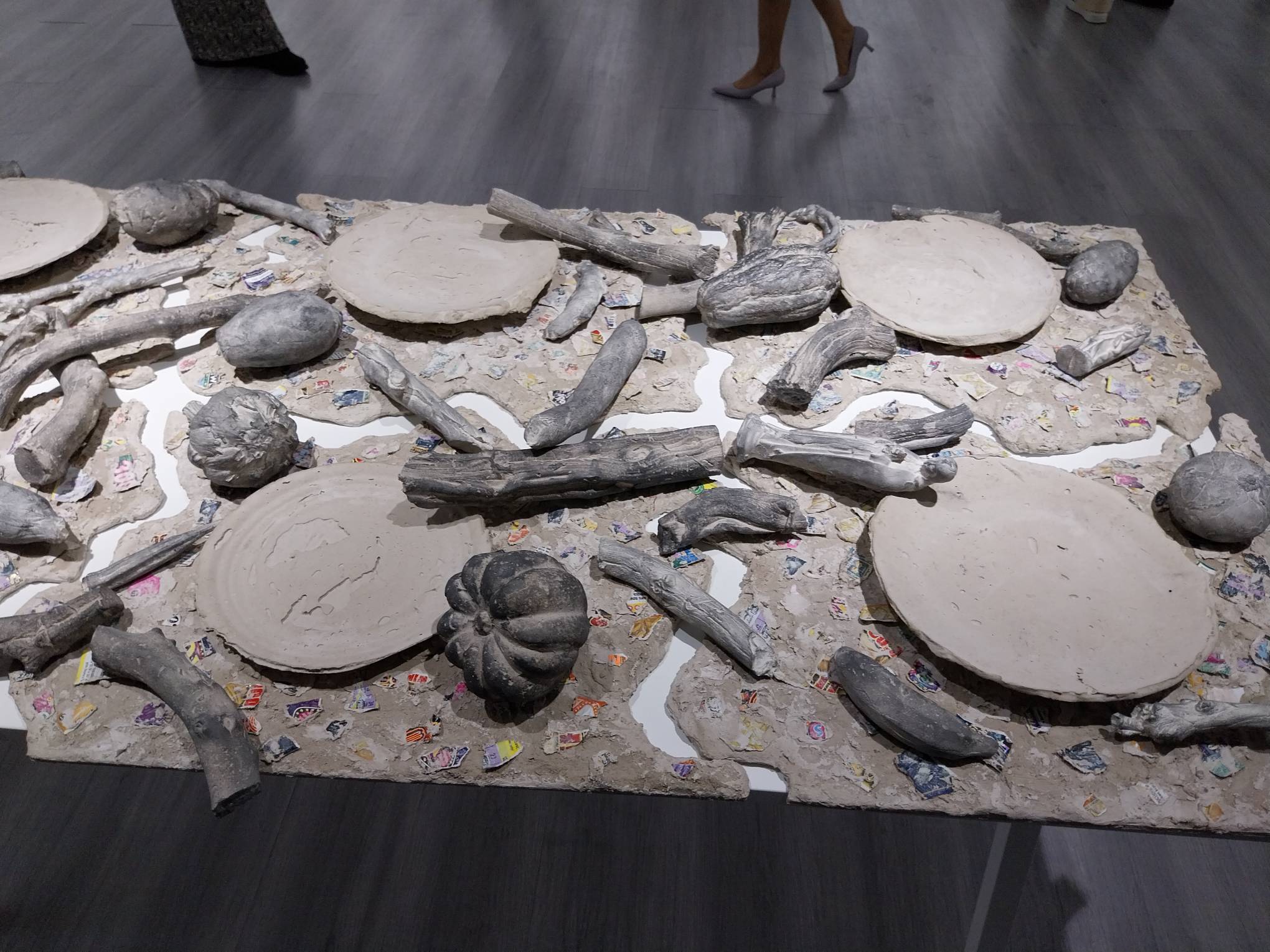
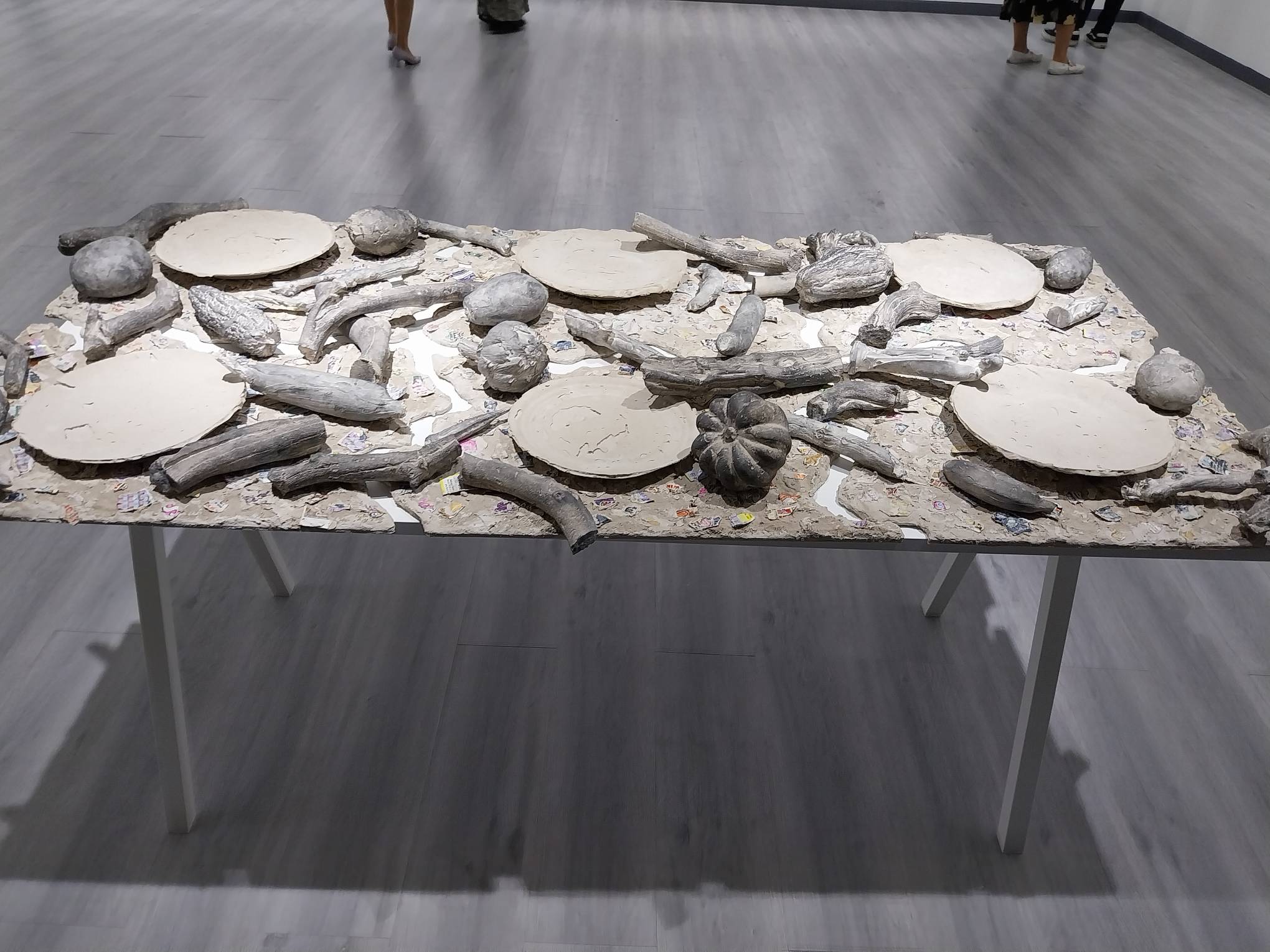
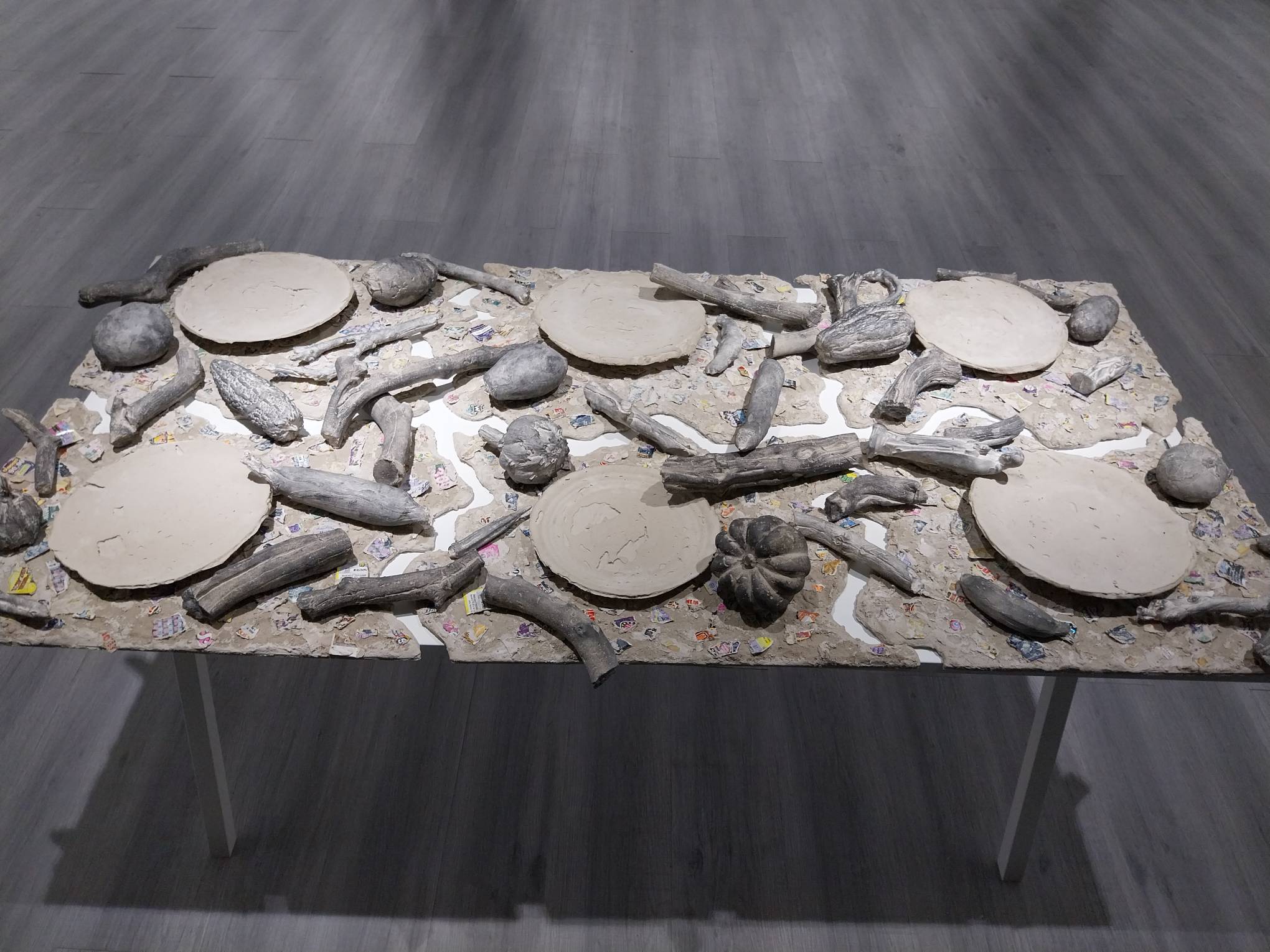
One work in the exhibit is an empty dinner table, a variety of seemingly fossilized vegetables surrounding empty plates. There’s a lack of sentimentality here, evoking the loss of connection for Gupit in families experiencing the effects of diaspora.
Close-up of the empty dinner table mixed media artwork for “Mother/land.”
The empty dinner table mixed media artwork for “Mother/land.”
Artwork by Nicolei Buendia Gupit.
“The loss is like, for example, in my family, we don’t eat together,” she said. “We don’t have reunions in person. We’re not able to spend time together in a meaningful way. And so, that’s something that I think Filipinos in the Philippines often overlook [when discussing diaspora].”
Many of the works in Mother/land show the lack of unity within a family. The paper layers over each other, linking past images and documents shakily together. One work shows an empty family tree, its branches lacking any members. Instead, different documents and crumpled documents float in the scene, seemingly lost in time.
“What I learned is that people often focus so much on the privilege or a kind of perceived success of emigrating or living and working in another location abroad. But then what’s overlooked is the kind of emotional toll [it takes on people],” she said. “Sometimes it’s tragic. The ending is that we don’t have a family tree. It’s really just fragmented. We’re in different geographical places.”
Advertisement
The Lottery of Success
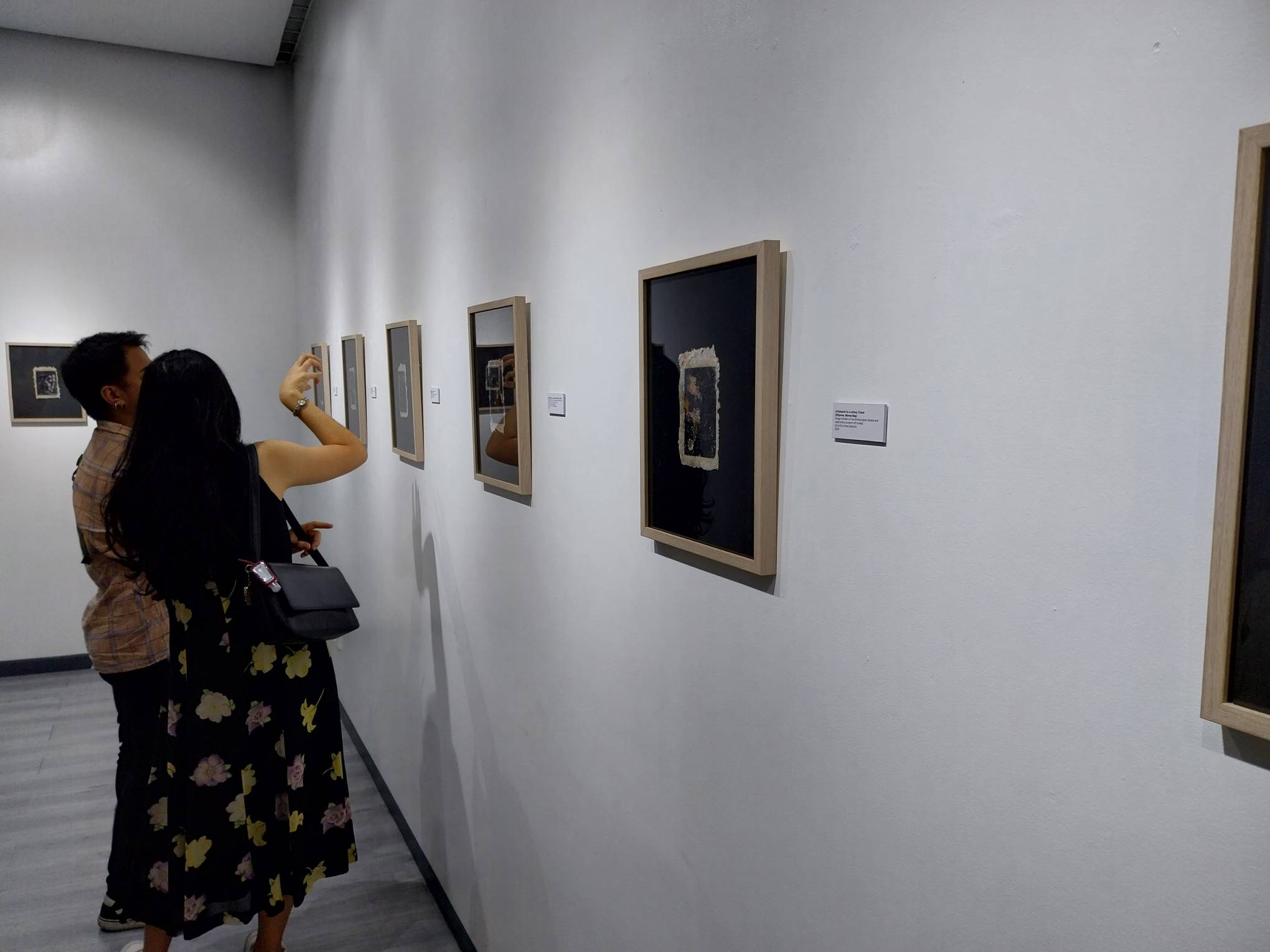
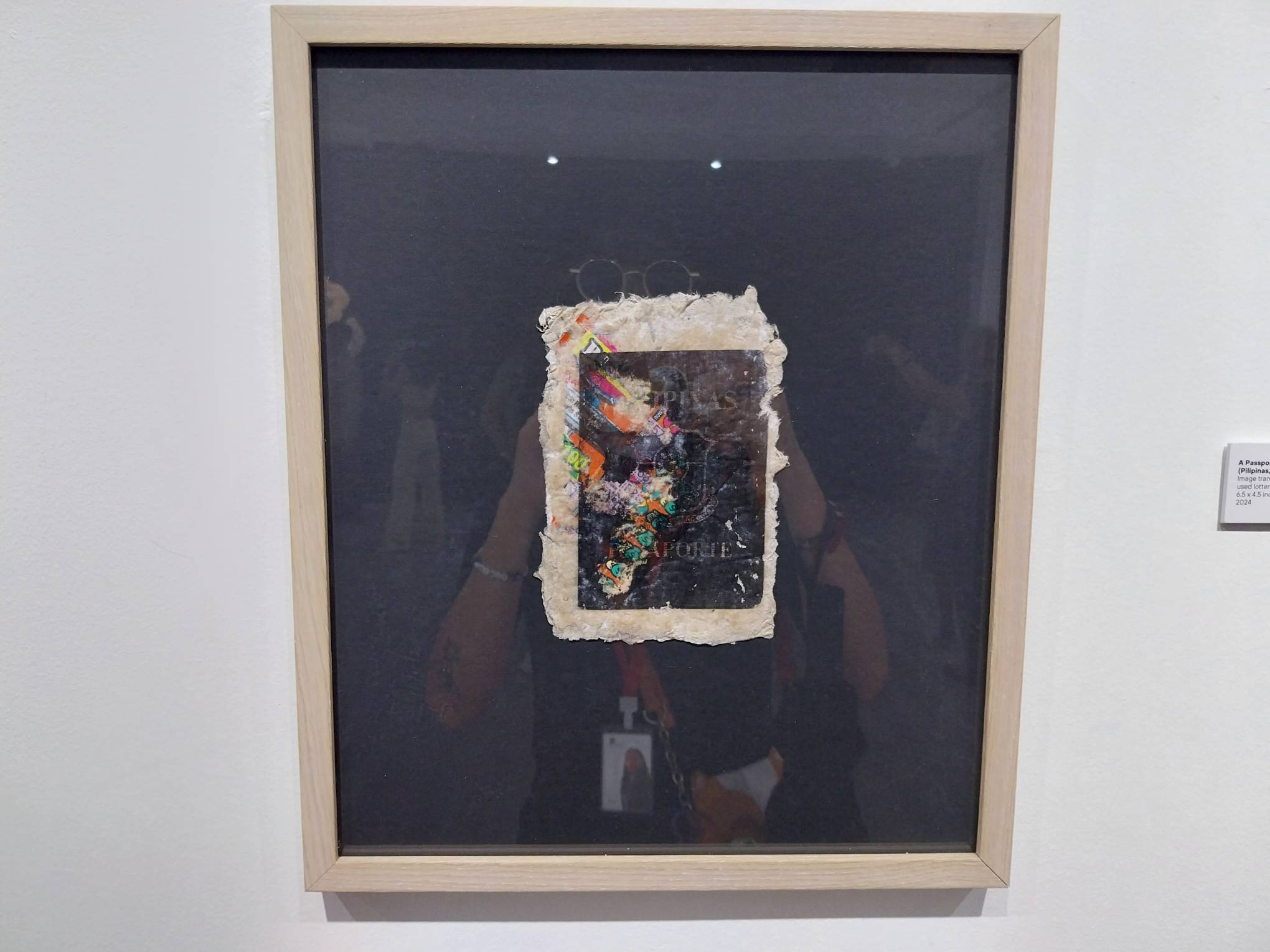
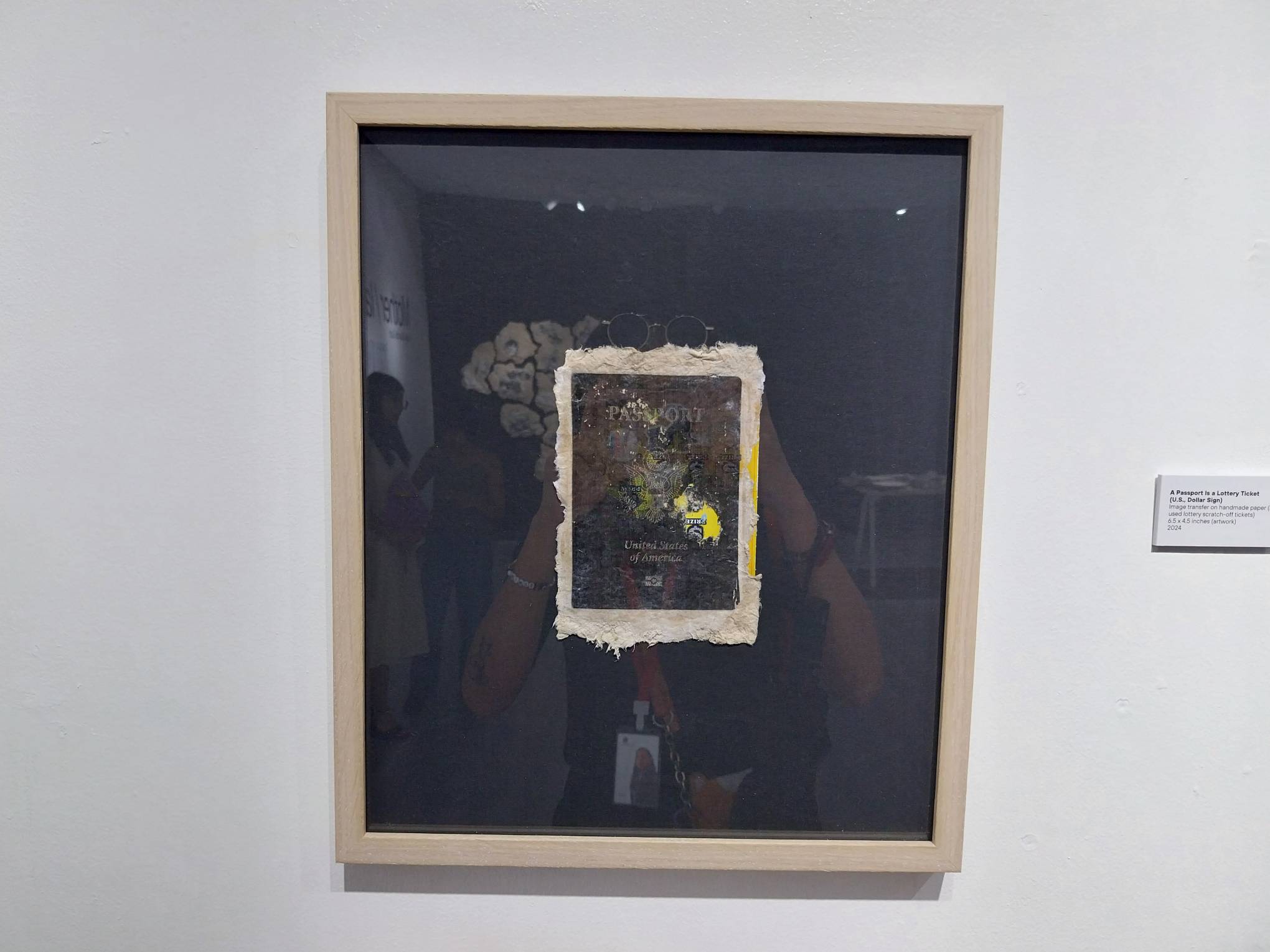
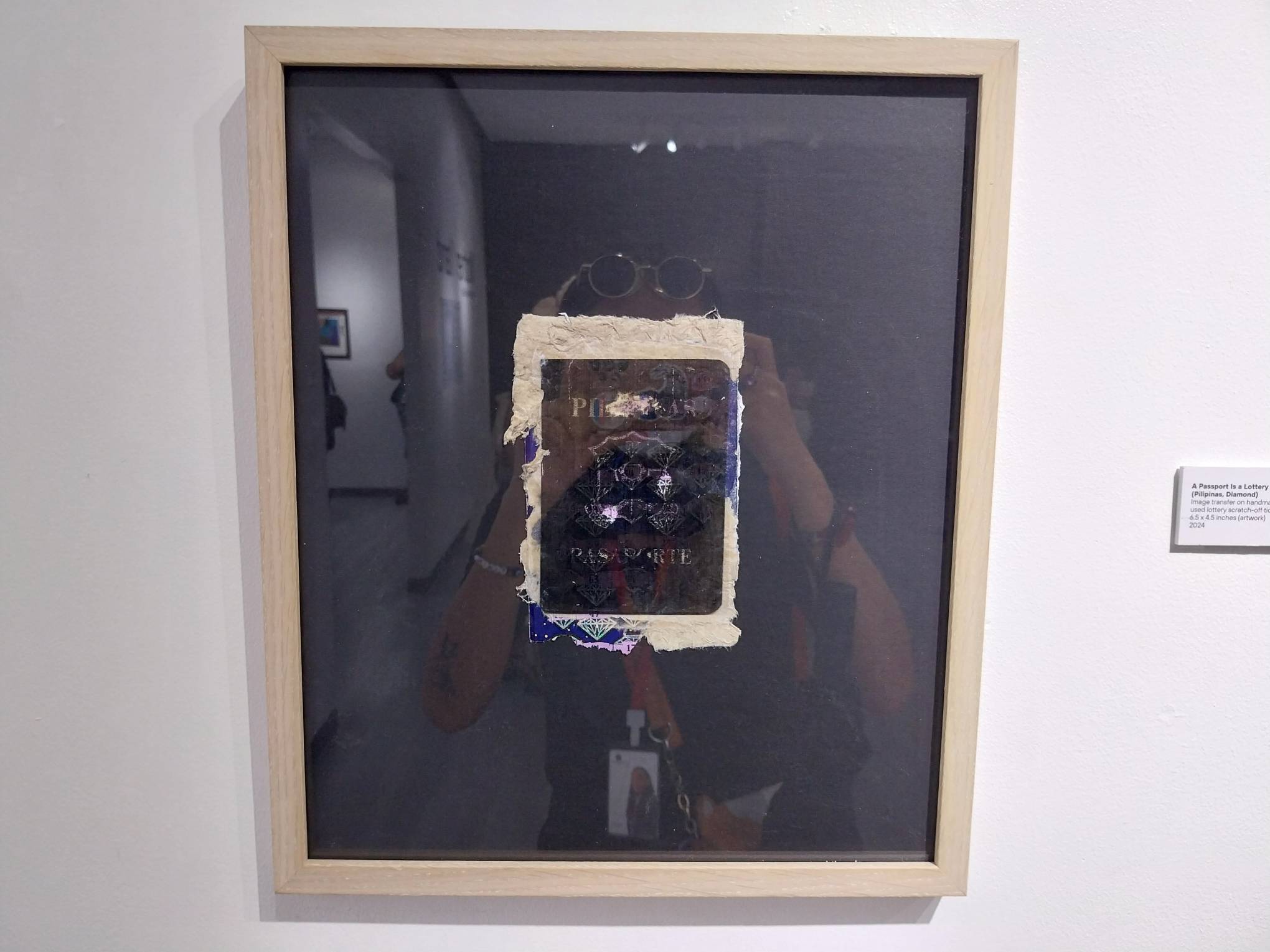
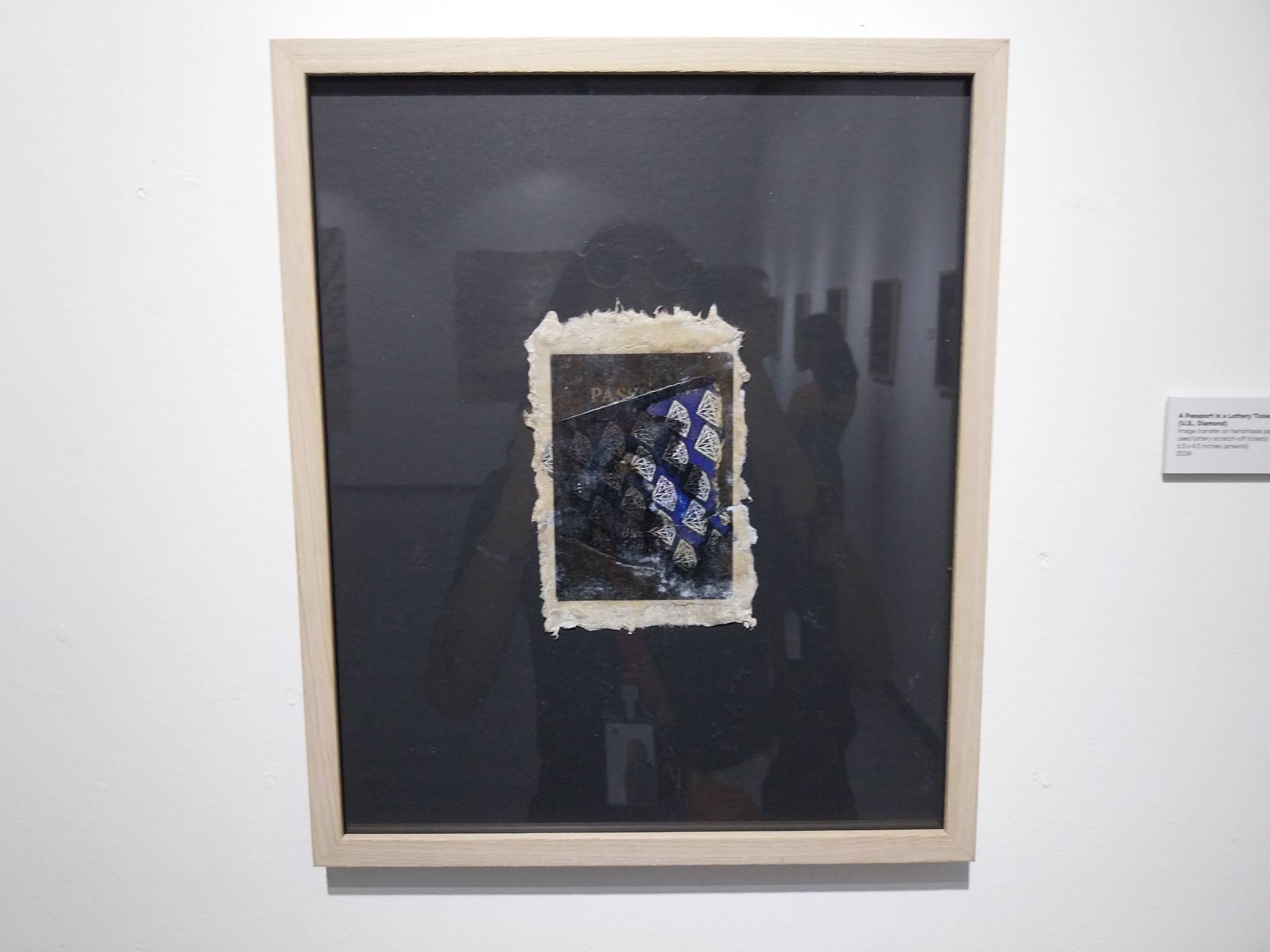
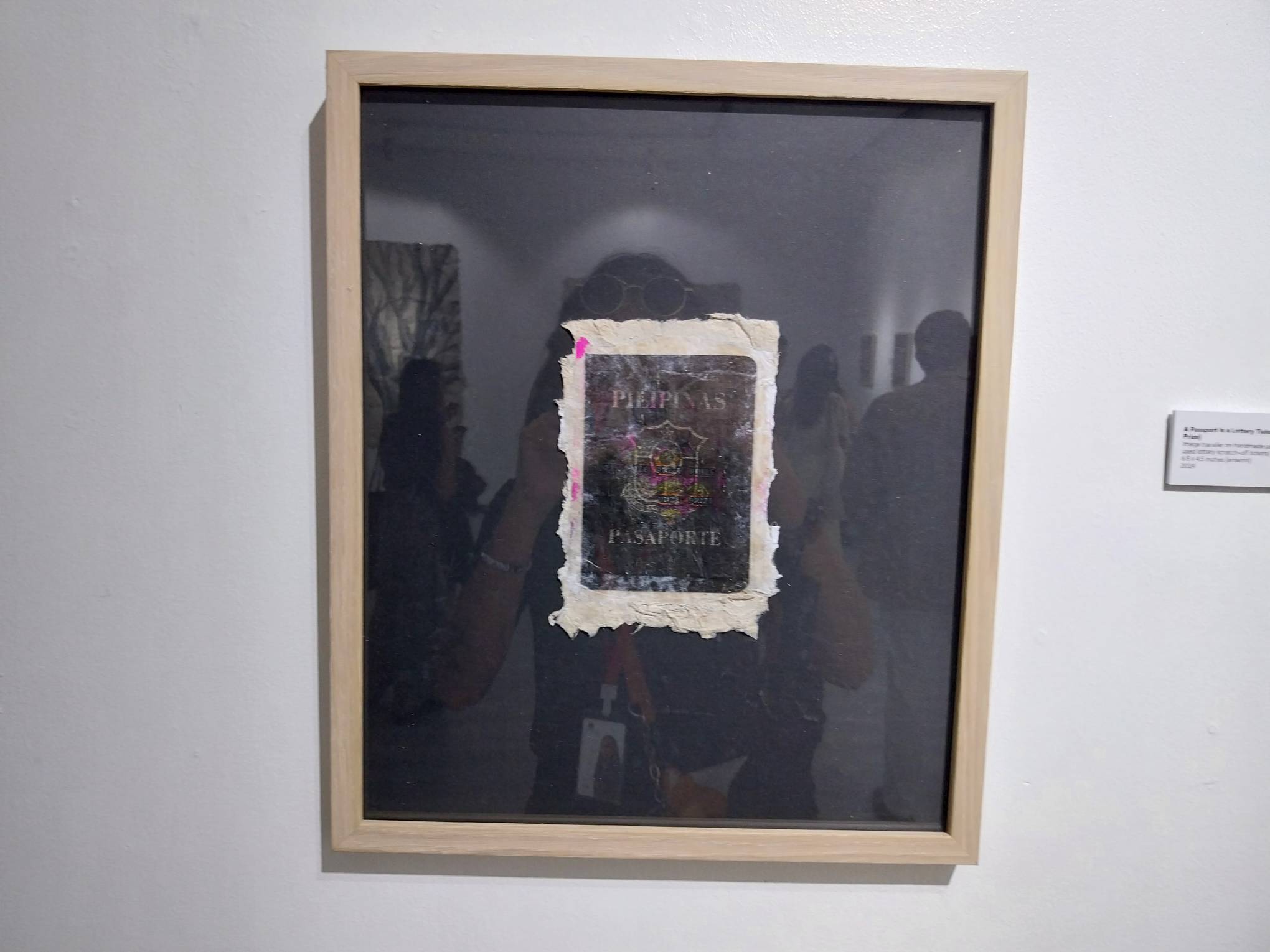
A series of works for Mother/land shows off vandalized Philippine passports, with different symbols imposed over them. They imitate the transparent symbols printed on lottery tickets.
Audience members discussing “Mother/land.”
An artwork by Nicolei Buendia Gupit showing the Philippine passport as a lottery ticket.
An artwork by Nicolei Buendia Gupit showing the Philippine passport as a lottery ticket.
“The reason why I used the [image of the] lottery ticket in a lot of the works is because I think of diaspora as a gamble, where there’s no guarantee that people will be economically successful. But there’s a kind of promise, right, because of the American dream, people think that if they gamble on their life, that they have a chance to become successful,” she said.
The Consequences of Colonialism
Mother/land is a compelling look at the kind of destructive force that labor exportation has become in the Philippines. The Philippine diaspora negatively touches the lives of even those thought privileged to leave.
The artist Nicolei Buendia Gupit in front of one of her works for “Mother/land.”
Even the supposed financial upsides might not pan out; the country ends up with severed families and the destruction of the community that affects how our culture grows onward. It makes the audience reckon with the stark effects of this practice. The exhibit asks us to consider the emotional toll it puts on families, cultures, and the country as a whole.
Advertisement
“It’s also always a story about sacrifice and loss,” she said, “and that it’s much more complicated than a simple story. So I use my family as just a case study to speak on [the] many varied and diverse experiences of the diaspora.”
Mother/land is showing in Altro Mondo Creative Space until November 29.
Denise de Castro, Principal Architect of DEQA Design Collaborative, believes that designing with equity in mind means starting at the workplace. Values and practices that your studio or office espouse inevitably filter down to the work that you do. Equitable design ensures that people with different needs and different backgrounds are supported through fair access, […]
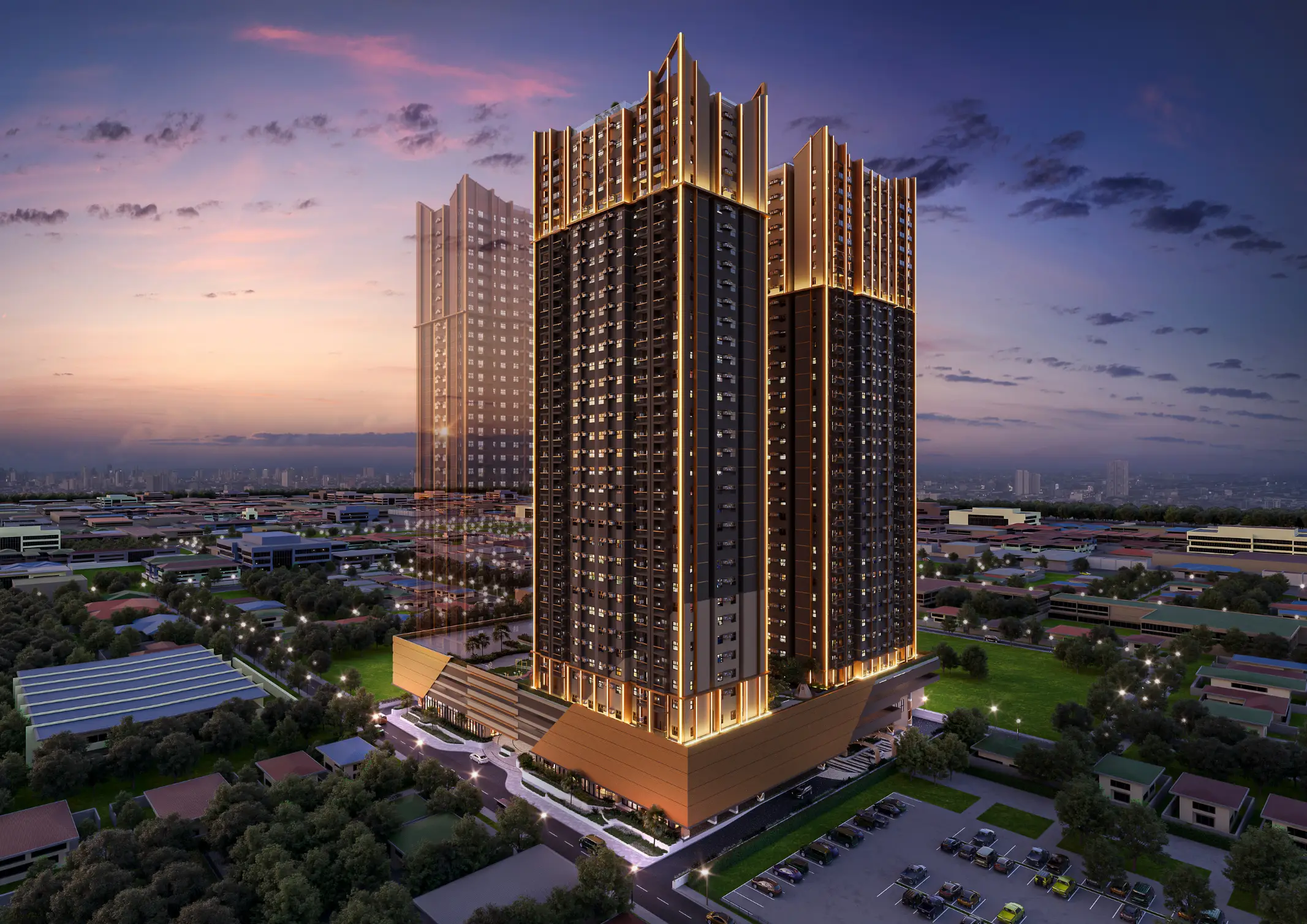
Across Metro Manila, residential developments are increasingly designed around proximity. As cities grow denser and mobility becomes more complex, new housing is often positioned near transport nodes, commercial districts, and educational institutions. This approach reflects a broader shift in urban planning. Mixed-use environments allow residents to live closer to daily necessities—reducing commute times while supporting […]
Luxury in design is undergoing a quiet shift. Where once luxury was measured primarily through visual opulence, today it is increasingly defined by responsibility—through the way spaces are built, the materials selected, and the impact those decisions leave behind. At the Philippine World Building and Construction Expo (WORLDBEX) 2026, this evolving definition of luxury takes […]
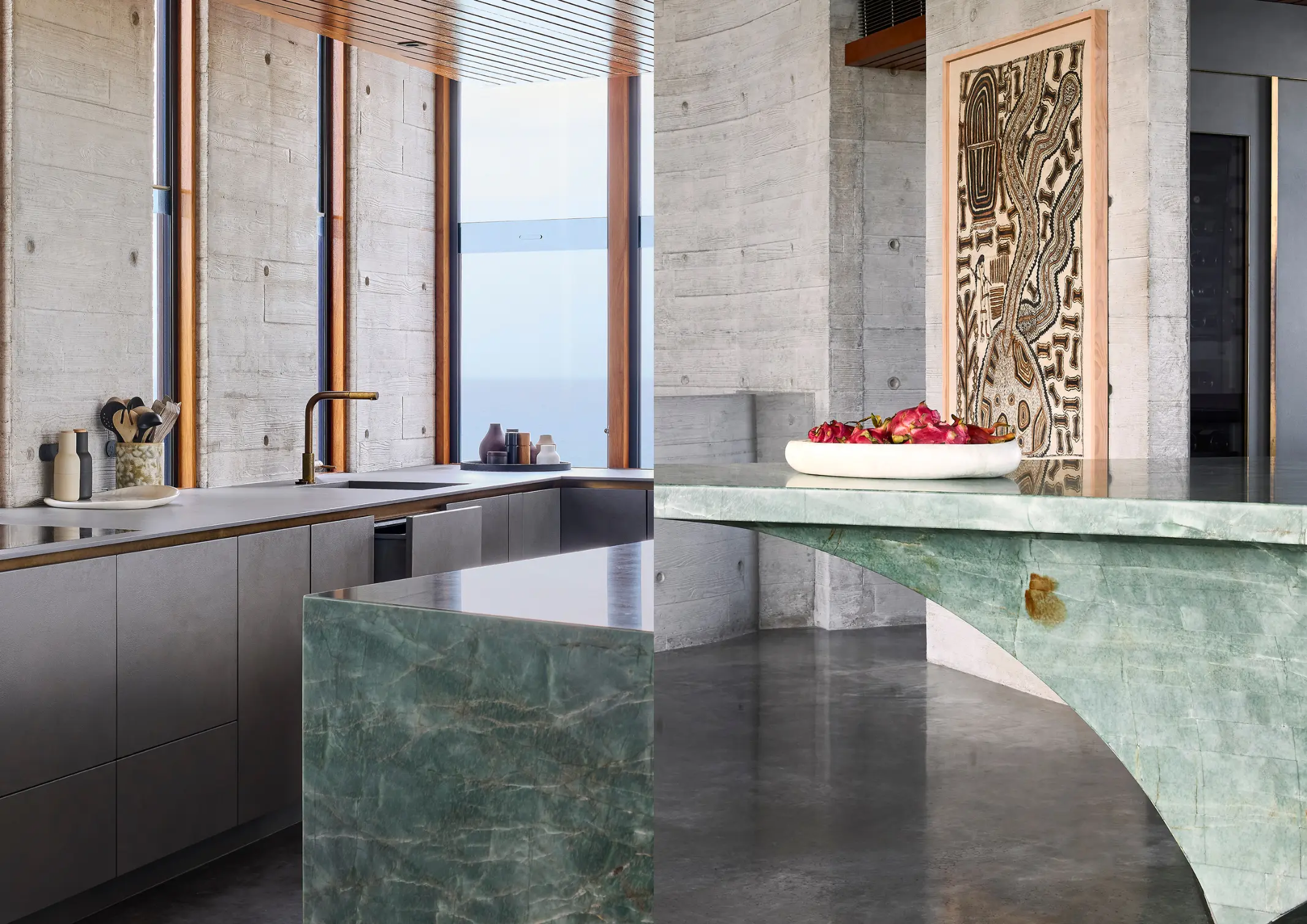
For more than nine decades, Fisher & Paykel has approached design with a simple but exacting belief: that the best living environments are those shaped by people, place, and purpose. Rooted in New Zealand and deeply attuned to island and coastal living, the brand’s philosophy centres on quiet performance, material honesty, and appliances that integrate […]
At Helm, dining unfolds as choreography. An open kitchen anchors the room, allowing guests to witness the precision behind its Michelin-starred fine dining menu. Designed by Kevin Nieves of Headroom, the 24-seat restaurant reflects that same discipline in its interior design. Tucked within Ayala Triangle Gardens in Makati, Helm brings together culinary recognition and architectural […]
Exhibition designer Baby Imperial of All At Once shaped the spatial strategy of ALT ART 2026, its largest edition to date. The fair occupied Halls 1 and 2 of SMX Convention Center Manila, expanding in both footprint and ambition. Organized by the ALT Collective—Artinformal, Blanc, The Drawing Room, Galleria Duemila, Finale Art File, MO_Space, Underground, […]
Download this month's BLUPRINT magazine digital copy from: