The first thing people usually think of when they think about art is “paintings.” The brush, the palette of colors, the canvas: all come together to form what people stereotypically see as “art.” But a deeply important medium within the large umbrella of “art” is sculpture.
Sculpture is an essential part of our conceptualization of artistry, especially because, unlike many paintings, sculptors work in a three-dimensional medium, seeing angles and ideas that painters may not consider.
For our year-end roundup this 2025, we give a salute to the sculptors and ceramicists of our era, as we see the ways the art form has evolved in 2025, and what that hints for its future within our local art scene.
Advertisement
The Orlinas and Glass Sculpture
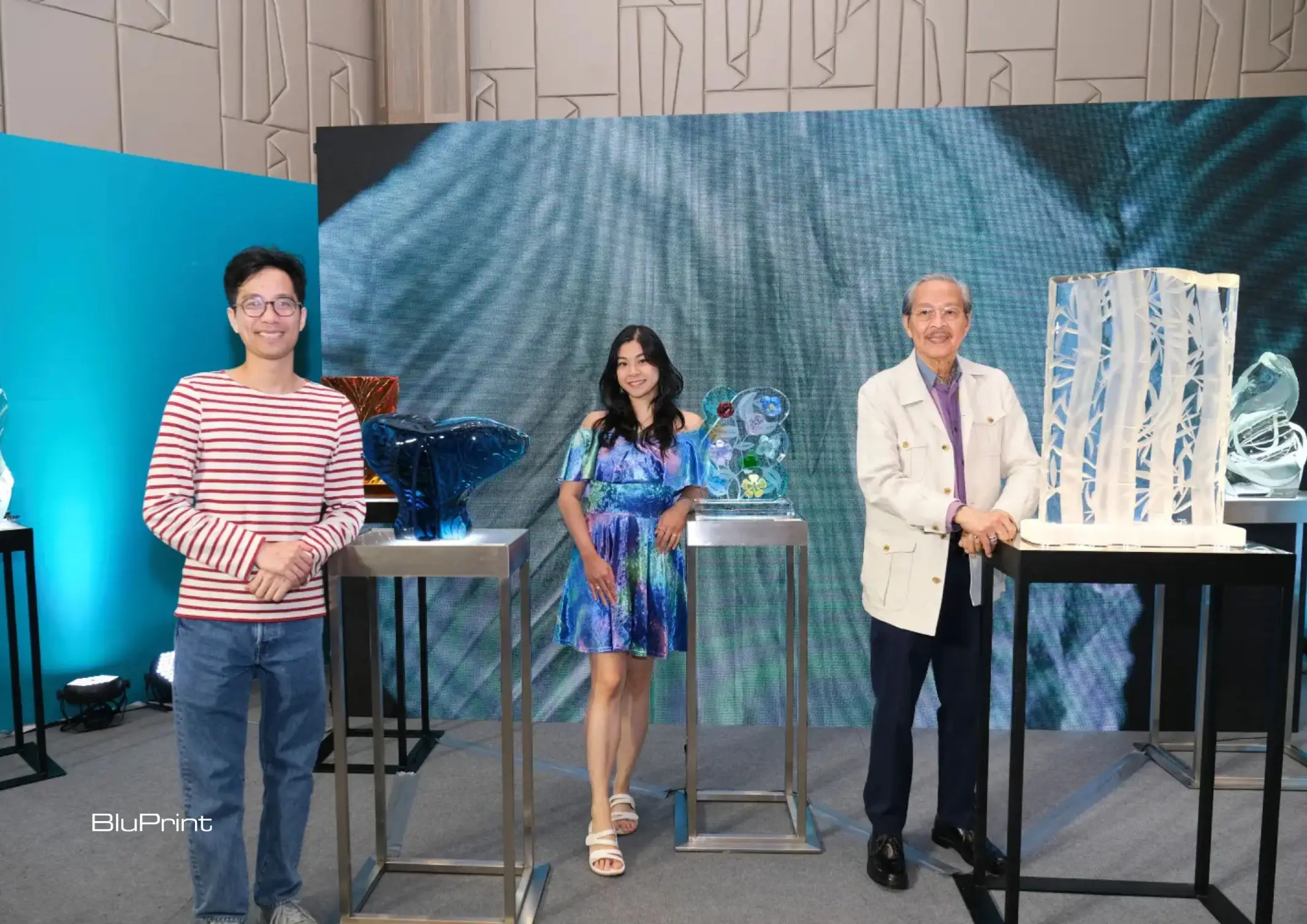
The Orlinas—patriarch Ramon Orlina, and his children and protégés Anna and Michael—have had a very active year in the Philippine art scene. Michael Orlina, for example, had his debut solo exhibition in Galerie Stephanie this year, while Anna Orlina ventured into fashion during the Lamina Lifestyle Fair.
The Orlina Family, featuring Ramon, Anna, and Michael, showcasing their works for MoCAF 2025.
Ramon Orlina is one of the signature figures of glass sculpture in the Philippines; indeed, he may be the signature figure, especially as he is still active in today’s art scene. Orlina’s children have taken up the mantle of glass sculpture, and they bring with them newer techniques they learned abroad to push the boundaries of local glass sculpture to new heights.
And as all three continue to be active in the sculpture scene, whether directly or by exhibiting up-and-coming sculptors in Museo Orlina, they bring with them the hope for a Philippines to be truly at the cutting edge of the art world.
The Pettyjohns and Moving Philippine Ceramics Forward
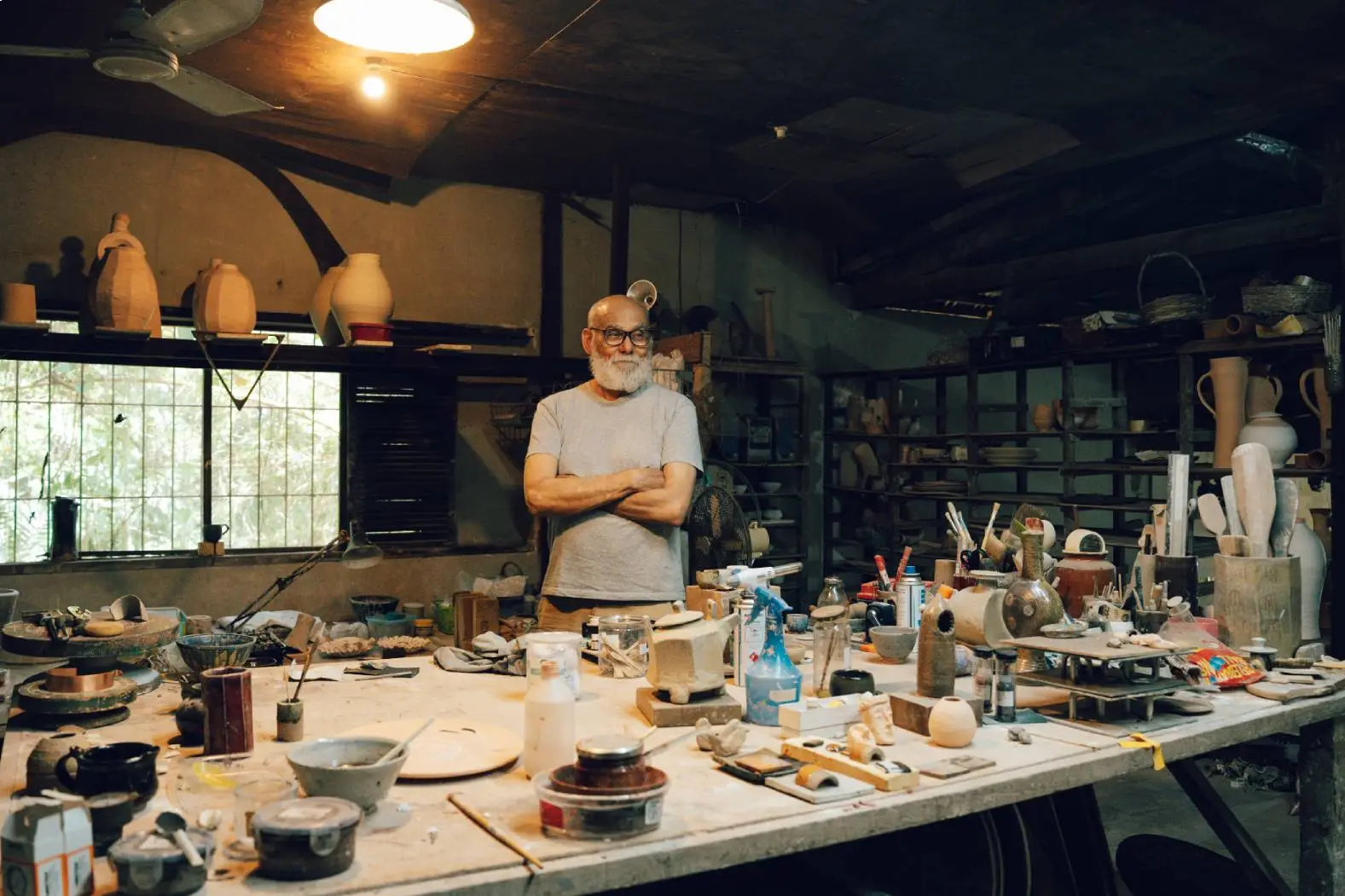
On the other side of the sculpture divide is Jon and Tessy Pettyjohn, pioneers in Philippine pottery and ceramics. Jon himself was in the spotlight this year for his collaborative exhibition with his daughter Hanna, and the exhibition highlighted the differing styles of the two and how they found a way to bridge them together for the exhibition.
Jon mixes the modernity of the craft today with the traditions of the past; at times, he has expressed his gratitude for being able to witness and learn indigenous ways of making ceramics in the country. The ability to merge the two, to find a harmonious balance between the past and the future, is what makes him such a significant presence in the art world today.
Jon Pettyjohn at his and his wife Tessy’s workshop.
“The history of crafts always continually absorbs what’s [the] new available techniques and materials,” he said. “That’s important. If you try to keep anything [the same], anytime you talk about purity, or keeping something, the traditional art, like, pure, that’s a very deadly thing because then it dies. If it cannot evolve, it’s finished.”
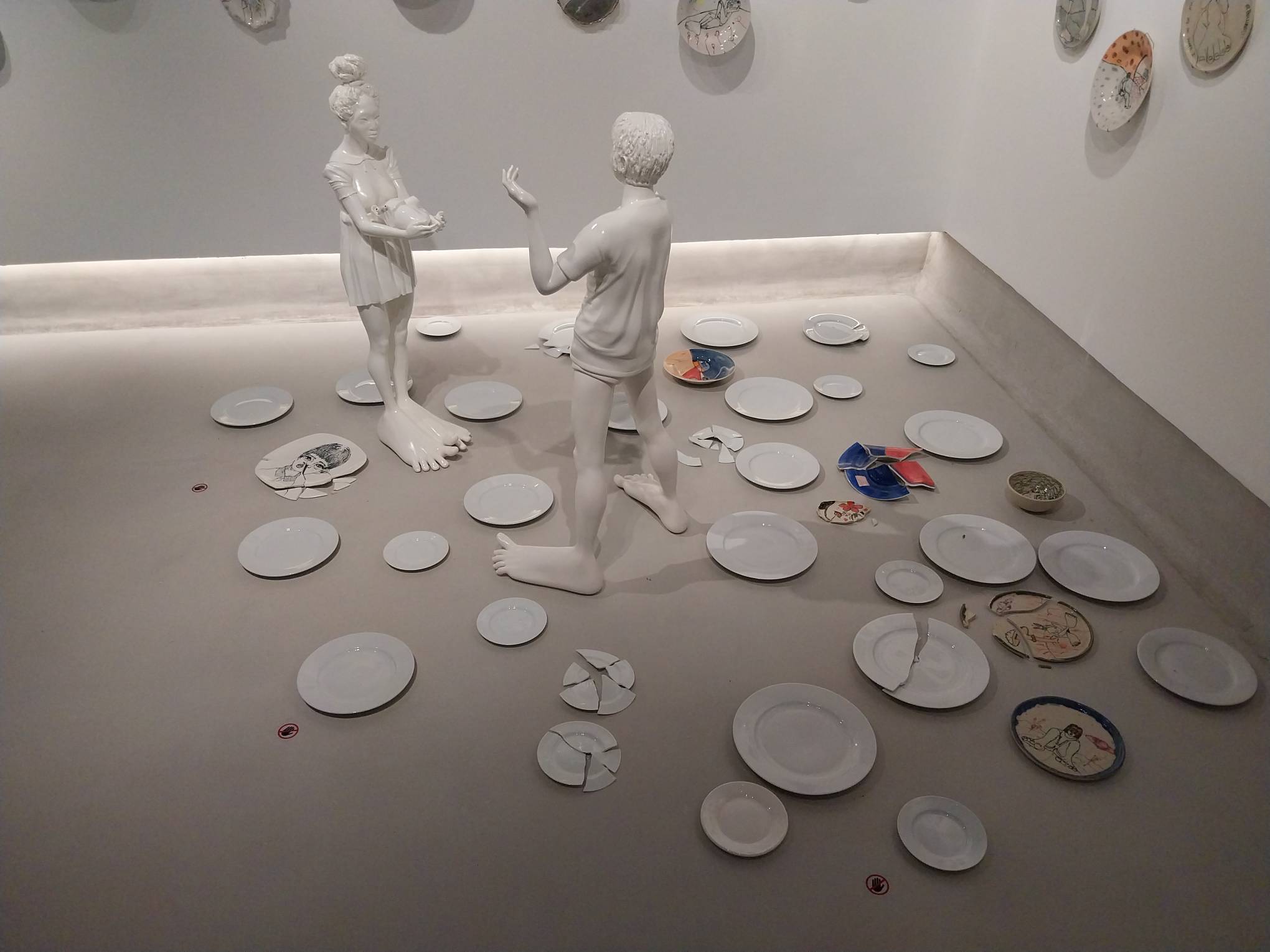
For more unique uses of sculpture within the art scene, Ciane Xavier’s February exhibition at Galerie Stephanie, Breaking to Mend, utilizes porcelain statues, plates, and figures to depict a slew of scenarios and emotions inherent to the human condition.
One angle of the work of Ciane Xavier in the exhibit. One of the figures is giving their heart to the other.
In there, the discussion centers on the portrayal of the fragility of human emotions, especially with its central sculptures of two people in the midst of an argument, whilst surrounded by broken plates. It is a very evocative exhibition, and one that shows a way for sculpture to meld the figurative language of art to the literal materiality of sculpture.
Advertisement
“In its fragility, this delicate material is strengthened by stories that are glazed by the human emotions and the relationships that bind one to another,” the exhibit write-up said. “This exhibition is an invitation to engage in the metaphorical mending of ‘moments we cherish and the moments we fear.’”
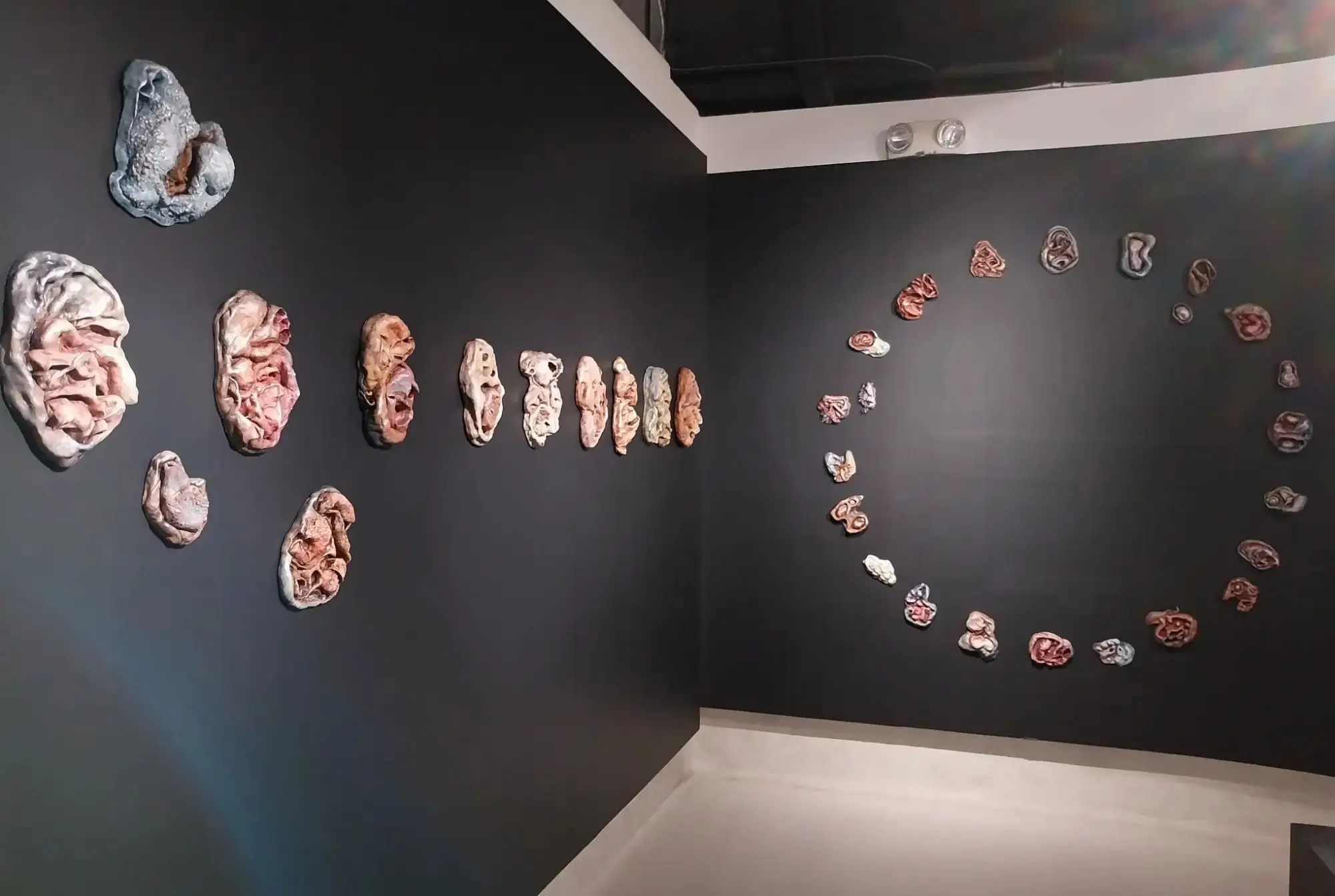
Finally, in this list, we have Sam Feleo, whose artwork experiments with form and structure, creating pottery and sculpture with a one-of-a-kind organic look to their forms. Feleo does this look by avoiding common pottery techniques like glazing, only doing bisque firing for the works, and hand-painting each creation itself.
Sam Feleo’s artworks as shown in “Grip/Pulse” at Cartellino Art.
It ends up looking strange and fleshy, folded in ways that ceramics tend to avoid, and at times with crystals clutching to the structure after being buried in water for a period of time. The works look fluid and flowing, embodying the “embryonic state” that she wanted to showcase in her exhibitions.
Advertisement
“Kaya siya embryonic forms kasi gusto ko paglaruan ang idea na ang art, hindi nila kailangan maging static, pwede siyang nag-ta-transform, nag-pupulsate,” she said. “I wanted to capture that softness, the organicness in these works.”
These four examples illustrate sculptors’ appetite for innovation in the field of sculpture. Whether it’s merging the past and the present, or coming up with new methods that go against the grain of society, Philippine sculpture refuses to be stagnant—only growing more and more interesting as time goes by.
Denise de Castro, Principal Architect of DEQA Design Collaborative, believes that designing with equity in mind means starting at the workplace. Values and practices that your studio or office espouse inevitably filter down to the work that you do. Equitable design ensures that people with different needs and different backgrounds are supported through fair access, […]
Across Metro Manila, residential developments are increasingly designed around proximity. As cities grow denser and mobility becomes more complex, new housing is often positioned near transport nodes, commercial districts, and educational institutions. This approach reflects a broader shift in urban planning. Mixed-use environments allow residents to live closer to daily necessities—reducing commute times while supporting […]
Luxury in design is undergoing a quiet shift. Where once luxury was measured primarily through visual opulence, today it is increasingly defined by responsibility—through the way spaces are built, the materials selected, and the impact those decisions leave behind. At the Philippine World Building and Construction Expo (WORLDBEX) 2026, this evolving definition of luxury takes […]
For more than nine decades, Fisher & Paykel has approached design with a simple but exacting belief: that the best living environments are those shaped by people, place, and purpose. Rooted in New Zealand and deeply attuned to island and coastal living, the brand’s philosophy centres on quiet performance, material honesty, and appliances that integrate […]
At Helm, dining unfolds as choreography. An open kitchen anchors the room, allowing guests to witness the precision behind its Michelin-starred fine dining menu. Designed by Kevin Nieves of Headroom, the 24-seat restaurant reflects that same discipline in its interior design. Tucked within Ayala Triangle Gardens in Makati, Helm brings together culinary recognition and architectural […]
Exhibition designer Baby Imperial of All At Once shaped the spatial strategy of ALT ART 2026, its largest edition to date. The fair occupied Halls 1 and 2 of SMX Convention Center Manila, expanding in both footprint and ambition. Organized by the ALT Collective—Artinformal, Blanc, The Drawing Room, Galleria Duemila, Finale Art File, MO_Space, Underground, […]
Download this month's BLUPRINT magazine digital copy from: